
The so-called Faster Labor Contracts Act (FLCA — S. 844/H.R. 5408) aims to narrow the time it takes for labor unions and employers to sign contracts with each other. It would do so by stipulating that, after a few months of negotiation with no agreement, federal arbitrators will gain the power to write up their own labor terms and impose them on the union, the business, and the workers without further debate.
That kind of “binding arbitration” could certainly be “faster,” but the government dictating its own terms doesn’t exactly create a “contract,” a mutual agreement between two parties.
Nevertheless, the FLCA may soon get a vote on the House Floor. A discharge petition on the bill has reached 214 signatures: nearly every Democrat plus Republican Reps. Mike Lawler of New York, Robert Bresnahan and Brian Fitzpatrick of Pennsylvania, and Max Miller of Ohio. Four more signatures would get the petition to 218, enough to circumvent Speaker Mike Johnson and force a House vote.
FLCA’s rise has baffled many labor policy experts because the bill copies almost verbatim binding arbitration language that Democrats tried and failed to pass using the filibuster-proof majority they briefly held in 2009. That year, Democrats took control of 60 U.S. Senate seats. With Barack Obama in the White House and Nancy Pelosi in charge of the House of Representatives, the party, if united, was unstoppable. Not even a Republican Senate filibuster could prevent the Democrats from passing any extreme legislation they wanted.
First, they turned American health care upside-down by passing Obamacare, but Democrats also hoped to use their huge majority to pass the radical Employee Free Choice Act (EFCA), which would have fundamentally changed the laws that govern how employers, employees, and labor union officials interact. The bill faced opposition so intense that even a few Senate Democrats balked, and EFCA was narrowly defeated.
Yet with Sen. Josh Hawley, R-Mo., introducing the Faster Labor Contracts Act in early 2025, one of EFCA’s main provisions is back in zombie form. Hawley’s bill has a small but growing contingency of 17 House and 3 Senate Republican supporters, including the handful who are working to get it discharged to the House floor.
Democrats have been more than happy to play along, and legislation that was once seen as too extreme for their Obama-era supermajority is getting alarmingly close to passing. To understand why its modern counterpart is so bad, one has to understand the warped thinking that went into EFCA.
EFCA’s creators wanted to make it easier for union officials to take control of a new workplace. When union organizers approach a group of workers at a particular company, their goal is to be certified by the government as the workers’ “bargaining agent” so that they can then negotiate a contract with the workers’ employer.
Most contracts come with a lucrative prize: Union bosses get the ability to extract union dues directly out of workers’ paychecks. Each newly organized workplace becomes an additional revenue stream that ultimately helps fund a multibillion-dollar political machine that unions use almost exclusively to benefit Democrat candidates for office. That’s why the Democrats who wrote EFCA were eager to make it as easy as possible for union bosses to get dues extraction started at a new workplace.
With some exceptions, U.S. labor law puts two main requirements on union bosses before they can start taking money from workers. They must win an election among employees, then negotiate and sign a contract with their employer. EFCA sought to speed up that process by replacing elections and contract negotiations with laughable parodies.
Instead of voting via secret ballot, workers would be subject to “card-check drives.” Union organizers would approach workers one by one and demand they sign a union card. If the worker relented, that would count as a “yes” vote in favor of unionization. Unions have a reputation for real and threatened violence during organizing drives, so it’s no wonder they felt their chances were much better if workers made the “choice” to unionize in full view of union organizers, who were free to pester them again and again until they signed away their rights.
Instead of contract bargaining, there would be “binding arbitration.” For 90 days, unions and employers would come to the table as normal and work toward an agreement. After that, the Federal Mediation and Conciliation Service could be called in to “mediate” the talks for an additional 30 days. If no agreement was reached, the agency gained the power to convene an arbitration panel that would write up a contract that bound both the union and the employer for two years.
EFCA made unionization faster, but only by taking away checks that workers and employers had on union bosses.
Today, unions are still pushing for the “binding arbitration” half of EFCA. It’s on the smorgasbord of provisions in the so-called PRO Act, a union-backed bill supported by all but a few congressional Democrats, and it’s central to the Faster Labor Contracts Act.
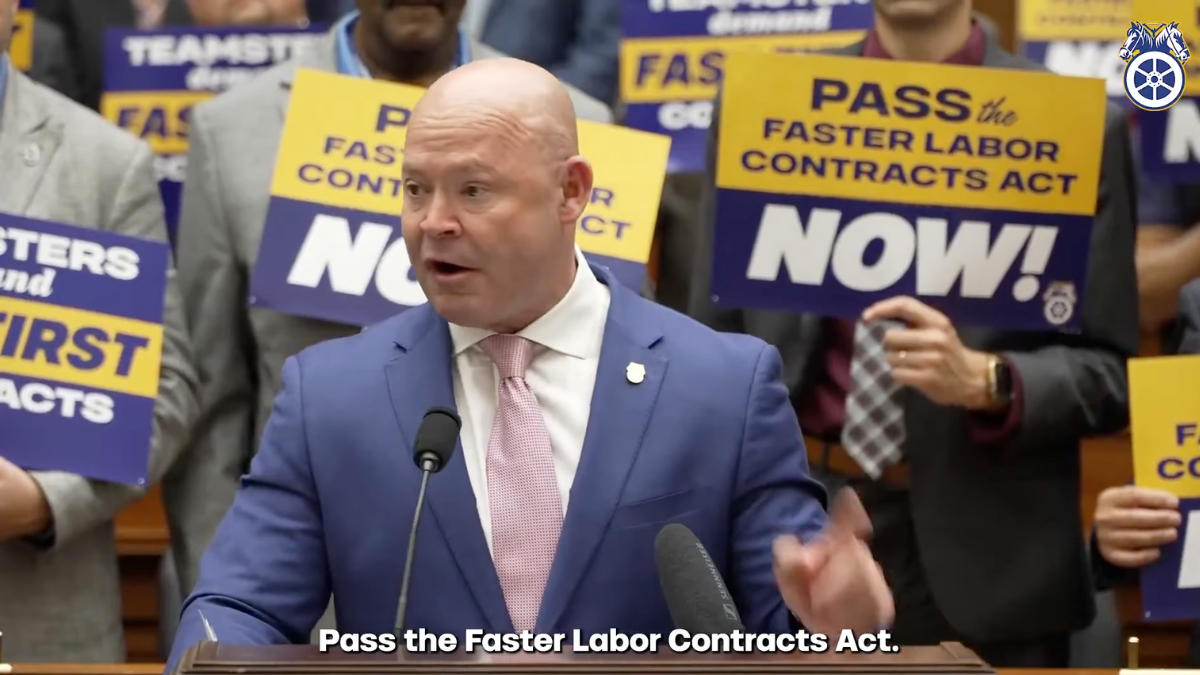
The handful of Republicans who are supporting FLCA have no doubt been influenced by lobbying pressure from the Teamsters Union and its president, Sean O’Brien, who has made headlines for his supposed overtures to Republicans.
O’Brien and the cadre of D.C. intellectuals who welcome increased union boss involvement in Republican politics point out that working-class voters are now more likely to support Republicans than they were in decades past. But shifts in voting patterns don’t turn bad policies into good ones.
The ultimate goal of giving the government the ability to write labor terms and impose them on private sector workers and businesses through binding arbitration has always been to give more power and money to union officials, the ones who wield power in Washington, not individual union workers.
That’s an important distinction that conservatives understood when they stood strong against EFCA. They should oppose the Faster Labor Contracts Act just as vigorously.