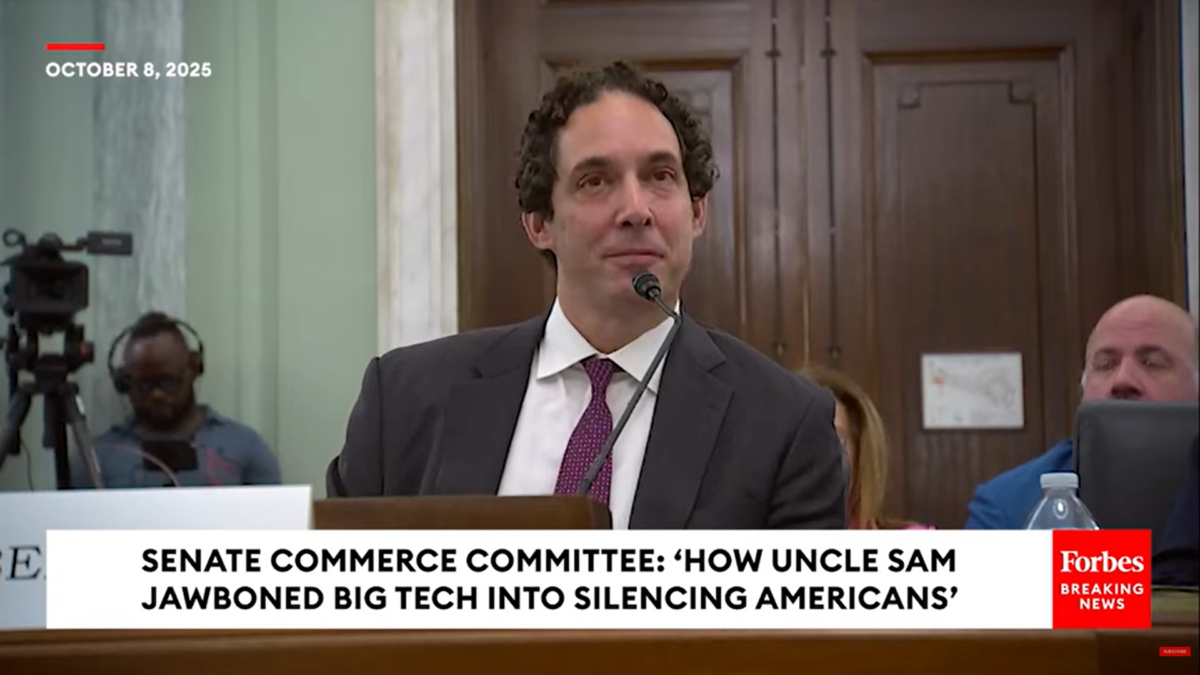
Independent journalist Alex Berenson scored another victory for free speech last week when he settled his lawsuit against the federal government for $150,000 and an acknowledgement that “the Government did in fact violate the First Amendment by exerting substantial coercive pressure on social media companies such as Twitter to suppress disfavored speech like Plaintiff’s; . . .” Berenson’s win does not end his case, however, as he continues to pursue his claims against two other defendants. And in settling with Berenson, the Trump administration just strengthened the former New York Times reporter’s case.
In 2020, Berenson gained a heavy following on Twitter as he criticized the public policy response to Covid-19 and challenged the conventional wisdom of the safety and efficacy of the vaccines. As his lawyer would later explained in briefing, “Twitter became the primary outlet for his journalism which earned him hundreds of thousands of followers while the company resisted calls from third parties to censor his reporting.”
However, following coercion from members (and then former-members) of the Biden Administration, along with alleged pressure from representatives of Covid-19 vaccine manufacturer Pfizer, Twitter permanently banned Berenson. Unaware of those concerted efforts toward banning him, Berenson originally sued only Twitter, alleging, among other things, breach of contract and other state law claims premised on the social media giant’s violations of its own promises and policies in banning Berenson.
As part of the discovery in his case against Twitter, Berenson obtained internal Slack messages which revealed the Biden Administration’s role in Berenson being permanently banned from the social media giant. After Berenson went public with the Slack messages, Twitter settled with Berenson, reinstating his account and acknowledging he never should have been suspended.
After settling with Twitter, and based on the evidence he obtained during discovery, Berenson filed suit in April of 2023 against then-President Biden; Andrew Slavitt, who had served as the Senior Advisor to the COVID-19 Response Coordinator; Robert Flaherty, who served as the Director of Digital Strategy at the White House; Vivek Murthy, the Biden Administration’s Surgeon General; Scott Gottlieb, who was a former FDA Commissioner and member of the Board of Directors of Pfizer; and Albert Bourla, who served as the Chief Executive Officer of Pfizer. Berenson’s lawsuit detailed efforts by the defendants that began soon after President Biden’s inauguration in January 2021.
The complaint highlighted an April 2021 White House meeting led by Slavitt at which the Biden Administration pushed Twitter to remove Berenson from the platform. According to the complaint, the efforts to ban Berenson took on new urgency in July of 2021, after the Biden Administration and Pfizer learned the mRNA shots were losing their efficacy much faster than anticipated. Twitter temporarily suspended Berenson’s account, but following his reinstatement, former FDA Commission and Pfizer Director Gottlieb complained to a Twitter lobbyist about Berenson. Soon after “Gottlieb’s complaint, Twitter banned Mr. Berenson permanently and told media outlets he had committed ‘repeated violations of our COVID-19 misinformation rules,’” the lawsuit alleged.
Berenson’s complaint alleged three claims, with Count I alleging the government defendants violated the First Amendment. In Count II, Berenson’s alleged a Section 1985(3) claim against all of the defendants for conspiracy to violate his First Amendment rights. Count III was a state law claim for tortious interference brought against the two Pfizer defendants, along with Slavitt.
The defendants all sought dismissal of the lawsuit based on a variety of reasons, including a claim that the government defendants had not violated Berenson’s First Amendment rights. However, after Trump won re-election in 2024, the “official capacity defendants” — more on that terminology shortly — informed the Court that it was no longer arguing that Berenson had failed to state a plausible First Amendment claim. Nonetheless, the government defendants maintained that the Court should dismiss Berenson’s lawsuit for other reasons.
The district court agreed and dismissed all of Berenson’s claims. Berenson appealed to the Second Circuit and his settlement with the Trump Administration came with that briefing currently half-finished.
Here, it is important to recognize that Berenson sued the government defendants in two capacities: in both their “official capacities” and in their “individual capacities.” A lawsuit against a defendant in his “official capacity” is, in effect, against the government or the government position, while an individual capacity lawsuit is against the individual personally and liability would be against that individual.
This distinction matters because the settlement agreement Berenson reached last week with the federal government resolved solely his claims against the “official capacity” defendants. Berenson had previously settled the individual capacity claims against Flaherty, Slavitt, and Murthy. However, his claims against Gottlieb and Pfizer CEO Bourla, under Section 1985(3) for conspiracy to violate his First Amendment rights, remain at issue in the pending appeal.
And as Berenson told The Federalist, “the government’s admission is a crucial step forward in our case. It proves the Biden Administration violated my First Amendment rights by forcing me off Twitter, a necessary predicate for a [Section] 1985(3) conspiracy claim.”
To expand on Berenson’s point: The First Amendment prohibits the government — not private actors — from abridging freedom of speech and of the press. But Section 1985(3) applies to private actors who conspire with the government to violate an individual’s constitutional rights based on the Plaintiff’s membership in a class. And “[t]he evidence we have provided in our complaint shows beyond doubt that Pfizer’s top officials conspired with the administration to coerce Twitter to ban me,” Berenson told The Federalist.
Further, in his complaint Berenson alleged he was “speaking on behalf of an identifiable class of Americans who had chosen not to receive a COVID-19 vaccine.” The complaint further stressed that that class “‘includes a disproportionate number of African-Americans, political conservatives, and evangelical Christians.’” In fact, as Berenson’s appellate brief noted: “The political nature of the class was not lost on the Government itself. In February 2021, while serving in the White House, Slavitt stated that COVID-19 vaccine hesitancy ‘may be political.’”
The courts are currently split on the types of “classes” that qualify under Section 1985(3), but to prevail against the other defendants Berenson must also establish a First Amendment violation — or an attempt to violate the First Amendment. Prior to Berenson’s settlement agreement with the government defendants, the other defendants could argue alternatively either that Berenson lost because he did not allege a class protected under Section 1985(3) or because he did not allege a First Amendment violation.
That latter argument will surely fall flat now with the government acknowledging in its settlement agreement that it violated Berenson’s First Amendment rights. That remains true even though the settlement agreement added the lawyerly caveat that the settlement agreement “shall not be construed as evidence or as an admission regarding any issue of law or fact, or regarding the truth or validity of any allegation or claim raised in this action, . . .”
It matters not that the settlement agreement cannot be construed “as evidence” or “as an admission” because we already have President Trump’s acknowledgements of the abridgements of free speech in his various Executive Orders — which were also quoted in the settlement agreement. Add to that, the associate attorney general’s statement in announcing the Trump Administration’s settlement with Berenson that “[t]he Biden Administration engaged in blatant viewpoint discrimination, wielding power over social media to kick conservatives off Twitter completely.”
That leaves really only one main issue for the appellate court, namely whether Berenson alleged a “class” for purposes of Section 1985(3). Or, as Berenson told The Federalist, “[t]he question the Second Circuit must now answer in deciding if my [Section] 1985(3) claim can move ahead is this: Do people unvaccinated against Covid deserve the same civil rights protections as other minority groups who have faced discrimination?” “We believe Second Circuit precedent – along with the words of then-President Biden himself during the summer of 2021 – provides ample room for the court to provide that protection,” Berenson added.
Until now, the Pfizer defendants seemed content with arguing that Berenson could not sue under Section 1985(3) because “unvaccinated Americans” is not a “cognizable class under Section 1985(3).” However, with Berenson’s victory against the government defendants and their admission to violating his First Amendment rights, the calculus to settle might now have changed for the alleged Pfizer-connected co-conspirators — for they must consider not merely the law but also the potentially negative public relations impact on the pharmaceutical giant.
This article has been corrected since publication.