
The debate over AI data centers, and the growing opposition to them in local communities, is partly a proxy for deep anxiety about artificial intelligence itself and the kind of future AI companies are trying to create.
Same goes for the college graduates who recently booed their keynote speakers for praising AI. The viral clip of University of Arizona graduates repeatedly booing Eric Schmidt, the billionaire former CEO of Google, for praising AI and urging grads to embrace an AI-dominated future might prove to be a turning point in this debate.
At the very least, it was revealing. Every time Schmidt, a man who made his fortune in disruptive technology, so much as uttered “AI,” a chorus of boos rippled through the stadium. The same thing happened at the University of Central Florida, where graduates of the College of Arts and Humanities and the Nicholson School of Communication and Media practically booed their commencement speaker, a real estate executive, off the stage after she declared, “The rise of artificial intelligence is the next industrial revolution.” When she said, “Only a few years ago, AI was not a factor in our lives,” the graduates erupted in applause — cheering for a world they wish they could go back to.
The speaker was a woman named Gloria Caulfield, the VP of Strategic Alliances at the Orlando-based Tavistock Development Company, which creates technologically advanced, master-planned communities. Among Caulfield’s roles is to manage AI medtech partnerships for places like Tavistock’s Lake Nona development. In other words, she inhabits a professional world that really is being revolutionized by AI, and for her and her professional peers, that’s a good thing. When the booing began, Caulfield was genuinely confused. She has no frame of reference for why anyone would oppose AI or be suspicious of it.
But for most college graduates — from a communications school, no less — the advent of AI likely means that the skills they just spent four years acquiring are already obsolete. If AI is the “next industrial revolution,” they’re the textile workers about to be rendered obsolete by mechanical knitting machines. It makes perfect sense that young people like this are the least convinced by the promise of AI, since they’re the ones that will likely bear the brunt of the economic disruption it will bring to nearly every industry.
But they’re not the only ones suspicious of the AI future. A Gallup survey last week found that seven in ten Americans oppose the construction of an AI data center in their local area — a higher disapproval rate than nuclear power plants. It’s not hard to understand why. The data centers in question are massive, multi-billion dollar installations that use an enormous amount of electricity and water, often at the expense of local residents who are indirectly subsidizing their construction through tax breaks granted to AI companies by local governments. Increasingly, communities are pushing back. According to a recent report in Fortune, at least 48 data center construction projects (representing $156 billion in investment) were blocked or delayed last year due to local opposition.
Some of this opposition is practical — local residents don’t want to subsidize data infrastructure for some of the most powerful and profitable companies on earth. But some of it is intuitive, animated by a sense that whatever AI is, it isn’t an unalloyed good, and it might prove disastrous in the long run.
Lurking behind much of this AI anxiety is a creeping suspicion that the people building out its infrastructure and deploying it in our economy don’t actually have our best interests in mind. What if the future being created by top AI companies might be one in which ordinary people are much worse off than they are now, while AI tech moguls and the super wealthy are much better off?
Added to this is a sense that we don’t really know what AI is, and don’t have a clear way of talking about it. It seems clear, even at this early stage, that artificial intelligence is something more than just a new and uniquely powerful technology. It appears at times to have a measure of autonomy, like no one is really in control of it. At other times, it seems candidly malevolent. Certainly no one has a clear idea what effects its widespread use will have on our society. In the face of ubiquitous AI, what is going to happen to the human person? No one really knows.
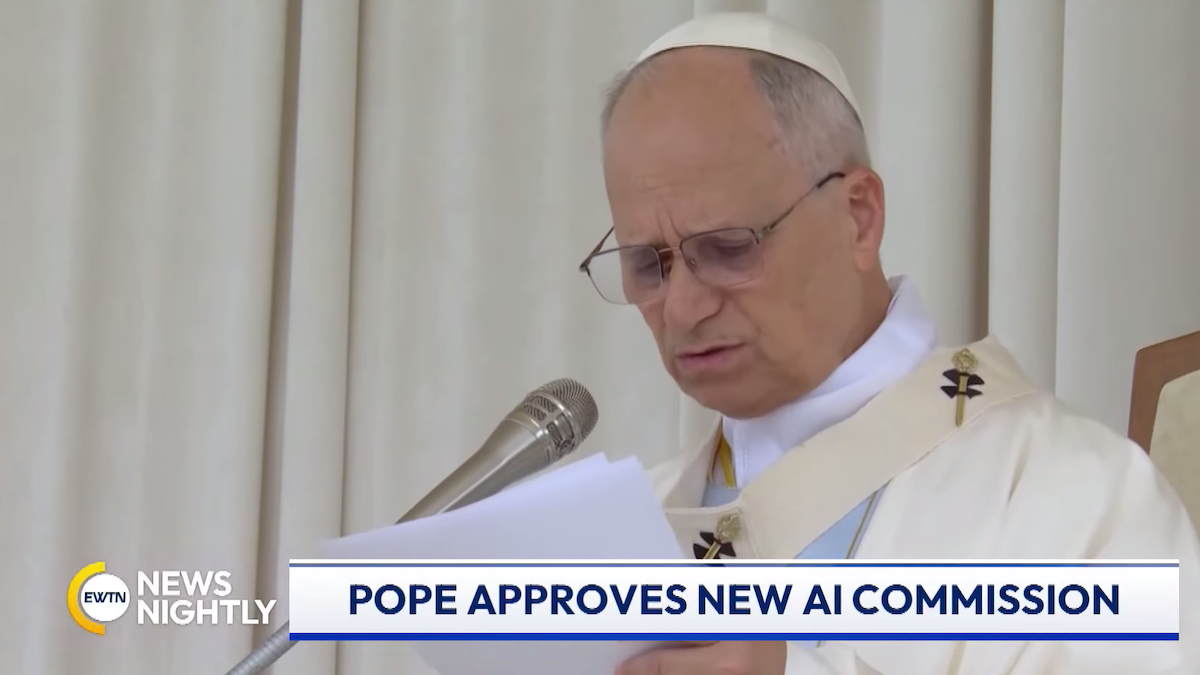
It’s no surprise then that Pope Leo XIV has chosen AI as the topic for his first encyclical, Magnifica humanitas, on preserving the human person in the age of artificial intelligence, set for release on May 25. Significantly, Leo signed the document last Friday, May 15, which was the 135th anniversary of the publication of Pope Leo XIII’s Rerum novarum. That encyclical dealt with the changing social conditions and human misery brought on by the Industrial Revolution, and made a powerful case for things like workers’ rights, limits on industrial capitalism, and the obligation of employers to their employees. It was specifically concerned with the preservation of human dignity and social solidarity under conditions of massive technological disruption, and became the foundation of Catholic social thought.
Like his namesake, Leo XIV has signaled from the outset of his pontificate that the dignity of the human person must not be lost in the age of AI. The Vatican previously announced that Leo had created a study group on AI ahead of the publication of the encyclical for the purpose of examining its “potential effects on human beings” and “the church’s concern for the dignity of every human being.” Last week, Leo warned against the use of AI in warfare, saying it could trigger a “spiral of annihilation,” and argued for stricter regulation of its use in the military, “so that it does not absolve humans of responsibility for their choices and does not exacerbate the tragedy of conflicts.”
These are not merely academic issues. On the first day of the Iran war, American warplanes struck a girls’ primary school in southern Iran, killing 175 people, most of the them schoolgirls under the age of 12. The school was next to an Islamic Revolutionary Guard Corps compound and had been mistakenly classified as a military building in a Defense Intelligence Agency database. In their opening strikes on Iran, U.S. military commanders running Operation Epic Fury used an AI targeting system called Maven, built by Palantir Technologies, that drew on this database. Hence, the school was hit — not directly by AI targeting, but by AI-reliant systems and technologies operating at a speed that made it impossible to detect the targeting error until it was too late.
This is just one recent, and stark, example of the moral and ethical questions embedded in the AI debate. There are of course many others, and while we don’t yet know what exactly Leo’s encyclical will say, it’s safe to say it will address these moral questions. Just days after he was elected pope in 2025, Leo told the College of Cardinals that the Catholic Church was obliged to offer “the treasure of its social teaching” to confront the challenges posed by artificial intelligence on “human dignity, justice, and labor.”
It seems likely, then, that Leo will be a voice for the inviolability of the human person in the face of technology that threatens to erase what it means to be human. In addition, it’s likely that the encyclical will specifically come out against the notion of AI as a right-bearing entity. Leo has repeatedly said that AI is “above all else a tool,” and not an entity or a class of being that stands outside the human intelligence that created it. Moreover, he has specifically warned that AI technology “raises troubling questions on its possible repercussions on humanity’s openness to truth and beauty, on our distinctive ability to grasp and process reality.”
It’s perhaps significant (for good or for ill) that Christopher Olah, co-founder of Anthropic, one of the few major AI firms that has fallen out with the Trump administration over military applications of AI, will be at the presentation of the encyclical on Monday. Whatever the details of the encyclical, its very existence suggests that the Vatican sees this debate as among the most important of our time. To preserve the human person in an era of mass artificial intelligence, as the encyclical’s subtitle suggests, it does seem necessary to regard AI as a tool for our use and benefit, and not as an independent moral agent. And for AI to truly be a tool, then we must be able to understand it and control it.
Whether we can really control AI, and whether the people building it really want it to be controlled, is right now an open question. No wonder people are anxious about it.