
The Second Continental Congress called for a “day of humiliation, Fasting and Prayer” in May of 1776 amidst the impending separation with the Crown. As General George Washington stated, the day was set to “supplicate the mercy of Almighty God” and seek forgiveness for the nation’s sins before undertaking what would become the American Revolution.
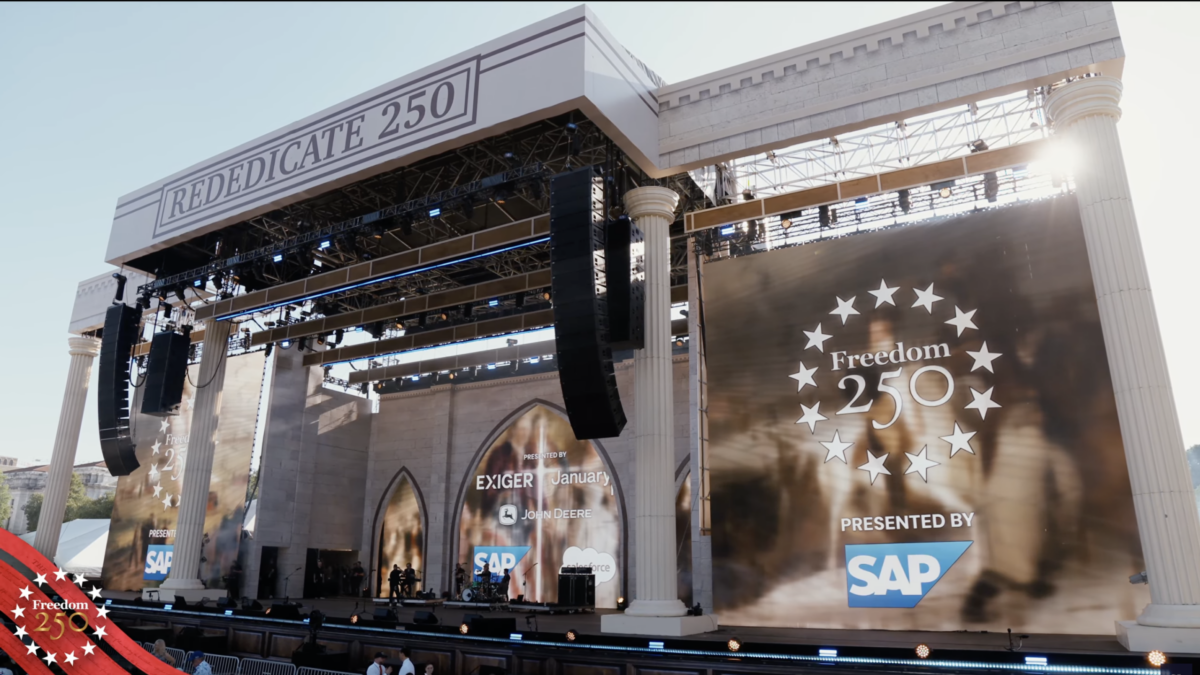
Two hundred and fifty years later, President Donald Trump’s administration held a national prayer and rededication event. But the day of rededication ignited rebuke from the usual suspects, who framed the event as an alarming attempt to rewrite American history by portraying America as a nation founded in Christianity.
“Trump Administration Pushes Narrative of Christian Founding at Rally,” The Times’ Ruth Graham and Elizabeth Dias wrote. “The rally aimed to crystallize the narrative that the nation’s founding was an intentionally Christian project, a framing disputed by many scholars.”
But it’s not a “narrative” — it’s a matter of historical record. Nonetheless, The Times pivots to the familiar talking point that — in The Times’ words — “The separation of church and state has long been a bedrock principle of American democracy,” citing the First Amendment’s prohibition on federally established church. The irony of course is lost on The Times, that is, that the same generation that prohibited a federally established church is the same generation that proclaimed national days of prayer and thanksgiving and openly spoke of religion as essential to the republican form of government they created.
The Times’ dispute of our Christian Founding is so weak that their strongest rebuttal came from historian Joseph Ellis, who declared the idea that the founders viewed America as an explicitly Christian nation is “nonsensical” and “dead wrong.”
“Instead, the founders were explicitly pushing back against an assumption that persisted through the Middle Ages, that states needed common religious preference to unite people, he said,” The Times reported.
It’s an odd claim, considering Founder John Jay wrote in Federalist Paper No. 2: “I have as often taken notice that Providence has been pleased to give this one connected country to one united people — a people descended from the same ancestors, speaking the same language, professing the same religion…”
Federalist No. 2 was part of a compilation of writings meant to explain and justify the purpose of the Constitution.
The Times then cites Rachel Laser, president of Americans United for Separation of Church and State, who told The Times that the event showed separation of church and state is “under extreme attack.”
“If Trump really wanted to celebrate what is unique and foundational about America, he’d be celebrating our promise of church-state separation and religious freedom for all,” Laser told The Times.
Yet the founding generation — the same generation that created the First Amendment — did not share Laser’s modern understanding of the First Amendment. At the time of the ratification of the Constitution, at least 9 of the original 14 states had religious oaths of office and limited office holding to Christians and Protestants. In fact, states like Massachusetts, Connecticut, Rhode Island, and New Hampshire had taxpayer-funded churches.
But The Times wasn’t the only outlet mad about the national rededication.
“An all-day prayer event on the National Mall on Sunday — backed by the White House through a mix of taxpayer funds and private donations — marked the latest flashpoint in the Trump administration blurring separation of church and state,” CNN’s Aleena Fayaz wrote before citing several voices who condemned the rally as Christian nationalism or unconstitutional.
The Washington Post’s Michelle Boorstein and Laura Meckler said “scholars of U.S. religious history and critics of the Trump administration … point out that, amid much debate, the founders chose to keep religion at arm’s length from government in the Constitution.”
For decades there has been a historically illiterate position amongst the left that the Founding generation just all happened to be some denomination of Christian but that their Christian faith had nothing to do with the country they created.
But the United States was not created in a vacuum. It was built by people who overwhelmingly were shaped by their Christian faith.
John Adams wrote in an 1813 letter to Thomas Jefferson: “The general Principles, on which the Fathers Atchieved Independence, were the only Principles in which, that beautiful Assembly of young Gentlemen could Unite … And what were these general Principles? I answer, the general Principles of Christianity, in which all those Sects were United.”
Even Jefferson, the man invoked by modern secularist for his “wall of separation” letter, regularly attended worship at Christian services held inside the House of Representatives during his tenure as president. Whatever “separation of church and state” meant to Jefferson and the founding generation, it certainly did not mean banishing religion from the public square or government for that matter. In fact, the founders didn’t think that faith was a threat to the Constitution, they thought it made the Constitution — and country — possible.
Adams warned that the Constitution was made “only for a moral and religious people,” and that it would be inadequate for any other. Washington said in his Farewell Address that religion and morality are “indispensable supports” for political prosperity. Jefferson himself wrote that our liberties are only secure if people believe those rights are a gift from God. Because if rights come from government, government can take them away.
When America rededicates herself to the foundation of all our freedoms, that is, Christianity, they’re not advocating for a theocracy. But they are recognizing the moral framework that underpins natural rights and our republican form of self government.
The New York Times and the left seeks to deny or minimize our Christian founding because they reject the moral order stemming from Christianity that built this country. In their fight to institute their dystopian Marxist society, they must deny our past in order to shape our future, for with religion, our political prosperity is secured, as Jefferson and Washington warned.