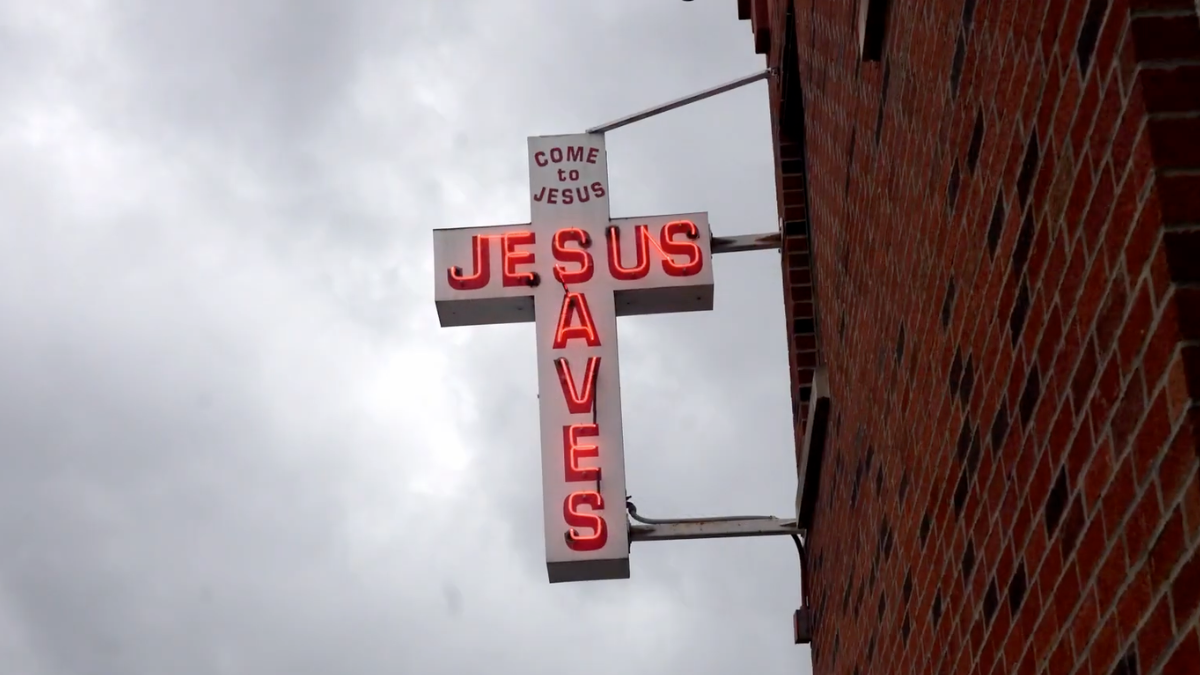

Just a short walk from New York State’s capitol and the Empire State Plaza are the bleak streets of Albany’s South End. But out of the squalor, on the upper brick wall on a corner of South Pearl Street, shines a white cross with two intersecting words on it in red neon letters: JESUS SAVES.
The landmark sign welcomes tired, hungry, drug-and-alcohol-ravaged souls to the Capital City Rescue Mission, which houses more than 300 homeless people a night, according to Perry Jones, who has been the mission’s executive director for 44 years. But many have to sleep on mats on the floor, which is why the Christian shelter is seeking to build a $6 million four-story addition on land it owns.
But the city planning board, after nearly five years and several contentious public meetings, declined to even vote on the project, claiming the mission’s 420-page draft environmental impact statement (DEIS) is “incomplete and inadequate.” The mission repeatedly addressed a long list of supposed deficiencies in the DEIS, only to have the board continue to claim that the hefty document was lacking. The city’s claim also apparently contradicted regulations of the state Department of Environmental Conservation that the DEIS should not be “encyclopedic” and should address only effects that can be “reasonably anticipated.”
The cynical strategy behind the city’s stonewalling seems obvious: to force the mission into a complex, costly legal battle or scrap the project.
So in January 2025 the mission sued the city of Albany in federal court under the Religious Land Use and Institutionalized Persons Act (RLUIPA). Congress enacted RLUIPA in 2000 to ensure that religious organizations aren’t discriminated against by municipalities that use zoning laws and bureaucratic regulations to block their projects. RLUIPA was designed to guarantee religious entities their First Amendment right to freely exercise their religious beliefs, including acts like serving poor and homeless people.
Started by a small group of businessmen, the Capital City Rescue Mission has been serving “the least of these,” as Jesus says in Matthew 25, in Albany for more than three-quarters of a century. By 2000 the mission had outgrown its longtime home and moved a short distance to the South End.
The mission does a lot more than just give homeless people clean sheets and a pillow and a blanket and a roof over their heads for the night. Jones says it serves upward of 1,000 free meals every day of the year and hands out two tons of food a week to the community. It also offers an addiction recovery and Christian discipleship program for men, a separate women and children’s program, 56 transitional apartments, a free health clinic, and a learning center that helps participants get a GED and jobs.
There’s a crucial difference between the mission and government- and grant-funded homeless efforts. The mission targets the root of the problem: the soul. In other words it gives homeless people what no social welfare agency or secular nonprofit can ever provide — eternal hope — salvation through repentance and belief in Jesus Christ. In fact the mission is incorporated as a church and presents daily Christian sermons.
“The Capital City Rescue Mission saved my life seventeen years ago,” said David Poach Sr., the mission’s chief of staff, at a city planning board meeting in August 2022. “I graduated their program along with thousands of other men and women who are now living, working in Albany, paying taxes in the city.” Poach went on to say that 90 percent of the mission’s frontline staff “came off the streets.”
Roger Murman, vice president of the mission’s board, told the city planning board at the same meeting that the mission has invested $12.7 million in the South End to buy and rehabilitate derelict buildings. When one of the planning board members unwittingly asked if that money came from the city or other grants, Murman said without missing a beat: “Every penny that the mission spent is from donations from the Christian community around the Capital District.”
There was momentary silence. Not gorging at the public trough is unthinkable — politically blasphemous — in this deep-blue crumbling city of about 100,000.
In fact the city seems to be punishing the mission for not being part of the Homeless Industrial Complex, which keeps vagrants on the streets and puts money in the pockets of their enablers — the so-called homeless advocates and their governmental accomplices.
The other factor that appears to gall the mission’s opponents, based on reactions at the public meetings and elsewhere, is that its leadership staff are evangelical Christians. Their animosity isn’t surprising. Albany regularly places high in surveys of the most godless metro areas in the country. And most of the mission’s leaders are also white (though the board president and many of the frontline staff are black). The South End, historically among Albany’s poorest neighborhoods, is predominantly black.
So a host of South End residents and demagogues, abetted by the local media, have made the mission a scapegoat for the troubled neighborhood.
Take Sam Fein, who is now city auditor but was an Albany County legislator who represented the South End in 2023. On the eve of a second major public meeting on the project, Fein sent a letter to the city planning board urging it to subject the mission to an intensive review. This runs counter to both federal law and state guidelines. His letter was signed by 56 people, including other city officials. Among them was Dorcey Applyrs, who was then city auditor but was recently elected Albany’s first black mayor.
One of the ostensible objections often cited against the mission’s proposed addition is the presence of a nearby elementary school. In his inflammatory letter, Fein essentially blamed the mission for all the woes the schoolchildren encounter in the South End — “panhandling, public urination, people sleeping or nodding off on sidewalks … liquor bottles and drug paraphernalia.” According to him, it’s all the mission’s fault.
Fein’s implication, in short, is that the mission is the “Great Satan,” as Murman phrased it at one meeting.
The truth is the mission isn’t the creator of the South End’s many misfortunes or even a contributor to them. In fact it’s a committed and compassionate bulwark against them. Those who complete the mission’s addiction recovery and discipleship program and become Christians are transformed, and not just spiritually. Many of them stay sober, get a job, get an apartment, and get off the public dole.
Like Willie McKnight, an older black man who ended up working at the mission. At a city planning board meeting on the project in January 2023, the board wouldn’t allow commenters to talk about how the mission had helped them. McKnight and others tried to anyway.
“When I came to the door, I seen the sign that says, ‘Jesus Saves,’” McKnight said. “And that was the building I came to. If it wasn’t for that building being there on that corner, where would I would have been?”
To answer his rhetorical question: back on the bleak streets of the South End. Without true hope.