
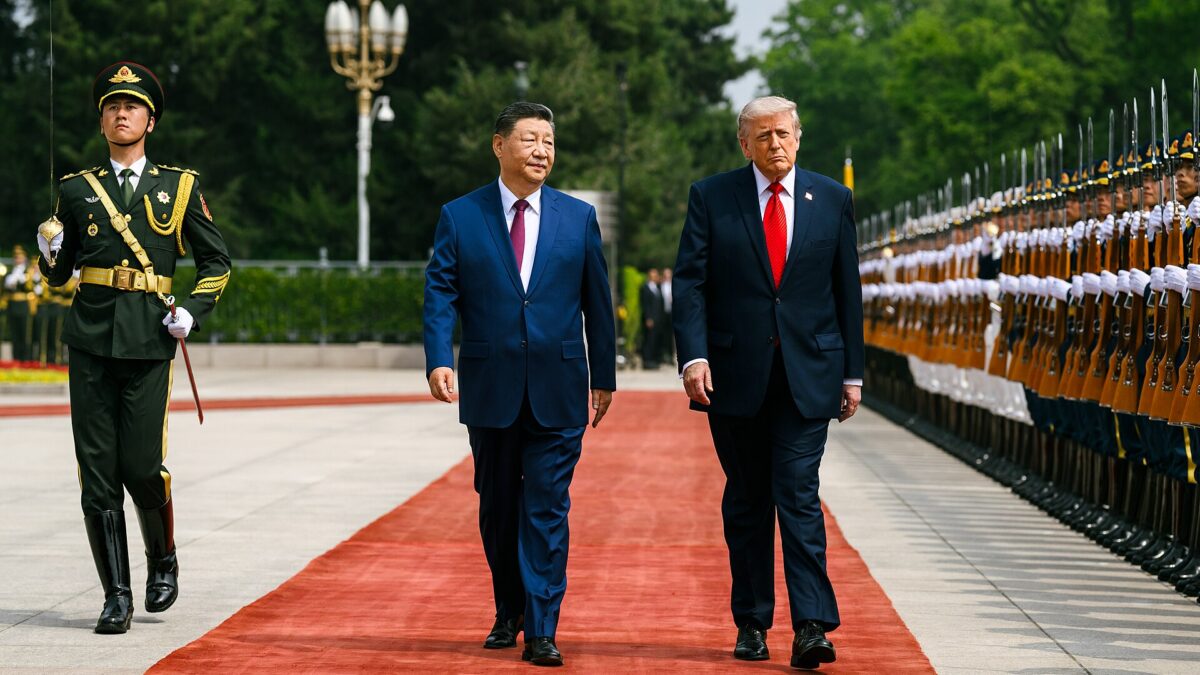

President Trump and his administration have regularly maintained that America winning the AI race is a “national security imperative” and that it must do “whatever it takes” to beat Red China in the competition for AI dominance.
“We are beating China by a lot [in AI] because I allowed these plants to be built,” Trump recently said of his efforts to help Big Tech firms power their resource-sucking data centers with their own plants. “These companies build their own electric units now, they don’t use the grid at all. Otherwise, we wouldn’t be able to compete … It’s important that we win” (emphasis added).
Yet, for all the president’s intent on “winning” the AI race (whatever that looks like), it underscores a notable contradiction in his stated policy agenda — one that significantly undermines his position that America must do whatever it takes to beat communist China.
At the same time Trump is casting Beijing as America’s main adversary in the AI race, he’s advocating for allowing hundreds of thousands of Chinese students access to American universities, which are training the next generation on AI, computing, and other technologies his administration deems critical to U.S. national security interests.
Just last week, the president reaffirmed his longstanding support for permitting Chinese nationals to study at American colleges, telling Fox News’ Sean Hannity that to revoke such a policy would be an “insult” to the Chinese Communist Party (CCP). He further espoused concerns that “lower” colleges would “d[ie] all over the place” if America cut off Chinese students from its university system.
Putting aside the America Last nature and glaring national security risks associated with such a stance, consider how illogical it is when further contrasted with the president’s insistence that America win the AI race against China.
A growing number of Chinese graduates — including those in the AI and tech fields — are opting to return to China after acquiring their degrees.
The Wall Street Journal reported earlier this month how the “number of recent Chinese graduates returning home to seek jobs grew 12% in 2025 from the previous year, and the figure has more than doubled since 2018, according to a report by Chinese recruiting platform Zhaopin.” The outlet noted that while many such individuals “continue to build careers in the U.S.,” the CCP “is working to ease homecoming pains” to draw them back to China.
Circling back to the president’s point, if beating Beijing in the AI race is the goal, then how does it make sense for the United States to admit swaths of Chinese students to its colleges and equip them with extensive knowledge and research about AI and related fields, only for some of those same students to then go back to China and help their native country win the AI race? Under the president’s position, America is training its chief adversary’s rising intellectuals to help the CCP outflank the United States in AI development.
What’s equally significant about this dynamic is that China’s national security laws explicitly require all Chinese citizens and organizations to “support, assist, and cooperate” with so-called “national intelligence efforts.” They also give the Chinese government the power to demand “relevant organs, organizations, and citizens provide necessary support, assistance, and cooperation.”
That means that even if Chinese students studying in America didn’t want to forfeit critical information and research on AI to the CCP, there’s a probability Beijing would give them little choice but to do so. The CCP has been known to have its agents threaten and coerce Chinese citizens abroad into complying with the party’s demands and suppress dissent — even going as far as targeting their family members in China.
To think they wouldn’t use such tactics to acquire sought-after AI research for their national benefit is pure wishful thinking.
The siphoning of American AI secrets to Beijing has already proven to be a real concern. Earlier this year, a Chinese national and former Google employee who previously studied at the University of Southern California was convicted “on seven counts of economic espionage and seven counts of theft of trade secrets for stealing thousands of pages of confidential information containing Google’s trade secrets related to artificial intelligence technology for the benefit of the People’s Republic of China (PRC),” according to the Justice Department.
As The Federalist’s Brianna Lyman recently surmised, there is nothing “MAGA” about the president’s stance on this issue. His continued willingness to accept hundreds of thousands of Chinese students is an America Last security risk that’s undermining one of his stated policy goals. He would be wise to listen to his voters and reverse course.







-20260514.jpg)