
A day after Ketanji Brown Jackson once again showed herself to be the worst justice on the U.S. Supreme Court, Clarence Thomas reminded us why he’s the best.
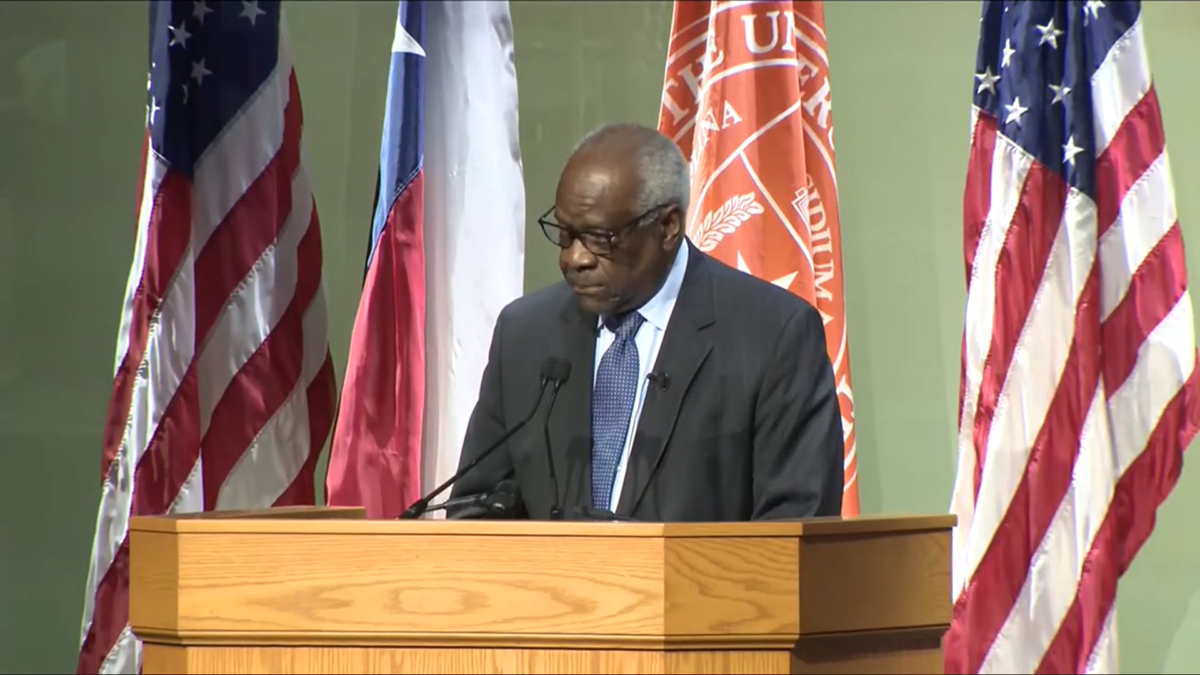
The current court’s longest-serving member delivered a resounding speech at the University of Texas on Wednesday commemorating the 250th anniversary of the Declaration of Independence. Drawing on his own life story growing up in the segregated South, the Bush 41 appointee gave a full-throated defense of America’s founding ideals and principles.
“The second paragraph of the Declaration proclaims, ‘We hold these truths to be self-evident, that all men are created equal, that they are endowed by their Creator with certain unalienable Rights.’ Throughout my youth, these truths were articles of faith that were impervious to bigotry and discrimination,” Thomas said. “Despite the multiplicity of laws and customs that reeked of bigotry, it was universally believed among those blacks with whom I lived and who had very little or no formal education, that in God’s eyes and under our Constitution, we were equal.”
“At home, at school, and at church, we were taught that we are inherently equal; that equality came from God, and that it could not be diminished by man,” he added.
Thomas went on to herald the Founding Fathers for their bravery in signing their names to the Declaration, a decision he noted could have constituted treason against the British crown. He further underscored that “what changed the world was not the words” of the Declaration, but “the commitment and spirit of the people who were willing to labor, sacrifice, and even give their lives — what [Abraham] Lincoln in Gettysburg called ‘the last full measure of devotion’ for the Declaration’s principles.”
“It is that devotion to which we owe our rich inheritance. It was that devotion that sustained the Founding Fathers and the Continental Army as they fought and won the Revolutionary War, braved the winter at Valley Forge, crossed the Delaware and defeated an army many times their number and firepower to win their freedom,” Thomas said. “That devotion has driven the great achievements and heroism of Americans in the 250 years since.”
Such devotion, however, appears to be lacking in today’s political climate.
The justice noted how many talking heads in Washington, D.C. are quick to pay “lip service” to these founding principles but quickly cower when the going gets tough. He then paraphrased a passage he recently read to note how, once put in the public spotlight, “many people fall prey to the lores that are set up to turn them away from their previously untested principles. They become petrified by criticisms; so fearful of negative attention that they find ways to avoid doing the right thing; or they fall prey to the enchanting siren songs of flattery and become so bewitched by praise that they will desperately seek to conform accordingly.”
“They recast themselves as institutionalists, pragmatists, or thoughtful moderates, all as a way of justifying their failures to themselves, their consciences, and their country,” Thomas said, while presenting the Supreme Court’s decades-long failure to overturn Plessy v. Ferguson as an illustration of such cowardice.
“When Americans look to Washington and wonder why it so often disappoints, it is not because there are too few people who know what is right. It is not because we lack the intellect or the capacity or the talent. It is instead because there are too few people who are willing to do what it takes to do the right thing; to sacrifice the popularity, flattery, comfort, and security that are the purchase price for principle.”
Thomas’ assessment of the American experiment also included a pointed criticism of its chief opponent — that is, progressivism. He notably critiqued 20th century progressives like President Woodrow Wilson and John Dewey and underscored how such an ideology is completely antithetical to the Declaration’s devotion to natural rights.
“Progressivism seeks to replace the basic premises of the Declaration of Independence, and hence our form of government,” Thomas said. “It holds that our rights and our dignities come not from God, but from government. It requires of the people a subservience and weakness incompatible with a constitution premised on the transcendent origin of our rights.”
In closing his remarks, the senior justice said that Americans will come upon moments in their lives that require them to possess the same devotion that the founders displayed in their time. While these incidents may be challenging and contain high risks, he encouraged listeners to do what is right, stand by principle, and “respond with courage.”
“Channel the courage of the men who faced down a king and signed [the Declaration], or a president who led the nation in a civil war rather than permit this house to be divided by the great contradiction of slavery,” Thomas said. “Take increased devotion to that cause for which they gave the last full measure, and with a firm reliance on the protection of divine providence, let us mutually pledge to each other our lives, our fortunes, and our sacred honor.”