
The prevailing question of the past year — which will likely prove to be the prevailing question of our generation — is this: What does it mean to be an American? Is America a transferable idea, or a people?
This debate reached the U.S. Supreme Court directly earlier this month, when the court heard oral arguments in Trump v. Barbara. The Trump administration argues that being born to a foreign trespasser or surrogate baby-carrier on U.S. soil does not make someone an American. The ACLU and its backers in the media argue that it does.
Much of the argument centered on a highly technical debate over the meaning of the 14th Amendment’s description of a natural-born citizen as “subject to the jurisdiction” of the United States. Questioning the lawyer for the ACLU, Justice Samuel Alito drew the conversation into the real world, asking if a boy “born here to an Iranian father who has entered the country illegally” with “a duty to provide military service to the Iranian government” would not be considered “subject” to the foreign government of Iran under the Civil Rights Act of 1866, a key contemporary text of the 14th Amendment.
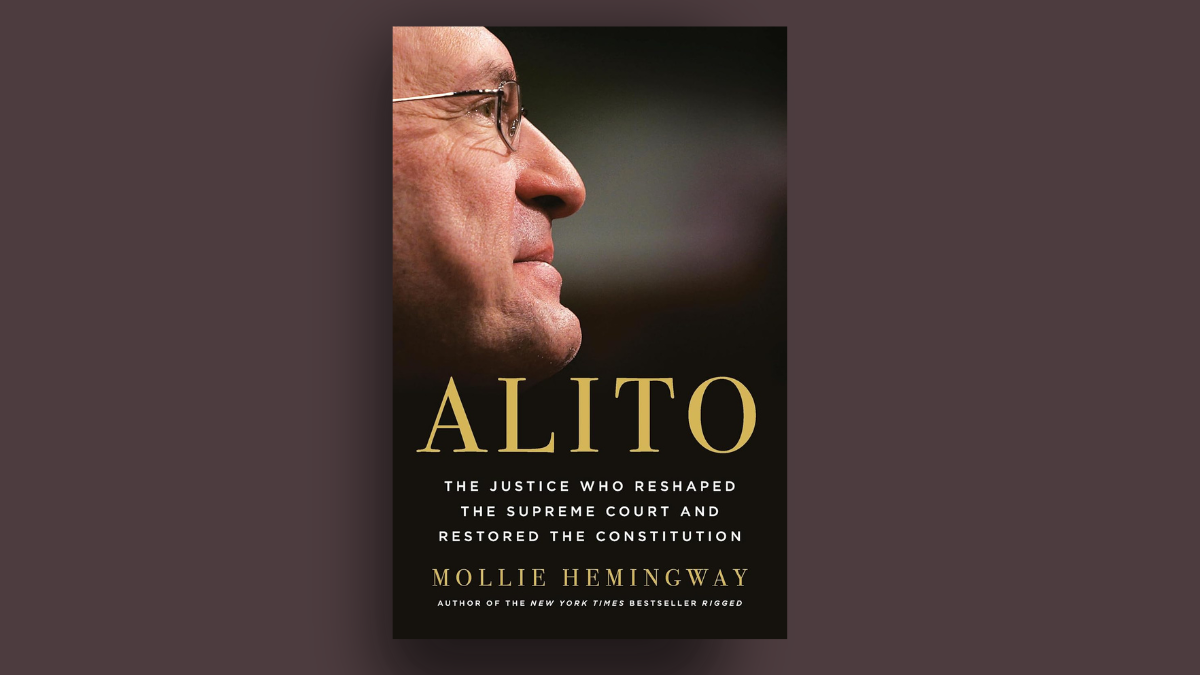
That ability to interpret the law more clearly by understanding its application in the real world is a key strength of Alito’s, as personably illustrated in a new biography of the justice by The Federalist’s own Mollie Hemingway.
In Alito: The Justice Who Reshaped the Supreme Court and Restored the Constitution, Hemingway acquaints the reader with the most underrated justice, his life story, and his unflinching jurisprudence. From his Italian-American upbringing in a New Jersey manufacturing community to his prominent love of baseball, Alito is a walking American Dream. As the coalition-building justice who united the majority in Dobbs v. Jackson Women’s Health Organization, the Supreme Court decision overturning Roe v. Wade, he is a brilliant jurist. As one of the chief targets of attacks from leftist agitators — attacks ranging from threats to his family’s physical safety to character assassination by the media — he is, as his fellow justices described him to Hemingway, “courageous.”
All that and more are presented in charming detail in the book, with endearing anecdotes presented alongside never-before-reported revelations about the dramatic leak and eventual release of the Dobbs decision. But perhaps the most useful chapter is the epilogue, where Hemingway presents Alito’s characteristic jurisprudence as a path forward for the conservative legal movement.
Alito is an originalist, which Hemingway defines as someone who believes “the Constitution’s meaning is determined by the original meaning of the text, and judges must not abuse their authority by imposing their personal policy goals.” The foundational doctrine of the modern conservative legal world, originalism is a counter-philosophy to the judicial hyperactivism of the late 20th century. But Alito also describes himself as a “practical originalist,” meaning he understands that laws and constitutions exist in the context of the people they govern.
Classical and Christian philosophers have spoken for centuries about man’s nature as an embodied soul: a spiritual being who is nevertheless connected to a physical created order designed with its own purpose and beauty. To extend the metaphor — and without intending to minimize the devout justice’s soul — Alito is an embodied mind. Alito’s Constitution is not just a concept to be parsed but something to be applied to a physical populace in pursuit of virtue. His reticence to uphold certain abusive forms of expression in the name of free speech, illustrated in several of his dissents, is one example Hemingway provides.
It’s a very Burkean sensibility, as Hemingway and others have observed. Dubbing Alito “The Burkean Justice,” Adam White observed in 2011 that “Justice Alito is uniquely attuned to the space that the Constitution preserves for local communities to defend the vulnerable and to protect traditional values.” When he applied as a young man for a role in the Reagan administration’s Justice Department, Alito himself professed his “very strongly” held belief in “the legitimacy of a government role in protecting traditional values.”
When pressed by a Democrat senator on what he meant by those “traditional values,” Alito’s response reflected an understanding of both the “little platoons” and the intergenerational contract that undergird Edmund Burke’s political philosophy. Hemingway writes:
Later, when Alito had been nominated to the Supreme Court, Senator Herb Kohl, a Democrat of Wisconsin, asked what he meant by that. “I think a traditional value that I probably had in mind was the ability to live in peace and safety in your neighborhood,” Alito responded. “I think the ability of people to raise a family and raise their children in accordance with their own beliefs is a traditional value. I think the ability to raise children in a way that they are not only subjected to—they are spared physical threats but also psychological threats that can come from elements in the atmosphere is a traditional value. I think that the ability to practice your own conscience is a traditional value.”
In true Burkean fashion, Alito’s emphasis on people and place has not just a forebear in Burke, but an heir in the making. If Alito views the Constitution as a charter tied intrinsically to a particular people and designed to support their moral edification, a new conversation has emerged on the Right about who that particular people are.
In an iconic speech to the Republican National Convention accepting the party’s nomination for vice president in 2024, now-Vice President J.D. Vance painted a picture of Americans who “love this country, not only because it’s a good idea, but because in their bones they know that this is their home, and it will be their children’s home, and they would die fighting to protect it.” Reflecting on the cemetery where his ancestors are buried, Vance added, “Even though the ideas and the principles are great, that is a homeland. That is our homeland.” It was a direct rebuttal to the Obama-era doctrine that America and the Constitution that governs it are merely ideas which can be applied to any populace with comparable success.
That defensive posture has led some on the right to reject the constraints of originalism for a “common-good conservatism,” a concept popularized by Adrian Vermeule. Common-good conservatism emphasizes the government’s legitimate role in, as Vermeule put it, helping “direct persons, associations, and society generally toward the common good” even when doing so requires a “strong rule.” Hemingway presents Alito’s judicial philosophy as an attractive alternative.
“Many participants in these debates see Alito’s jurisprudence as rooting originalism in firmer moral ground than pure legal positivism,” she writes. The biggest limitation on that approach, Hemingway notes, is that it requires judges with no less restraint and wisdom than Plato’s philosopher kings to implement it.
The only mention of a “philosopher king” in the book is a humorous zinger from a “Court insider,” who told Hemingway that Alito’s newest colleague, Justice Ketanji Brown Jackson, “makes [Justice Sonia] Sotomayor look like a philosopher king.” But the concept — that of a just ruler who does not abuse his power but uses it for the benefit of those he oversees — seems to inform Alito’s jurisprudence. Alito understands, as Hemingway explains, that the greatest constitution in the world is only as good as those who steward it. Originalism is not an end in itself, but a means by which good men past and present can restrain bad men. The end is preserving a just and moral society for the particular people for whom the Constitution was written.
Or, as one friend of Alito’s noted to Hemingway: “Sam wants clerks to recognize that this is a war, that they’re on the same page and fighting for America.”
Alito: The Justice Who Reshaped the Supreme Court and Restored the Constitution is now available on Amazon or at bookstores nationwide.