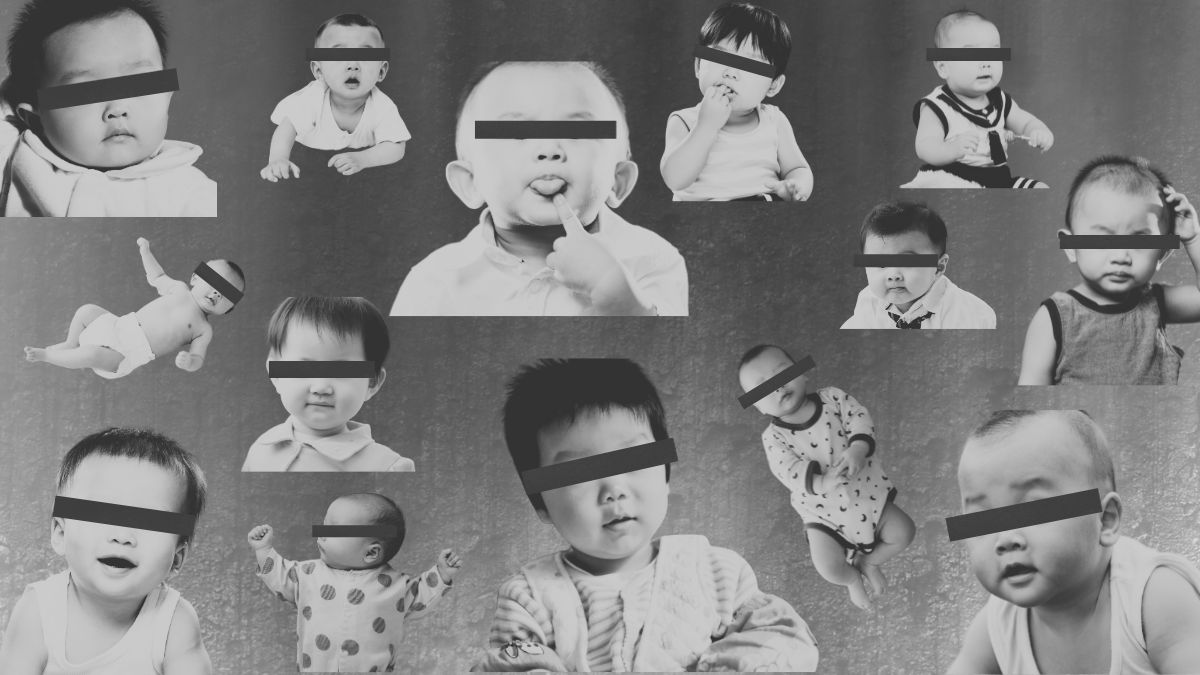

If anyone wants proof that commercial surrogacy needs to be banned, look no further than California, where a Chinese couple took advantage of lax rent-a-womb policies to commission the creation of around two dozen children now scattered across foster homes in the U.S. amid allegations of abuse.
Eyebrows certainly raised in July 2025 when 21 children belonging to a Chinese couple were placed in state custody after a baby arrived at the hospital with a brain bleed. The real shocker came when news broke that most of the kids were under three years old, and many were reportedly created using a deceptive multi-state simultaneous surrogacy scheme called Mark Surrogacy, run by none other than the owners of the home: 65-year-old Guojun Xuan and 38-year-old Silvia Zhang.
There are no laws banning the use of multiple simultaneous surrogacy — a process that involves impregnating multiple surrogates at a time to have babies closer in age than traditional reproduction and gestation allow. In California, where Xuan and Zhang ran Mark Surrogacy, legislators have worked to create “surrogacy friendly” laws and policies that make it easier for anyone to use third-party reproduction to obtain children. Nevermind the threat such laxity poses to national security.
A new deep dive from The New Yorker details developments in the latest commercial surrogacy horror story. The article dives into the alleged abuse, potential financial corruption, and even hints at a birthright citizenship scam, but the prevailing theme is that third-party reproduction in the form of commercial surrogacy hurts everyone involved, especially the children created from it.
Full House
It’s hard to pin down the exact number of children Xuan and Zhang used third party reproduction to obtain. In fact, the New Yorker story reports that Zhang had to check her notes to answer investigators’ questions about how many children she had.
What is clear is that, between 2019 and 2025, Xuan and Zhang lured women into a paid surrogacy scheme with a sob story about a married Chinese couple (Xuan and Zhang actually never legally tied the knot) who could no longer conceive children on their own.
Many of the surrogates seem to have a similar story: For nine months, these women would gestate babies created with Xuan’s sperm and a purchased egg (“Guojun wanted egg donors who were younger, non-Asian, and more educated,” a former aide to Zhang told the New Yorker) with little to no direct contact for the entire pregnancy.
According to the New Yorker’s account of one of the women, when the time came for the baby to be born, Zhang showed up to the hospital clad in a leather jacket, handed the surrogate mother and the other people present a wad of cash, and “barely glanced at her newborn daughter.” Zhang also “said that she’d forgotten a car seat.”
Inside the couple’s gated California property, as investigators later discovered, children with shaved heads were handed over to nannies who were captured on cameras “physically disciplining them: forcing them into squats, spanking them on top of a table, and hitting them in the face.” Xuan reportedly “ran his home like a police state” with significant surveillance.
It was only after one of these nannies reportedly beat a two-month-old baby so hard he fell unconscious and suffered “bleeding behind his eyes and inside his brain” that authorities acted on years of abuse complaints. Baby “Walter” required immediate medical attention for his injuries, but was not admitted until Zhang brought him to the hospital with complaints that he had fallen off a bed, seemingly days after the hitting occurred.
Eventually, some of the surrogates connected online and compared enough notes to determine they were being scammed into concurrently having babies for the couple. The surrogates’ ability to do something for children that they had no biological connection or legal right to, however, is limited. One surrogate was even appointed as the primary caregiver of the child she carried, Gabriel, for two and a half months until authorities in her state, Georgia, removed him from her home “without warning.”
Foster care is exactly where at least 23 of the couple’s children are until various states’ courts decide their fates. Even if justice according to the California court system is served, there is nothing deterring Xuan, whose lawyers have “denied” or disputed many of the allegations detailed in the New Yorker report, and Zhang from using surrogacy to secure more children.
The report indicates that, even “after their arrest” last year, Xuan and Zhang successfully rented another womb through their original surrogacy agency BabyTree, a “leading California surrogacy agency,” to gestate what is estimated to be their 25th child or 26th.
Band-Aid On A Bullet Wound
The kids already born of similar surrogacy arrangements will also suffer. Not simply because many allegedly endured months or years of abuse and neglect that manifested in “scratches, red marks, scars, and old bruises on various parts of their bodies” or dehydration and dirtiness. But largely because these children will likely never know their biological mother, nor the mother who carried and nurtured them for nine months.
That wound alone should be enough to start the conversation about banning commercial surrogacy. Instead, the defense of third-party reproduction continues. Even The New Yorker author, in spite of all of the commercial surrogacy consequences she documented throughout her article, tries to defend the rent-a-womb industry’s “self-regulation” streak.
“Whenever a scandal ruptures the tightly bound world of surrogacy, the industry tends to call for a renewed commitment to self-regulation rather than for sweeping legislation. This is not without reason,” Ava Kofman wrote. “Surrogacy is a vital lifeline for anyone who, by nature or by circumstance, can’t carry a child. In a post-Dobbs landscape in which even I.V.F. has, at times, seemed at risk, few fertility advocates thrill to the notion of the federal government dictating what a family should look like, or how it should be made.”
Media and reproductive technology activists pretend that this California abuse story, IVF-addicted 68-year-olds, pedophiles buying proximity to children through surrogacy, and rent-a-womb racketeering rings are one-offs. The truth is, there’s nothing stopping those situations, leaving the door wide open for irrevocable physical, emotional, and mental harm to happen again and again and again and again. Anyone with enough money to buy an egg and/or sperm, retain a fertility specialist and OBGYN, and pay a surrogate could easily replicate Xuan and Zhang’s scheme.
What people like Kofman at the New Yorker further fail to fully recognize or admit is that third-party reproduction, no matter who uses it under whatever circumstances, hurts women and babies alike. No amount of regulation, oversight, or even ethics campaigns can fix a system that is predicated on encroaching on a child’s natural right to his biological mother and father.