
All too often, officials in Washington, D.C., profess to believe in what is right and just. And all too often, many of those same individuals cower away when the time comes to stand by those convictions.
But the same cannot be said of Supreme Court Justice Clarence Thomas.
Since arriving at the high court in 1991, the second-longest serving justice in history has regularly brushed aside the dishonest slings from leftist haters to fulfill his oath to the Constitution and American people. In ruling after ruling, he has sought to uphold the law’s original meaning — regardless of whether it’s considered “popular” among D.C. “elites.”
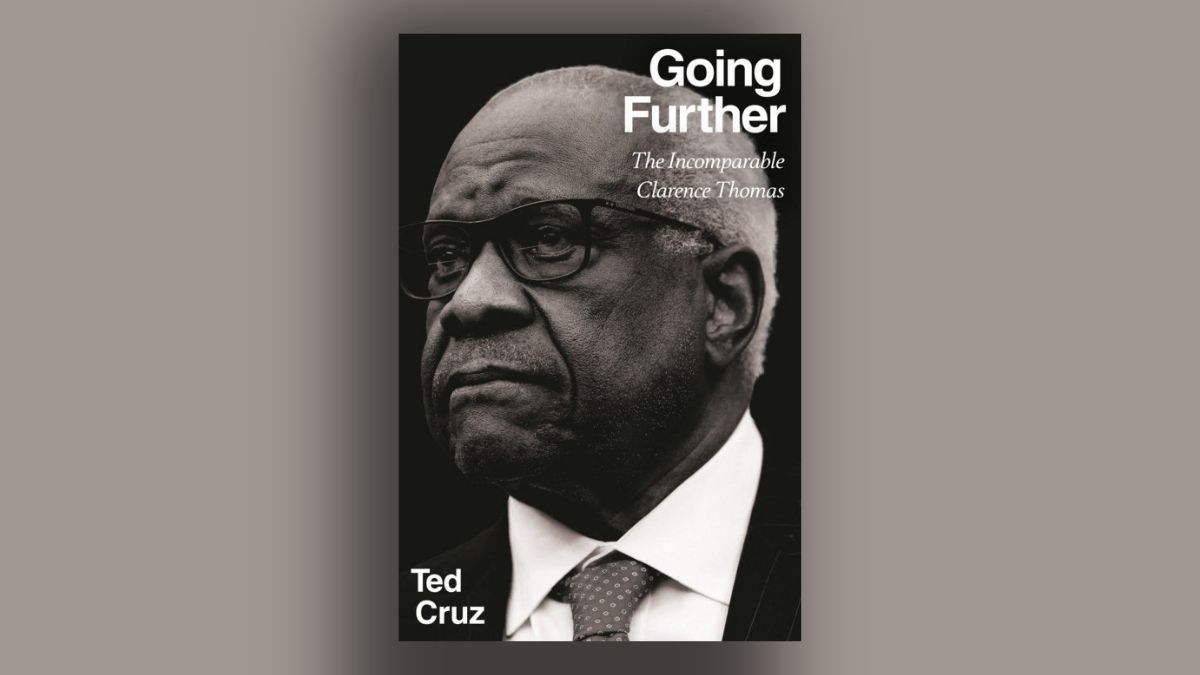
It’s this profile in courage that is front and center in Ted Cruz’s newly released book, Going Further: The Incomparable Clarence Thomas. Filled with insight from the man himself, the literary work traces Thomas’ origins from his upbringing in the segregated South to his time on the court and demonstrates how those experiences molded him into the justice he is today.
For those unfamiliar with his story, Thomas was born into poverty in Pin Point, Georgia, in 1948. Unable to manage raising Thomas and his brother on her own, his mother sent the boys to live with their grandparents in Savannah when Thomas was 7.
As Cruz documents in his book, Thomas’ grandparents — particularly his grandfather — would become instrumental in instilling in him a strong sense of hard work and discipline. So much so that his grandfather’s famous phrase “Old Man Can’t is dead, I helped bury him” remains etched in his brain to this day. And while the justice would exemplify that mentality at multiple points throughout his life, his path wasn’t always filled with the light and joy that now help define him.
Despite being raised in the Catholic Church and initially wanting to be a priest, Thomas would fall away from his upbringing and Christian faith in his teenage years. Angered by the state of race relations in America and the assassination of Martin Luther King Jr., he embraced left-wing orthodoxy and became a radical. Only after participating in a riot in Harvard Square in 1970 did Thomas ask God to “take hate” out of his heart and start his long “crawl” back to the church.
While Thomas “still clung to the slogans and surface-level beliefs of left-wing politics” in the years after that pivotal moment, Cruz makes clear that something had changed in the justice. He began thinking more deeply about the effect of race-based policies promoted by white liberals (for example, affirmative action) on black Americans and raised intellectual questions about such subjects. While he may not have known it at the time, what he was seeking above all else was the truth.
In the years that followed, Thomas would go on to work for Republican Jack Danforth during the latter’s time as Missouri attorney general and later as a U.S. senator. He would subsequently serve a short time at the Education Department before becoming the chair of the Equal Employment Opportunity Commission under Presidents Reagan and Bush.
It was throughout this period that Thomas’ worldview shifted. Working to leave the bitterness of his past behind him, he looked at the world through a clear lens in which facts and history took priority over unbridled emotion. It was also during this time that the Georgia native began to more closely examine America’s founding documents, works on history and political philosophy, and more. In doing so, Cruz noted, “Thomas’s reverence for the Constitution, already strong, increased tenfold.”
“He saw all over again how foolish he had been to assume that the country needed to be destroyed before something better could be built,” Cruz wrote. “The answer to the problems of minorities in the United States was not undoing provisions of the Constitution, but appealing to those provisions.”
Thomas’ talents eventually got the eye of the Bush White House and resulted in President Bush appointing Thomas to the D.C. Circuit Court of Appeals in 1990. While enduring petty antics from then-Sen. Joe Biden and Senate Democrats, his road to the appellate court would be nothing compared to the clown show that became his Supreme Court confirmation the following year.
Thomas came under excruciating attack after news leaked (in part thanks to Biden) that his former colleague Anita Hill had accused him of sexual misconduct in the workplace. While Hill’s claims were unsupported and riddled with inconsistencies, leftists used them to further defame Thomas in a blatant attempt to sink his nomination.
Relying on his Christian faith and those closest to him, Thomas refused to cower. He emphatically rejected Hill’s allegations and delivered impassioned remarks blasting the process for what it had become: “A high-tech lynching for uppity blacks who in any way deign to think for themselves, to do for themselves, to have different ideas, and it is a message that unless you kowtow to an old order, this is what will happen to you.”
The left’s efforts to destroy Thomas failed. Not only was he confirmed by the Senate, but the American people believed him over Hill by a roughly 2-1 margin.
Unfortunately for Thomas, Democrats and their allies weren’t finished with smearing him.
In the years following his confirmation, leftists would grossly paint him as a puppet of fellow originalist and Justice Antonin Scalia, as if he were incapable of independent thought. Others would regurgitate racist “Uncle Tom” attacks against him. They’ve also waged dishonest “ethics” smears and threats of violence against Thomas and his fellow conservative justices for issuing decisions they didn’t like.
But in spite of it all, Thomas has never wavered in his commitment to the one thing he’s pursued his entire life: the truth. Throughout his more than three decades on the bench, the justice has repeatedly decided cases based on what he believes to be the law’s original meaning — even if it meant standing alone.
Thomas’ embrace of this honest form of legal interpretation (originalism) has cemented his key role in the Supreme Court’s recent decisions upholding Americans’ religious freedoms, gun rights, free speech, a colorblind Constitution, and so much more. Even in good rulings where the majority doesn’t go as far as it could, the senior justice lays down a marker on what the ultimate truth is and why the court should get there.
What Going Further makes evident is that Thomas is not your everyday figure. He’s a man forged by adversity who is willing to lay everything on the line for what is right and just.
It took courage to turn away from the left-wing radicalism that defined his youth. It took courage to challenge the left’s racial politics. It took courage to keep going when attacked for working for Republican politicians as a black man. It took courage to face down Senate Democrats and Anita Hill’s despicable smears. And it takes courage to uphold the Constitution when confronted with the left’s ongoing war against him and his conservative colleagues.
Decade after decade, leftists have tried their darndest to defeat Clarence Thomas. And decade after decade, they have failed miserably.
But the best part about all of this is that Clarence Thomas is not done going further. Not even close.