
Cormac McCarthy was America’s great shaman-storyteller. His novels often seem as much called into being as written, demanded by the weight of the past forever encroaching into the present, and filled with ancient blood truths asserting themselves through whatever gloss of civilization we paint across man’s moral nature. But of course McCarthy was also merely human, an enchanter with words, an epic portraitist of the American landscape, a dour and exacting witness to character, and a link to the heyday of the Great American Novel.
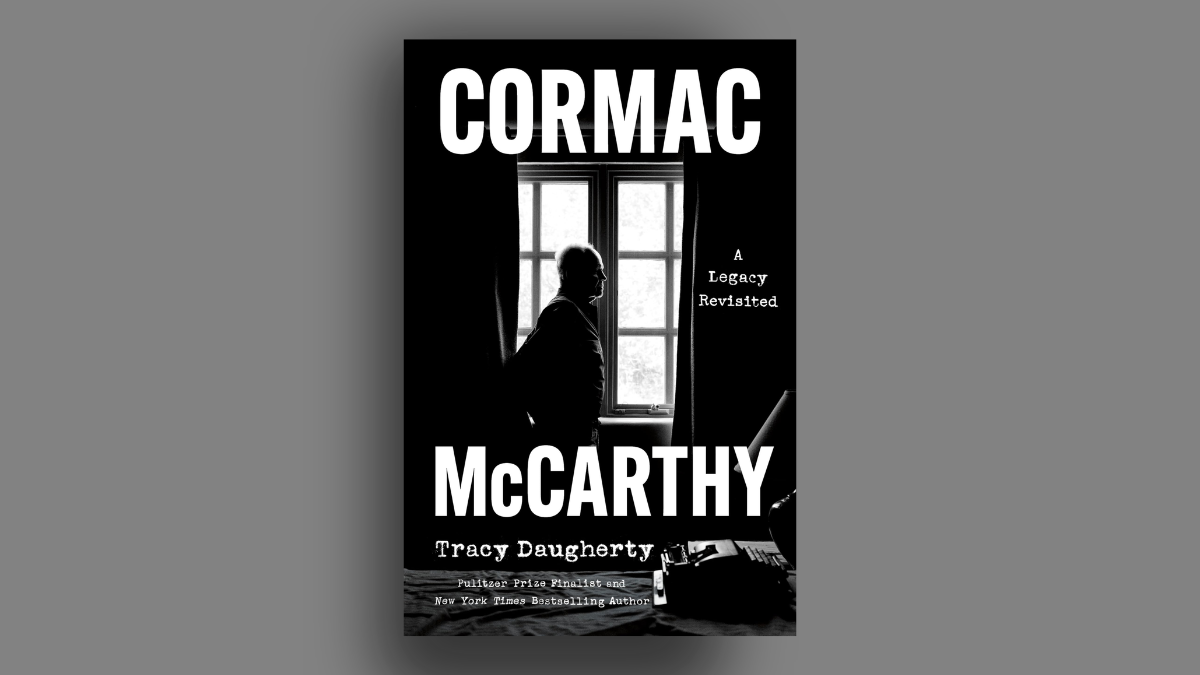
He deserves a biographer equal to the task of depicting his contradictory personal story, his monk-like devotion to his art, the muddy origins of his stark, noble, and often downright ghastly themes, his obsession with the skull beneath the skin and the viscera of life, and his literary and philosophical influences. Unfortunately, Tracy Daugherty, author of Cormac McCarthy: A Legacy Revisited, is not that biographer.
For starters, Daugherty seems to genuinely hate the South, particularly Knoxville — McCarthy’s hometown and, after the American Southwest, the greatest influence on his work — and expresses a condescending loathing toward the work of William Faulkner, as well, whom Daugherty depicts as an overrated mumbler propped up by the New York publishing cognoscenti of his day. Not exactly the best frame of mind to bring to an author who is, inarguably, Faulkner’s greatest heir.
The book is in large part a compilation of gossip drawn from McCarthy’s acquaintances, publishing associates, and former wives and girlfriends. Its literary analysis is banal — on the order of a junior-level college thesis paper with talk of “doubling” and other such clichés of literary analysis — and wholly misses the heart of McCarthy’s magnificence as well as the reasons for his literary shortcomings. Of course, McCarthy’s themes are Faulknerian, Southern, and, above all, the consequence of an existentialist’s life-and-death struggle with God, fate, and mankind’s soul — or lack thereof.
Daugherty’s reportage on the gossip of McCarthy’s wives and girlfriends is particularly cringeworthy. This Daugherty attempts to characterize as an indictment of McCarthy’s misogynistic nature, only to be belied by the actual words of the women who, for the most part, express understanding of McCarthy’s faults and failings — some of which were quite egregious — and admiration for his virtues. As Rick says of Renault in Casablanca, “Oh, he’s just like any other man, only more so.” Most of all, Daugherty’s thematic concerns — social justice, a Howard Zinn–influenced picture of a deeply flawed America — are most distinctly not those of Cormac McCarthy, who, despite his bohemian lifestyle and personal failings, was politically and culturally conservative and fairly patriotic (although politics hardly mattered to his larger concerns). One gets the sense that Daugherty’s attempt to paint McCarthy as a casualty of backward and unjust times would have seemed laughable and even loathsome to McCarthy, who considered himself nobody’s victim. For McCarthy, the world was headed downward, not upward, and always toward its doom.
Very little of what concerns Daugherty in his biographical sketch matters to McCarthy’s work — and that work is the key to its author’s character. Everything McCarthy did revolved around writing, and anything that stood in the way, however worthy in the moment, must be shorn from his life.
An Uncompromising Life
Born in 1933, Cormac McCarthy was the third child and oldest son of six siblings. His given name was Charles Joseph McCarthy, Jr., and his childhood friends knew him as Chuck or Charlie. In order to avoid constant association with the name of Edgar Bergen’s ventriloquist dummy — a comedy act that was ubiquitous in the 1950s and 1960s — he took the name Cormac from a nickname his Irish-American father had acquired as a child. McCarthy had a contentious relationship with his father, a Providence, Rhode Island, native (as was McCarthy’s mother) and Yale Law graduate who became a well-to-do lawyer for the Tennessee Valley Authority based in Knoxville. The older McCarthy seemed to his young son the definition of staid propriety, and it must be said that the father did not grasp his son’s genius until later in life. The elder McCarthys did, however, lend years of support in the form of cash and a crash pad for their errant knight of a son, and later provided a summer haven for McCarthy’s older son, Cullen, who otherwise grew up separated from his father in Bakersfield, California. Throughout life, McCarthy remained close with his brother Dennis and sister Bobbie.
While Charles McCarthy, Sr., may have been the psychological model for Cornelius Suttree’s father in McCarthy’s novel Suttree (1979), he was hardly a monster, and McCarthy was hardly a saint as a son, as he himself acknowledged. Cormac grew up in a Knoxville suburb and was wholly of the Appalachian South. When he and his childhood buddies wandered, they traveled outward, into the nearby woods and fields for hunting with .22 rifles and adventure, then later to the pool halls and juke joints on the town’s periphery.
After a brief, unsuccessful stint at the University of Tennessee in the early 1950s, McCarthy joined the Air Force, where he deliberately flunked out of officer training school and spent four years stationed in Alaska, where he clerked and was a disc jockey on the Air Force radio station, but mostly read constantly and without ceasing. After the Air Force and some knocking about hitchhiking, he returned to the University of Tennessee in Knoxville, where he studied for several years and came into his own as a young writer mentored by several influential teachers and involved in the literary scene on campus. There he met his first wife, Lee Holleman, a student from Arkansas. When Lee graduated, the two moved to Chicago for a stint, where McCarthy took a job as a clerk at auto parts merchant J. C. Whitney (McCarthy had a lifelong love of cars and was a good mechanic) and began work on what would become his first novel, The Orchard Keeper (1965).
McCarthy and Lee returned to a house on the outskirts of Knoxville, where Lee became pregnant with Cullen. Meanwhile, the two were becoming more and more unhappy with circumstances and with one another. This led to a cataclysmic split, as Lee took a job in Montana and McCarthy almost inexplicably watched her leave with the baby and did not follow or attempt reconciliation. Lee eventually ended up in California, where she raised Cullen alone and taught high school English for decades. Father and son saw each other infrequently, and the usually penniless McCarthy contributed nothing to his son’s upkeep. Cullen McCarthy, who changed his first name to Chase, would eventually become an architect.
McCarthy spent the following years traveling and writing, with a long stint in Europe, where he met his second wife, English dancer and performer Annie DeLisle, whom he brought back to Knoxville. The two attempted to renovate a decrepit country house-cum-dairy barn about twenty-five miles south of Knoxville near Louisville, Tennessee, while McCarthy wrote, worked at odd jobs mostly to gain life experience rather than for the money, socialized with Annie with a friend group of cultured locals, and often caroused by himself with a group of drinking buddies who ranged from unstable to shady. The English-accented Annie, who had been a performer on a cruise ship when McCarthy met her, would remain in the area for life and eventually operated a successful Italian restaurant in Knoxville. McCarthy survived off his meager advances and a small grant his Random House editor, Tennessee native Albert Erskine, had a hand in arranging. Ever the observer, McCarthy seldom participated in any activity that seriously threatened his writing. In East Tennessee, he completed Outer Dark (1968) and Child of God (1973), and did much of the work on his first masterpiece, Suttree.
With Suttree apparently near completion in 1976 (he would not finish it for another two years), McCarthy seems to have exhausted the creative inspiration from his upbringing in Knoxville and life in Appalachia. Once again, McCarthy broke with a wife and took to the road, this time into the American interior, never to live permanently in Tennessee again. After much travel, McCarthy settled in El Paso, Texas — his base for the next two decades.
With the move to El Paso, McCarthy entered into the most important relationship of his life — with the American West. The land and its history became his muse, his obsession, and the undiscovered country of his soul. There he produced the apotheosis of his art, the dark masterpiece Blood Meridian (1985), which many regard as the greatest novel of the late twentieth century, comparable in scope and importance to Melville’s Moby-Dick, Twain’s Huckleberry Finn, Faulkner’s The Sound and the Fury, and Hemingway’s For Whom the Bell Tolls. In El Paso, he would also write his Border Trilogy, All the Pretty Horses (1992), The Crossing (1994), and Cities of the Plain (1998). Daugherty’s depiction and analysis of Blood Meridian in his biography are so dismissive and threadbare it leaves one wondering if he even read the novel. He certainly seems to dislike it.
Contra Daugherty, the last thing McCarthy seeks to do in Blood Meridian is to subvert the western as a fictional form. Instead, he takes the western genre seriously and gives himself wholly over to it as a writer, inhabiting its structure, minutely studying the physical landscape and people of West Texas and Mexico to fill out his setting. McCarthy traveled everywhere in the border region, driving thousands of miles, asking questions ceaselessly of the inhabitants, even learning Spanish, albeit a bit too late to complete his bachelor’s at Tennessee. Above all, McCarthy absorbed and brought to life the psychic landscape over which the American western is laid.
Taking a leaf from his greatest influence, William Faulkner, McCarthy comes at character obliquely, preferring to use setting and the exigencies of the story to reveal the bare bones of the man within. McCarthy is unconcerned with psychological niceties and is interested in what we are at base: creatures who are able to choose between good and evil and frequently choose evil. Our lives are bounded by necessity. We could die or be killed at any moment. But also we choose, and our choices, too, are woven into time’s landscape. Small threads, yes, but worthy of teasing out and following as each winds its way within the tapestry until finally playing out abruptly or fading imperceptibly into the woodwork. “One must imagine Sisyphus happy,” says Albert Camus, one of McCarthy’s favorites, in The Myth of Sisyphus. But Sisyphus also remains trapped forever in Hades. His actions may seem futile or even meaningless, but they matter to him. Even so, the violence-addled Kid in Blood Meridian, even so serial killer Lester Ballard in Child of God, and even so thrice-doomed cowboy romantic John Grady in All the Pretty Horses.
Equally missing from Daugherty’s book is a much-needed examination of McCarthy’s grappling with God. McCarthy was raised Catholic and spent twelve years in Catholic school but grew up in deeply Protestant Knoxville. He was dismissive of organized religion thereafter but was no atheist. He was never contemptuous of real faith when he saw it, which he considered as hard a path to follow as a life of pure violence. He was an admirer of Mother Teresa and was fond of her famous line, “My dear Senator, God did not call me to be successful. He called me to be faithful.” And finally, there is almost no accounting of McCarthy’s literary influences in the book, although McCarthy laid these face-up on the table for all to see. Daugherty’s dismissal of Faulkner and Melville is particularly egregious and practically criminal, in a purported biography of Cormac McCarthy. There is no excuse, either. McCarthy may have guarded details of his personal life, but he could be effusive when discussing the writers he loved and revered.
Carrying the Vanguard of American Literature
McCarthy ended up living eighty-nine years, and in his mid-sixties fathered yet another son whom this time he doted on, a relationship that inspired his final homage to striving in the face of inexorable fate, The Road (2006). By this time, his poverty was a thing of the past. Movies based on No Country for Old Men (2005) and The Road, as well as Billy Bob Thornton’s (nearly unwatchable) adaptation of All the Pretty Horses, had left him well off.
In the late 1990s, McCarthy became heavily involved with a think tank called the Santa Fe Institute, founded in part by McCarthy’s old friend and fellow MacArthur Genius Grant fellow, physicist Murray Gell-Mann (who predicted and named the subatomic particle the quark – and even played a notable role in media criticism, having lent his name to the phenomenon known as “Gell-Mann Amnesia”). McCarthy eventually relocated to Santa Fe in 2001. In a sense, and as McCarthy had long feared, academia — even though it was the Santa Fe Institute’s Hogwarts-for-physicists quirky version of it — had finally swallowed him.
Cormac McCarthy mustered out of the Air Force in 1957 determined to be a writer who carried on the grand tradition of American literature he found in all the novels he had imbibed. He spent the next fifty years doing just that, avoiding the temptation of joining (or even setting foot in) the academy and fleeing fame as if it were the plague. He lived life on his own terms. He was a stubborn cuss, a gentleman in temperament and manners (all of his former female companions testify to this), and without equal during his time on the American literary stage.
His full biography will have to wait for more capable hands, but Daugherty’s gossipy account is of interest if you can wade through his melodramatic purple prose and whining complaints about a country that, for all its faults, is great enough to have produced and intermittently nurtured a giant like Cormac McCarthy. Better yet, spend your time reading or rereading McCarthy’s great novels while we await a telling of the author’s story that is truly worthy of the man and the stupendous accomplishment of stubbornly carrying the vanguard of American literature into the twenty-first century.