
Natural law is not a papist plot.
This should be obvious. Scripture attests to the natural law, most notably in Paul’s epistle to the Romans. The leaders of the Reformation, including John Calvin, affirmed the doctrine of the natural law. And yet the natural law all but vanished from American evangelical thought and teaching for most of the last century.
This eclipse of natural law was overdetermined. Theologically, there was the influence of Karl Barth and others who denigrated the natural law as worthless for Christians, arguing they ought to rely on revelation, not reason, for knowledge of God and moral guidance. At most they saw natural law as a means of condemnation — unregenerate man can perceive just enough moral truth to be damned for his sins. Meanwhile, the rise of non-denominational congregations, along with the collapse of the Protestant mainline, produced an evangelical culture that ignored or even disdained most of the Christian intellectual tradition. The average megachurch attendee would find the name of Thomas Aquinas ringing only faint bells before guessing that he was a journeyman National League shortstop. And all of this was overlaid with suspicion that natural law theory was dangerously Catholic and prone to generating extrabiblical moral commands.
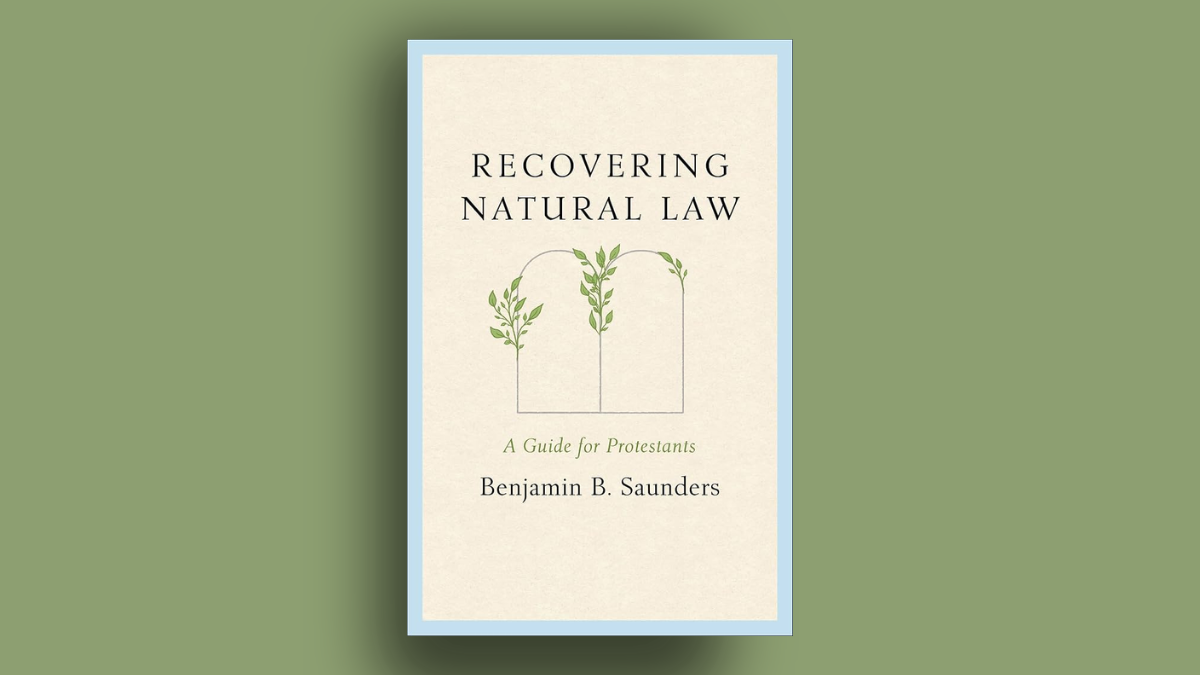
Consequently, natural law thinking withered among most evangelical Protestants. But a restoration is underway, with Benjamin Saunders’ new book, Recovering Natural Law: A Guide for Protestants, providing an excellent addition to this burgeoning genre. This book is meant for the layman, or the student — indeed, it would be ideal reading for introductory college or seminary courses. However, Saunders, an Australian law professor, has done the reading, and those looking to delve deeper into the subject will find a wealth of resources cited throughout.
Thus, though this is an introductory book, it will have not only students, but also seasoned natural law scholars, thinking about the subject in fruitful ways. Even accomplished academics need reminders as well as fresh insights. For instance, it helps to recall that we are mostly on the same side. Saunders is aware of the divisions between natural law thinkers, and points some of them out, but the general nature of this work highlights how much is held in common, something that can easily be lost the disputes between warring tribes of natural law scholars.
This big tent does not preclude there being, as advertised, a noticeable Protestant flavor to this book. Sometimes this is blunt, as when Saunders tells Protestant readers that “Anyone who takes the authority of Scripture seriously must affirm something like a doctrine of natural law.” More positively, this Protestant infusion is at its best through the distinct elements it brings.
Most prominently, the persistent references to Scripture are part of explaining the natural law to an evangelical audience, but they also illustrate how natural law reasoning and scriptural exegesis are meant to complement each other. This Biblical grounding and interplay is, as he observes, too often neglected: “The literature on natural law rarely seems to overlap with biblical scholarship. Much natural law theory pays little attention to the Bible.” Indeed. For instance, not enough attention has been given to Proverbs as an extended reflection on, and illumination of, the natural law. Yet through this sort of examination, we see how one of the purposes of natural law is to help Christians understand how to live rightly — and to explain to the world why Christian moral teachings are not arbitrary or capricious killjoys, but are for our good and the good of those around us.
Another element is this book’s emphasis on the limits of reason. Saunders does not, of course, disavow reason, but he has a Protestant-coded emphasis on sin’s darkening of both intellect and will, such that we may struggle to know what is good, and even more struggle to do it. One implication of this may be seen in Saunders’ avoidance of endorsing a single method of natural law reasoning. Rather, he seems to suggest that there is no dispositive natural law approach — rival schools of natural law theory may each be useful, none is definitive.
He also emphasizes that “it is not always possible to define and describe the moral in watertight propositions.” Natural law is not a geometry-like application of a heavenly statute book. Rather, it is the moral order of creation, which we may partially and imperfectly perceive, understand and articulate. It is an “invitation to wisdom and reflection on the moral order,” not a rationalist set of propositions that may be applied with mathematical certitude.
This is not, of course, a strictly Protestant point. Indeed, Notre Dame theologian Jean Porter has argued for an interpretation of Aquinas that is closer to Saunders’ view than to some of the more rationalistic natural law approaches. Nonetheless, it is fair to say that Catholic approaches to natural law tend to be more rationalistic, and that more Protestant participation in natural law theorizing may provide a useful corrective to such rationalistic tendencies.
Thus, it is unfortunate that Saunders deploys the dichotomy of objective vs subjective morality. What is meant, of course, is that moral truth is real, and comes from a source outside our wills and wants. The problem with describing morality as objective is that morality is not an object, and relying on such language is apt to mislead us. We need a philosophical vocabulary to describe moral truth as real and not subjectively determined without resorting to the rationalistic language of objectivity. It would, of course, have been too much to ask Saunders to develop this in a short introductory book, but the problem remains for the field at large.
What Saunders has provided is an important introduction to natural law for those (especially Protestants) new to the subject while also providing important reminders for scholars in this area. His call for Protestants to recover this critical aspect of our heritage of faith is timely. It is an exhortation toward greater holiness, for natural law can “function as a powerful aid to sanctification,” as we come to know the Creator and conform to His will through seeing the moral order of creation.
The Protestant theologians who dismissed the natural law got it all wrong, for “scripture and natural law should not be pitted against each other but should be seen as mutually illuminating.” One of the things scripture teaches us is that there is a natural law. And so the task of recovering the natural law within Protestant thought is also a warning, reminding us that teachers who deny the natural law are elevating their own theological systems above the plain truth of Scripture.