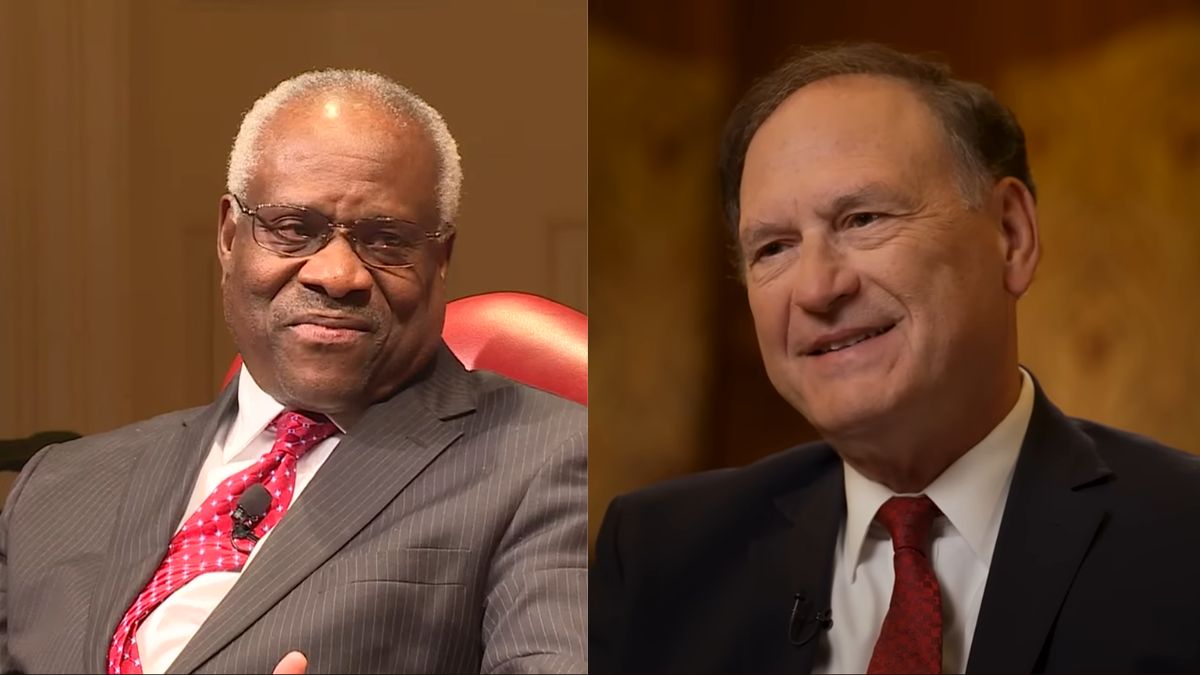

Justices Clarence Thomas and Samuel Alito often find themselves on the same side of cases at the U.S. Supreme Court. But what generally goes unnoticed is how the two justices’ similar yet differing approaches to the law come together to advance better constitutional interpretation for the country.
This dynamic was on full display in the court’s Thursday decision in Hamm v. Smith. The case centered around an Alabama man seeking to overturn his capital punishment sentence on the argument that he is intellectually disabled and therefore can’t be executed under the Eighth and 14th Amendments.
In a 5-4 ruling, with Justices Brett Kavanaugh and Amy Coney Barrett joining the Democrat appointees, SCOTUS declined to rule on the lower courts’ handling of the matter. The high court said that it made a mistake in agreeing to consider the case (“The writ of certiorari is dismissed as improvidently granted”).
Thomas and Alito disagreed. The two justices authored separate dissenting opinions explaining why the majority got it wrong and why the court should have ruled on the issue. More to the point, however, these opinions demonstrate how they work together to move the court’s jurisprudence in the right direction.
In his solo dissent, Thomas argued that the court’s Hamm decision “rewards” convict Joseph Clifton Smith’s efforts “to convince courts that he is not intelligent enough to be executed.” He contended the evidence shows that “Smith is not insufficiently intelligent to be executed,” and that the Supreme Court’s dismissal of Alabama’s petition “challenging the lower courts’ vacatur of his death sentence” under its existing Atkins v. Virginia (2002) precedent is wrong.
As described by Thomas, the Atkins majority “held for the first time that convicted murderers like Smith cannot be executed” under the Eighth Amendment “if they are deemed insufficiently intelligent, which the Court suggested would require that they had an IQ of 70 or below.” The court in Atkins said “[s]uch persons could not be executed,” Thomas wrote, “even if they ‘know the difference between right and wrong,’ even if they ‘are competent to stand trial,’ and even if they are intelligent enough to deserve other ‘criminal sanctions.'”
The Atkins decision was 6-3, with Chief Justice William Rehnquist and Justices Antonin Scalia and Thomas in the dissent.
In his Hamm opinion, Thomas noted how the evidence shows that Smith’s intellectual capabilities exceed the Atkins baseline and how the lower courts “held that he could not be executed based only on the hypothetical possibility that” his five IQ test scores over 70 “were all wrong and that his IQ is in fact 70 or below.” More notably, however, he called for the Supreme Court to overturn its Atkins precedent to establish a new one that’s in accordance with the Constitution.
“As this case shows, though, Atkins has bred only confusion and absurdity. Nothing in the text or history of the Constitution supports Atkins. It should be overruled,” Thomas wrote.
Alito, on the other hand, took a different approach in his dissent, which Thomas joined in full and which Chief Justice John Roberts and Justice Neil Gorsuch joined in part.
While agreeing with Thomas that the court should have resolved the Hamm case and that its precedents on the issue have “led to confusion and unsound analysis in lower courts,” the Bush 43 appointee took a more incremental route. Seemingly recognizing that not all of his conservative colleagues may be ready to completely overrule Atkins at this time, he argued that “At the very least, we should reverse the lower courts’ erroneous analysis of Smith’s scores and remand for a fresh consideration of his Atkins claim using any sound method.”
“Even if our decision went no further, we would provide clarity and coherence to one aspect of our Atkins doctrine. Instead, the Court shies away from its obligation to provide workable rules for capital cases,” Alito wrote. “In doing so, the Court disserves its own death penalty jurisprudence, States’ criminal-justice systems, lower courts, and victims of horrific murders.”
See the dynamic at play?
Whereas Thomas plants the beacon on where SCOTUS should be on an issue and where it needs to go, Alito is willing to stake out a milder position to help get it there over time. The former provides the big-picture outline, while the latter colors it in.
This pivotal working relationship was also on full display in the court’s Dobbs v. Jackson Women’s Health Organization (2022) decision overturning Roe v. Wade (1973) and the made-up “constitutional right” to abortion. In her bestselling book, Alito: The Justice Who Reshaped the Supreme Court and Restored the Constitution, Federalist Editor-in-Chief Mollie Hemingway notes how Alito was seen as “the best person” to author the majority opinion because “one of his greatest strengths is keeping a majority opinion together and incorporating arguments from everyone.”
This was especially crucial in Dobbs, where Alito had to balance Thomas’ willingness to frequently reexamine precedent and belief that SCOTUS “was in error when it kept finding rights” in the 14th Amendment’s due process clause (“substantive due process“) with Kavanaugh’s greater regard for precedent. Alito ultimately penned an opinion that did just that, while Thomas authored a concurrence outlining why the court should “reconsider all of [its] substantive due process precedents” since “any substantive due process decision is ‘demonstrably erroneous.'”
What cases like Dobbs and Hamm underscore is the often-unappreciated secret sauce behind many of the Supreme Court’s crucial decisions in recent years. That is, Thomas’ and Alito’s differing but equally necessary approaches to the law working together to produce jurisprudence that accords with what the Constitution calls for.
Whether in victory or defeat, these two justices are laying the foundation of solid originalist interpretation for future courts to look towards in related matters before the bench. Their combined presence at SCOTUS is a blessing, one which Americans would be wise to appreciate while they have it.