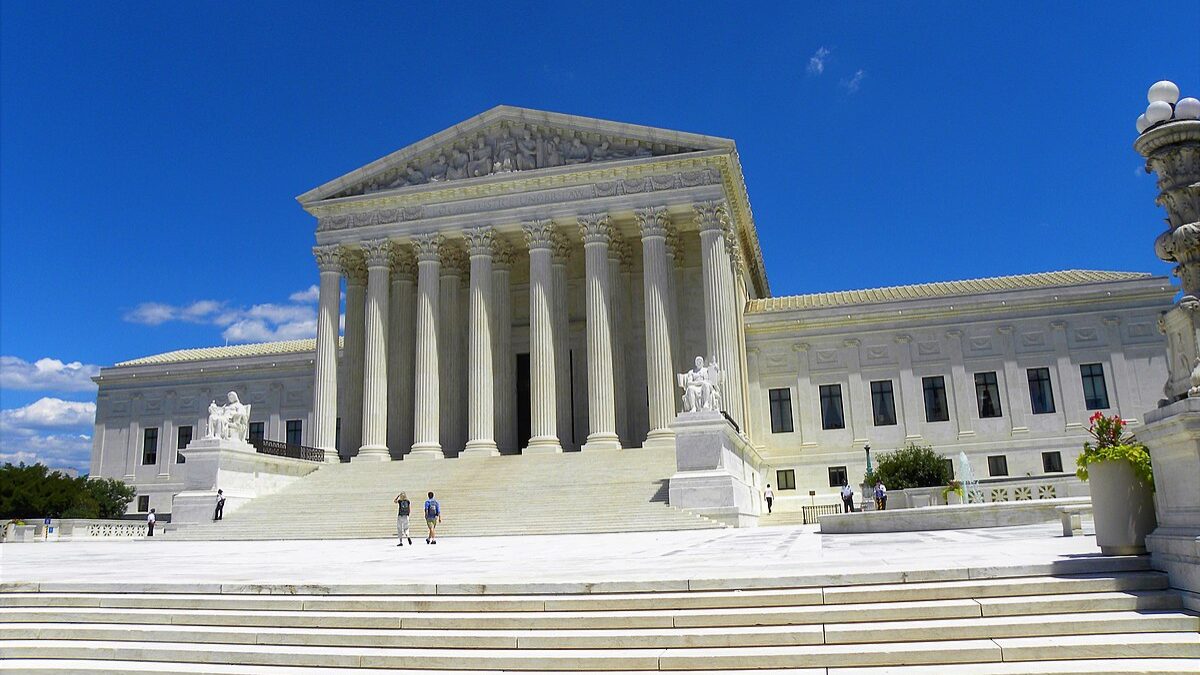

Justices Clarence Thomas and Samuel Alito had some choice words for their Supreme Court colleagues on Thursday over their “remarkable” decision “undermin[ing]” the court’s historic Dobbs decision overturning Roe v. Wade.
The stinging rebukes came in an order the high court handed down to temporarily pause an appellate court ruling that halted a Biden-era FDA rule allowing the mailing of mifepristone to women without an in-person doctor visit. In agreeing to halt the policy, the 5th Circuit Court of Appeals found that the FDA’s “progressive relaxation of mifepristone’s guardrails likely lacked a basis in data and scientific literature,” and noted how the “FDA itself now concedes the regulations were marred by ‘procedural deficits’ and a ‘lack of adequate consideration.’”
While seven justices agreed to temporarily pause the 5th Circuit’s order while litigation in the case continues, Thomas and Alito authored brutal dissents underscoring the illogical nature of their colleagues’ decision.
Thomas said that he would deny the application brought by the dangerous drug’s manufacturers and distributors to pause the appellate court’s order “because they have not satisfied their burden for securing interim relief.” He separately noted his agreement with Louisiana — which challenged the Biden-era rule — that “it is a criminal offense to ship mifepristone for use in abortions.”
“The Comstock Act bans using ‘the mails’ to ship any ‘drug … for producing abortion.’ … A neighboring provision makes it a felony to use ‘any express company or other common carrier or interactive computer service’ to ship ‘any drug … designed, adapted, or intended for producing abortion,’” Thomas wrote. “Applicants ‘[s]hip mifepristone … to certified pharmacies,’ which, in turn, must ‘ship mifepristone using a shipping service’ to users. … As relevant to this case, mifepristone shipped to Louisiana, which bans abortion, causes nearly 1,000 abortions per month. ‘All of this violates the Comstock Act.’”
The Bush 41 appointee went on to note how the mifepristone manufacturers and distributors aren’t entitled to a stay from the court “based on lost profits from their criminal enterprise.” He subsequently concluded that they can’t, “in any legally relevant sense, be irreparably harmed by a court order that makes it more difficult for them to commit crimes,” and that “whereas it would ‘serve the public interest’ to ‘reduc[e]’ applicants’ ‘opportunity to commit crimes,’ … a stay would have the opposite effect.”
Meanwhile, Alito characterized the court’s “unreasoned order” in the case as “remarkable.” He further admonished the majority for seemingly greenlighting efforts to “undermine” the court’s 2022 Dobbs v. Jackson Women’s Health Organization decision, which “restored the right of each State to decide how to regulate abortions within its borders.”
“Some States responded to Dobbs by making it even easier to obtain an abortion than it was before, and that is their prerogative. Other States, including Louisiana, made abortion illegal except in narrow circumstances,” Alito wrote. “But Louisiana’s efforts have been thwarted by certain medical providers, private organizations, and States that abhor laws like Louisiana’s and seek to undermine their enforcement.”
In describing medical providers’ and private organizations’ “operation” to ship mifepristone to women in states like Louisiana, Alito noted how the drug’s manufacturers and distributors “are obviously aware” of the efforts to sidestep pro-life protections “yet nevertheless supply the drug and reap profits from its felonious use in [the state].” He additionally highlighted how “[t]his scheme would not have been possible under FDA regulations had the federal government not taken steps” under the Biden administration “to facilitate mail-order abortions.”
The Bush 43 appointee delved into the Trump FDA’s pledge to conduct a study into the “inadequate” safety standards and how the lack of action from the current administration ultimately prompted Louisiana to file its lawsuit “to stop ongoing schemes to subvert its abortion laws.” In doing so, he explained that he would deny the applicants’ request to pause the 5th Circuit’s order “because, as things now stand, the manufacturers have failed to show that they face irreparable injury, without which this Court may not grant a stay.”
“Unless the Fifth Circuit’s order spurs the FDA into moving on its safety review, there is no indication that the Fifth Circuit’s order will adversely affect the manufacturers whatsoever in the near future. All the evidence is to the contrary,” Alito wrote. “So, at present, it is most unlikely that the manufacturers would be at all affected by the Fifth Circuit’s order for quite some time. That could conceivably change if the Fifth Circuit’s order were left in place and the FDA were spurred to speed up its safety review, but our disposition of this application cannot be predicated on the assumption that that will occur.”
Alito conclusively echoed Thomas’ assessment that the “irreparable injury” arguments put forward by mifepristone’s manufacturers and distributors hold no legal weight. He noted that, because their claims do not show “any imminent risk” of harm, “the Court must deny these applications regardless of how they fare on the other stay factors.”