
Democrats campaigned on “affordability” and “democracy.” They’re set to beat the hell out of both as they take control of Congress and statehouses across the country in January. The policies they’re pushing will prove costly to pocketbooks, but their lust for consolidated power could ensure one-party rule for the foreseeable future.
That is, of course, if their quest to neutralize the Founders’ ingenious system of electing presidents and vice presidents doesn’t end in civil war.
“We are playing with fire,” said Jason Snead, Executive Director of the Honest Elections Project, an election integrity advocacy and litigation organization.
Killing the Electoral College
One of the first orders of business for Democrats will be to introduce legislation for their states to join the National Popular Vote Interstate Compact, an agreement a quarter century in the making.
The NPVIC aims to make presidential elections a pure — or impure — popularity contest, bypassing the foundational Electoral College system. Under the popular vote concept, a state would give its electoral votes to the candidate who wins the most popular votes nationally, even if the candidate doesn’t win the state’s popular votes. For instance, Joe Biden won every one of the swing states but North Carolina in 2020’s disputed presidential election. Under the terms of the NPVIC, North Carolina would have had to award its 16 electoral votes to Biden, who won the national popular vote with an incredible 81 million votes, 7 million more than Trump.
Victors generally win a majority of the popular vote on their way to capturing the presidency, but not always. Elected presidents have lost the popular vote but won the electoral college majority five times in American history — 1824, 1876, 1888, 2000 and 2016.
As of now, 18 states and the District of Columbia have signed on to the compact, each controlled by Democrats, according to the National Conference of State Legislatures. California and its 54 electoral votes joined in 2011. Maryland and New Jersey were the first states to commit in 2007, followed by Illinois and Hawaii in 2008. Virginia, after securing the trifecta in 2025, joined this year.
Members currently account for 222 electoral votes. The compact’s proponents assert the agreement will take effect once membership reaches 270 Electoral College votes, a majority of the 538 total. After this month’s blue wave, the popular vote campaign moved a lot closer to the finish line.
‘Make Every Vote Equal’
The movement only needs Pennsylvania, Michigan, Wisconsin, and either Arizona or Nevada to hit the 270-vote threshold and bind every member to the agreement. Democrats in each state will control the legislatures and governor’s offices in 2027. And the compact is top of mind for a Democratic Party that believes pesky details like the constitution shouldn’t get in the way of consolidating their power.
Pennsylvania Gov. Josh Shapiro, a Democrat with eyes on a presidential bid in 2028, told the the left-wing Pod Save America” podcast “a national popular vote makes sense.”
Democrat Aaron Ford, Nevada’s newly-elected governor, says he’s changed his mind on the NPVIC. After winning the swing state, Ford told KOLO 8 in Reno that he’s “done enough research” on the subject and now wants to see Nevada sign on to the compact.
Incoming Arizona Senate Majority Leader Priya Sundareshan told Politico that her caucus has been prepared to join the caucus, and Democrats want to “make sure that we are showing that our priorities are reflective of what we really focused on on the campaign trail.”
So how exactly how will turning the presidential election into American Idol lower the price of gas and groceries?
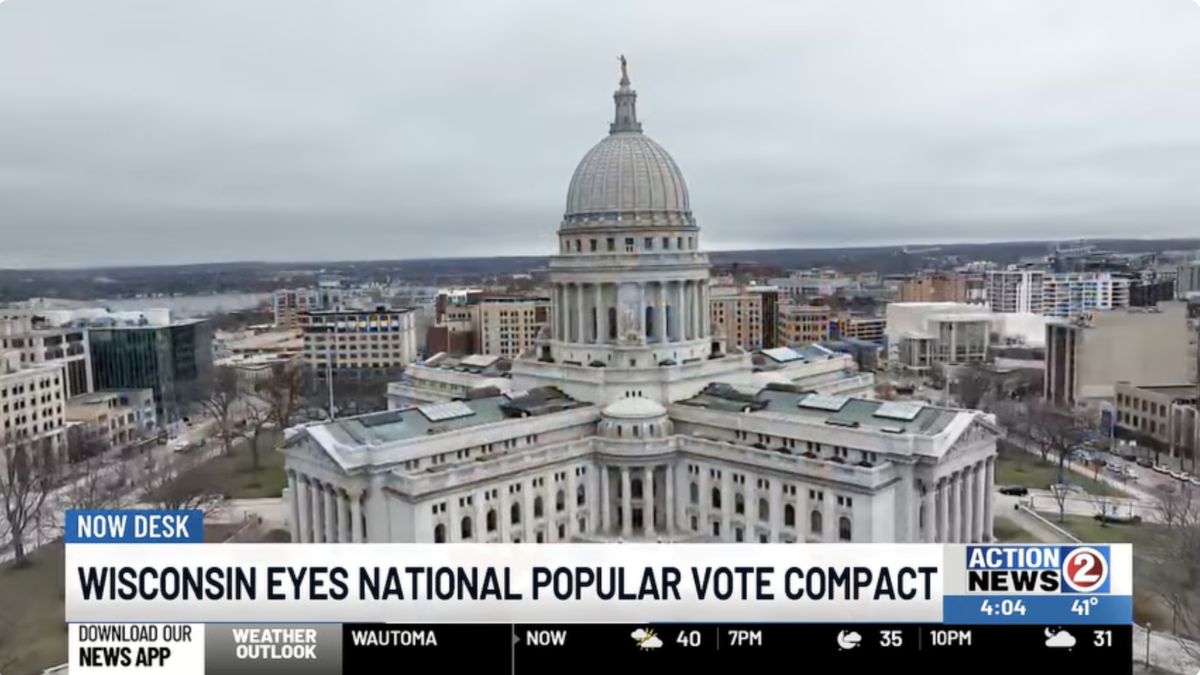
“The National Popular Vote bill will make every vote equal, and ensure that the candidate who earns the most votes wins,” Wisconsin state Sen. Kelda Roys, an extreme Democrat from Madison and failed gubernatorial candidate, said in a 2023 press release after she and her colleagues introduced a bill to make the Badger State a member of the compact. With Republicans in control of the legislature at the time, the bill went nowhere.
Roys is itching to bring Wisconsin into the fold. She recently told Wisconsin Public Radio that the outsized role of swing states in modern elections is “something that the founders would not have recognized.”
The lawmaker would be well served to pick up a copy of the Constitution.
‘There Could be Chaos’
The Convention of 1787 created a compromise constitution that balanced the power of the population centers against the larger geographic rural areas of America so that the most populous cities and states wouldn’t be able to play an overbearing role in electing the nation’s leader. Instead of one national election, the presidential contests are composed of 50 individual elections, plus the one in Washington, D.C.
Democrats see that as inconvenient.
“They really abhor any institution that they don’t control and that doesn’t give them outcomes reliably that they benefit from,” Snead told me on the latest episode of The Federalist Radio Hour.
While a a majority (58%) of Americans support amending the Constitution to eliminate the Electoral College system, the promoters of the compact know passing a constitutional amendment via supermajorities would be a tall order.
“So they decided they could graft on an agreement amongst the states that once you got enough states to sign on to equal 270 electoral votes then the states would stop listening to the voters in their states and instead award their electoral votes to whoever wins the ‘national popular vote,’” Snead said.
But even the “co-inventor” of the National Popular Vote concept has had his misgivings on the doomsday machine he had long supported.
Akhil Reed Amar, Sterling Professor of Law and Political Science at Yale University, introduced the end-run around the Constitution following the 2000 election in which Republican George W. Bush won the electoral college despite having lost the popular vote. The Supreme Court intervened. It was very messy.
Now, Amar warns the compact that Democrats are lusting over “could backfire big time.” Appearing on MS Now, Amar compared the glitch-filled compact proposal to AI. While it “can make our life better … it could melt down the universe.”
He notes the NPVIC hasn’t gotten a lot of buy-in from Republican states.
“That’s not a good sign for our country if one side thinks it’s a partisan scheme to help the other,” Amar said. Spoiler Alert: It is.
The other big glitch, he said, is a double-edged sword. The compact doesn’t feature the uniformity of central control. The Constitution gives the states control over how their elections are conducted. So, the war to turn out voters could become significantly more pitched, the professor said. California could push for 17-year-olds to vote, and Texas could counter with expanding the franchise to those 16 and up. Another state could make it legal for parents to vote for children. But God forbid some president like Donald Trump be placed in control of election decisions, the leftist professor said.
“There could be chaos,” he told the corporate media outlet.
A former Wisconsin governor is warning his fellow Democrats to be careful what they wish for. Jim Doyle, a two-term governor between 2003-2011, said Wisconsin benefits enormously from the Electoral College.
“If the Electoral College went away, nobody would spend any time in Wisconsin,” Doyle told WISCTV News3 in Madison. “They’d be in California, Texas, New York and Florida full time.”
‘Stop This De Facto Amendment’
If Democrats think they are easily going to roll out the NPVIC for 2028, they are sadly mistaken. Snead said the one thing certain about the compact is that it will draw litigation — lots of lawsuits. But the election law expert said there is no guarantee how the courts will rule, including the Supreme Court, despite what would appear to be clear prohibitions on something so constitutionally disruptive.
In his 2018 analysis for the Harvard Law School Journal on Legislation, Patrick C. Valencia, argued that the NPVIC and the Constitution are not compatible.
“There is no question that this is unconstitutional and completely against the Framers’ intent, or for that matter any conceivable public meaning of the Constitution,” Valencia wrote. He described the compact as a “constitutional crisis-in-waiting.”
NPVIC proponents argue Article II, section 1 is the vehicle that constitutionally drives the compact. But Valencia asserts the original understanding of the Electoral College “was to prevent both domestic and foreign powers from intervening in the electoral process through the electors.” Both have clearly been attempting to do so for some time, but Valencia argues the compact would cross a clear red line.
He urged the judiciary to stop “this de facto amendment to the Constitution”, should states ever reach the 270 electoral vote threshold. We are now approaching that moment.