
For years, the “standards of care” adopted by the radical World Professional Association for Transgender Health (WPATH) have been treated as incontestable expert guidance. Deep blue states like California have used WPATH standards to expand access to transgender interventions for children, and to force health insurance companies to cover sex-rejecting procedures. Believe in science!
But WPATH just told a court that it’s only guessing, and its guidance is all just an opinion. Challenged, the science ran away.
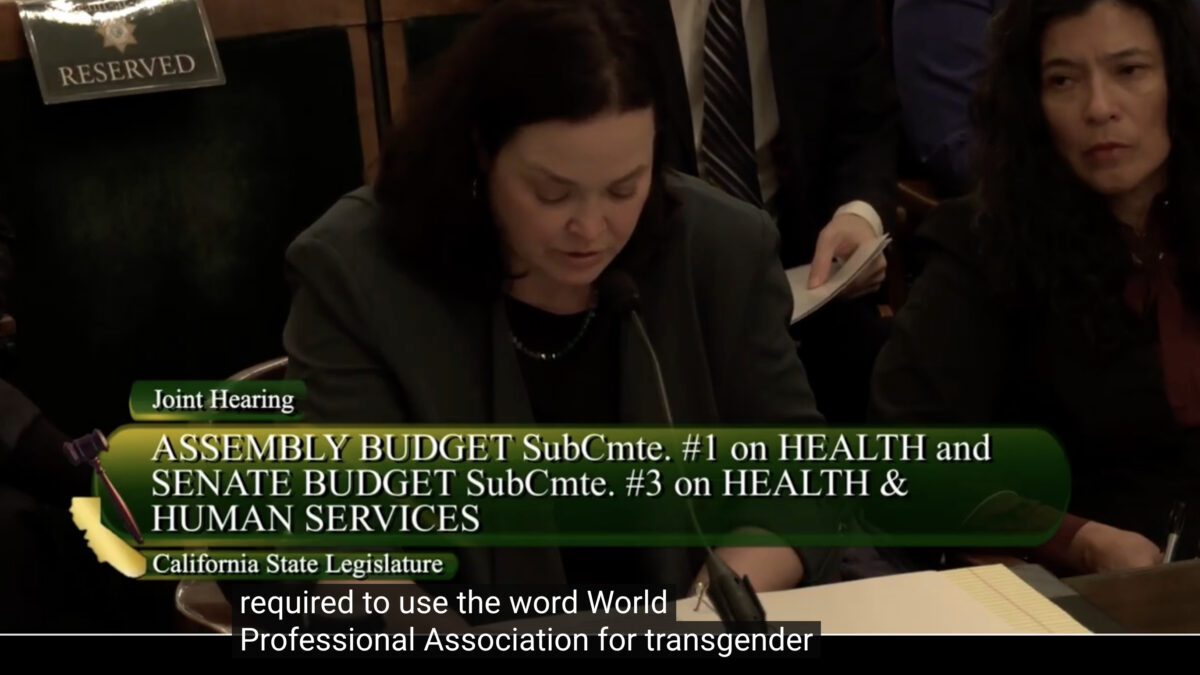
Rewind the tape for a moment, and start with the way WPATH’s standards of care have been used. As The Federalist has reported many times, California regulators have used those standards as a set of incontestable requirements established by rigorous scientific procedures. As we wrote in April, a legislative hearing on a measure to fund trans surgeries with taxpayer money featured extensive testimony from health care regulators who cited WPATH standards as the expert-established medical rules, handed down from the mountaintop on stone tablets:
“Plans are required to use the clinical criteria developed by nonprofit associations for the relevant clinical specialty when making medical necessity determinations. For services to treat gender dysphoria, health plans are required to use the World Professional Association for Transgender Health, or WPATH, guidelines.”
WPATH has spoken. The science is settled. One does not deviate from the established clinical criteria. Let no man contest the profound wisdom of WPATH, the organization of experts. Trans everything is a scientific commandment.
As The Federalist reported last week, California health care regulators have used the WPATH standards to force health insurance companies to cover an absurd range of transgender procedures, including cosmetic surgery like breast implants and hair transplants to make trans patients feel more like the sex they’d supposedly chosen. Using the bureaucratic tools of the All-Plan Letter (APL) and the Independent Medical Review (IMR), California pried open the major funding source for medical care and pointed it toward transgender “affirmation.” Three steps concretized trans mania: (1) WPATH standards (2) adopted without the slightest question by state health care regulators, (3) leading to virtually unlimited funding for trans everything.
Now: Responding to a deceptive practices lawsuit filed in June by the Federal Trade Commission and the states of Alaska, Iowa, Nebraska, and Texas, WPATH has just argued in court that its standards are just an opinion that doctors are able to independently consider, choosing to adopt them or disregard them. You can read WPATH’s entire motion to dismiss here. Here’s the bottom of the very first page:
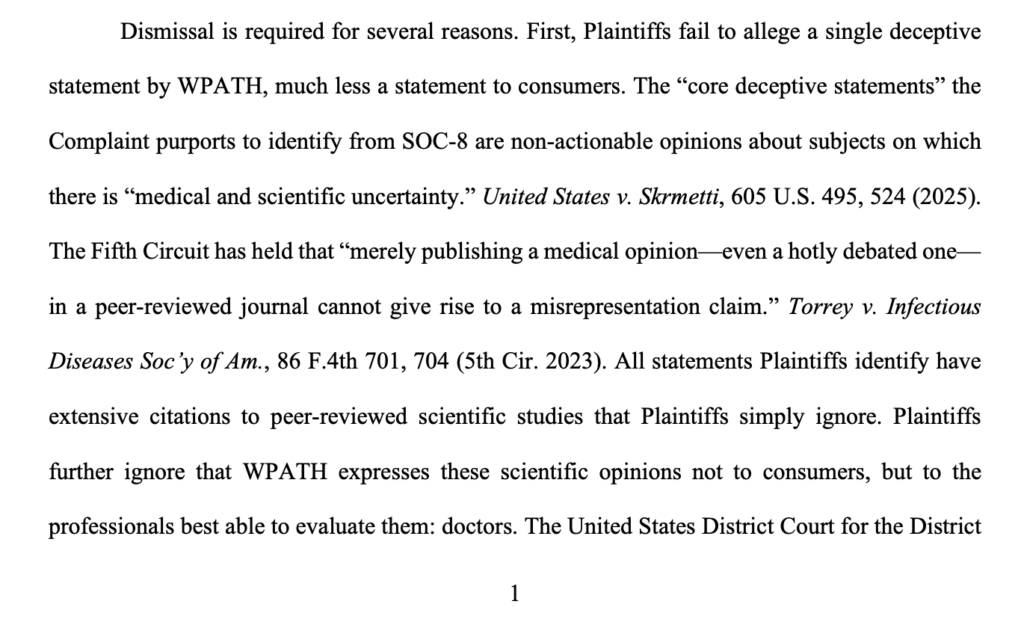
Look, this is an evolving field, there’s a bunch of uncertainty and debate, so we just give doctors one set of suggestions that they can evaluate if they want to. We’re just offering some opinions. In this excerpt from the brief, SOC-8 is a reference to the eighth adopted version of WPATH’s standard of care:
SOC-8 rejects a “‘one-size-fits-all’ approach” and states that individual transgender patients “may need to undergo all, some, or none of these interventions” depending on their unique circumstances. SOC-8’s “guidelines” are intended to be “flexible,” and SOC-8 explicitly encourages physicians to “modify” them in response to a patient’s “unique anatomic, social, or psychological situation.”
It’s all flexible and unique, and there’s no one standard. We offer a list of stuff that you can take or leave, like a buffet that lets you take the meatballs but skip the halibut.
This is exactly the opposite of the way WPATH standards have been used.
Consider this an important inflection point in the shamefully stupid descent into trans madness: Regulators are using WPATH standards as a set of absolutely certain and inflexible scientific rules at the exact moment that WPATH is shrugging and calling the whole thing a highly debatable guess.
How long will they get away with it?