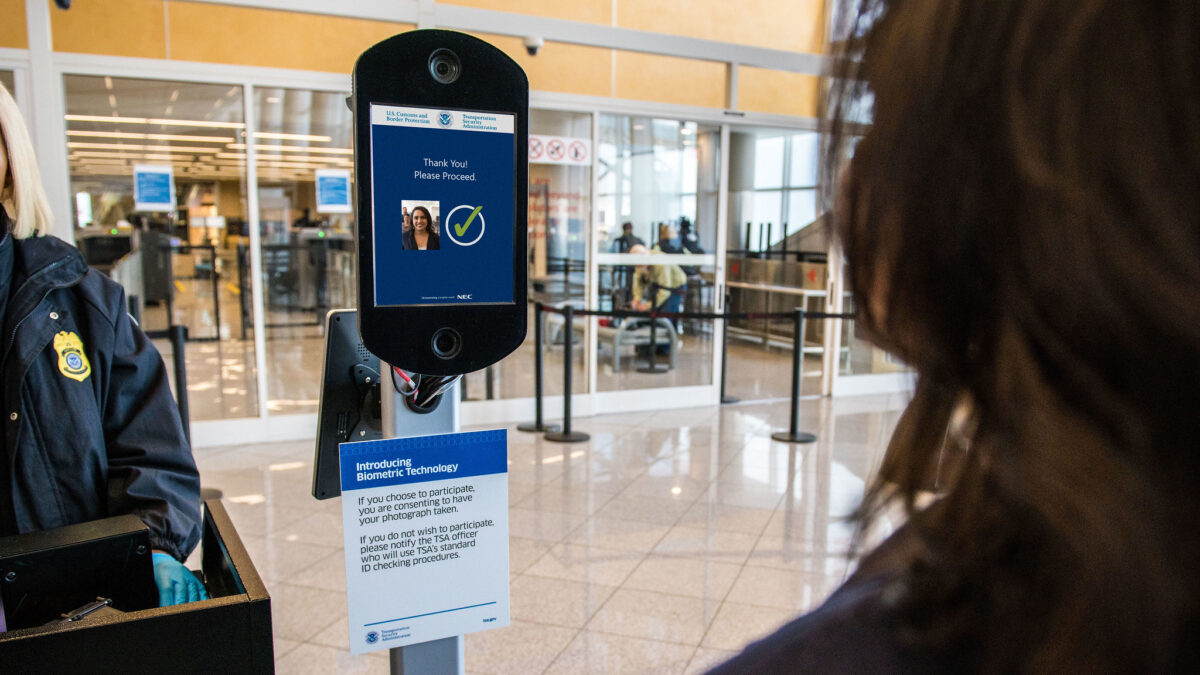

As we approach the 25th anniversary of the 9/11 Islamic terrorist attacks, Americans are still taking their shoes off, throwing out water bottles, and undergoing full-body scans before boarding an airplane. It’s all part of the security protocols Washington established after 19 Muslim terrorists came to the country, hijacked four planes, and murdered nearly 3,000 people.
And while the government changed the way Americans travel in response to the 9/11 attacks, it refused to do the one thing that would have prevented the terrorist attack (and many future ones) in the first place: stop letting in Third World foreigners.
If there was one obvious lesson from 9/11, it was that immigration is a national security threat and admitting people from Third World countries where there is instability, hostility, and anti-American sentiment carries risks that no airport scanner can fix.
In fact, the Staff Report of the National Commission on Terrorist Attacks Upon the United States warned that “border security still is not considered a cornerstone of national security policy” even after the attacks. (Notably, the commission’s final report acknowledged that “in the decade before September 11, 2001, border security — encompassing travel, entry, and immigration — was not seen as a national security matter.”)
Yet, instead of stopping immigration from those parts of the world, Washington decided to do the opposite and actually continue to import more immigrants from those areas, which highlights the problem with the government’s response to 9/11. We may take away water bottles, bolt cockpit doors, and make Americans prove they’re harmless before flying, but we did little when it came to a key culprit: immigration from countries and cultures that produce a disproportionate amount of national-security threats.
This response is what resulted in many post-9/11 terrorist attacks. Take the Boston Marathon bombers, who were brought to the country as children. Their father applied for asylum upon arrival through a tourist visa before other family members arrived. Tamerlan and Dzhokhar Tsarnaev both became lawful permanent residents, and Dzhokhar became a citizen just seven months before the attack. On April 15, 2013, the duo set off bombs at the Boston Marathon, murdering Krystle Campbell, Lingzi Lu, and Martin Richard — an 8-year-old. The brothers later murdered Officer Sean Collier during the manhunt. These brothers repaid America’s generosity in giving the Tsarnaev family refuge by murdering Americans and attacking the very country that foolishly welcomed them.
Then there was the San Bernardino terrorist Tashfeen Malik, who came to the country on a K-1 fiancée visa. Malik, a Pakistani national, had lived “most of her life in Saudi Arabia” before meeting Syed Rizwan Farook (an American citizen). Malik got a K-1 visa, came to the country in 2014, married Farook, and had permanent resident status. A little more than a year later, Malik and Farook showed up to a holiday party for Farook’s colleagues and opened fire. They murdered 14 people and injured 22 others. Once again, a legal immigration pathway admitted a future terrorist. The fact that Malik apparently had no disqualifying problems before entry shows the limits of merely having “better vetting” without limiting immigration itself.
Or take the Pensacola naval base shooter Second Lt. Mohammed Saeed Alshamrani, who was a Saudi military trainee admitted to the United States to get military training. On Dec. 6, 2019, he opened fire in a classroom at the base and murdered three American sailors while injuring eight others. Investigators later determined Alshamrani was radicalized in 2015 (prior to arriving in the United States) and had been in talks with Al Qaeda. According to the Justice Department, Alshamrani was in talks with Al Qaeda until the night before he attacked.
These attackers entered the country through various channels — which is precisely the point. The Tsarnaev brothers came through their parents (who sought asylum), Malik came through a fiancée visa, and Alshamrani came through a military-training program. Even after 9/11, our government continued operating under the assumption that foreigners should generally be allowed in unless we can prove in advance that these immigrants posed a threat.
But vetting only tells us past history (and even then, we missed past histories). It doesn’t detect beliefs, the likelihood of future radicalization, or hidden loyalties. The more we admit foreigners from societies in which radical Islam is prevalent, the more we risk death and terror attacks.
Of course there have been attackers who were born here, but that still doesn’t change the calculus. Take Orlando Pulse nightclub shooter Omar Mateen and Fort Hood shooter Nidal Hasan. Both were born here, but our soil is not magic. Mateen’s father, Seddique Mateen, for example posted videos expressing “gratitude toward the Afghan Taliban” and referring to them as “our warrior brothers,” according to The Washington Post. The New York Post reported that Seddique Mateen “hosted an anti-American talk show” while in the United States as well. Hasan’s Palestinian parents may not have been radical, but reports indicate Hasan became more extremist in his religious beliefs following their deaths. If becoming more religious leads you to commit terrorist attacks against America, then that religion should raise a red flag when it comes to immigration.
Regardless, in both instances, the earlier migration of their families — who came from places hostile to the West — was the problem, but it’s a problem that could be mitigated and prevented.
Immigration exists solely for the benefit of the American people. Foreign nationals have no inherent right to come here. And even if the overwhelming majority of immigrants don’t commit terrorism, we are not required to accept avoidable security risks to prove we’re tolerant when we can make changes to our immigration philosophy that stop us from importing people from countries and cultures that are simply incompatible. That starts with banning Third World migration. Maybe 25 years later, America can get it right.