


Cultural shifts sometimes happen in ways you can’t help but notice, like the sudden growth of transgender themes on television. But there are also a bunch of quiet maneuvers you don’t see, producing change through obscure bureaucratic procedures.
To begin your introduction to one of those little-noticed avenues of change, take a moment to read the Independent Medical Review (IMR) obtained by California health care regulators in 2025 on behalf of a biological male (in the record, a “transgender female”) who wanted his health insurance company to buy him a prosthetic “vagina”:
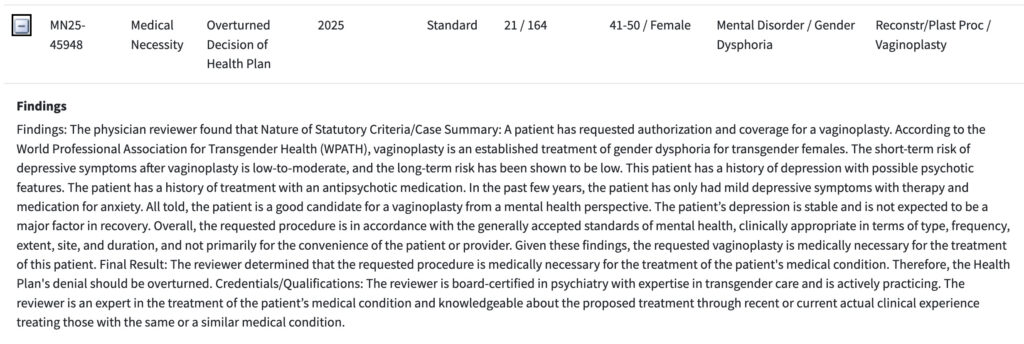
The transgender patient had a history of depression, “with possible psychotic features,” and was taking anti-psychotic medication when his insurer denied coverage for a surgically created artificial vagina. (Surgical neo-vaginas are created by penile inversion, or less frequently by cutting out a piece of the patient’s bowels and sewing it into a surgical hole between his legs.)
Appealing that decision, the potentially psychotic patient asked the California Department of Managed Health Care (DMHC), which regulates health insurance plans, to conduct a review in which an independent medical expert would decide if his surgery was medically necessary.
A finding on an IMR is binding. Insurers must cover procedures an “independent expert” finds “medically necessary.” As the state’s IMR request form says: “Health plans must follow the IMR decision and promptly provide the service.”
In this case, a psychiatrist reviewed the patient’s surgical request, with no review by a surgeon. The psychiatrist overturned the insurer’s refusal to pay. A male on anti-psychotic medications got a surgically implanted fake vagina, in a procedure covered by insurance, because a psychiatrist found the surgery to be medically necessary.
You can see these medical reviews for yourself. The DMHC maintains a searchable public database of IMR outcomes. Try searching with different terms to see how the results vary, like “dysphoria,” “gender identity,” and “transgender.” The results will look like this screenshot, and on the DMHC page you can click the plus sign on the left to read the details of each case:

In the single “upheld” decision above, with the case number ending in 46638, a patient sought “facial feminization surgery” and a hair transplant (“follicular unit transplantation”) to be performed at the same time.
The second reviewer in the case, a plastic surgeon, warned that doing both procedures during the same treatment session would require “both prone and supine positioning, which would unnecessarily prolong general anesthesia…but the technical concerns described above would not apply if the procedures were staged separately.” No concerns are noted from the first reviewer, a psychiatrist.
A biological male identifying as a transgender woman can get hair transplants through health insurance, because they’re cosmetic for a man but supposedly become medically necessary for a man who identifies as a woman, as long as the procedure isn’t combined with others. And insurers must cover medically necessary procedures.
Renee Chiea has worked in both of the worlds where these decisions are contested. A former DMHC employee, she left for a private health insurance company in 2011. In the first years she worked for an insurance company in California, she told The Federalist, insurers were almost entirely “denying everything” that transgender patients sought in order to change their appearance, rejecting those procedures as cosmetic and elective.
But state officials, Chiea says, wanted those procedures to be covered. Rather than serving as ideologically neutral regulators, she told The Federalist, they were “absolutely pushing the trans agenda 100 percent.” The IMR was one of their tools for forcing change.
“In the early days,” Chiea says, “there were a lot of discussions about boob jobs.” Men taking female hormones grow breasts, supposedly affirming their new identity as women, but trans patients were demanding bigger breasts. An absurd discussion took place inside health insurance companies: Is it medically necessary for a “trans woman” with a B-cup to receive D-cup breasts?
Other cosmetic procedures were repackaged as “gender-affirming.” Liposuction became a part of transgender “body contour surgery,” a “medically necessary” reconstructive procedure.
The process appears to have changed over time. Initially, Chiea says, DMHC asked surgeons alone to conduct IMRs for surgical procedures. Over time, though, Chiea saw more and more transgender IMRs being conducted by psychiatrists.
Surgical decisions were more likely to be made by mental health practitioners. Records appear to support the claim, as the importance of psychiatrists in transgender IMRs is easy to see in the outcome reports listed on the state website.
As Chiea saw it from her position inside a health insurance company, IMRs for transgender patients conducted by psychiatrists became easier for patients to win and insurers to lose. Then the insurers became more likely to just approve coverage of transgender medical procedures, knowing that the IMR process was likely to go poorly for them. At least in part, a cultural change – the increasing prevalence of transgender identity that’s socially affirmed by medical and surgical procedures – happened in and through a little-noticed bureaucratic procedure.
As part of the background behind changes in the IMR, you can see what California regulators were thinking about transgender medical procedures by reading their “All-Plan Letters,” or APLs. To use just one of several available examples: APL 16-013, dated October 6, 2016, directs all managed care health plans (MCPs) to use nationally recognized medical standards to determine what transgender procedures to cover. The letter offers a single example to illustrate the point: the standards of care established by the activist pro-trans organization WPATH.
As the letter adds, “Nationally recognized medical experts in the field of transgender health care have identified the following core services in treating gender dysphoria: behavioral health services; psychotherapy; hormone therapy; and a variety of surgical procedures that bring primary and secondary gender characteristics into conformity with the individual’s identified gender.”
Chiea describes the imposition of standards by regulators applying WPATH guidance as “sub-regulatory pressure,” not imposed through law or a formal administrative rules-making process but rather through bureaucratic wishcasting: Everybody has to do what WPATH says, because we sent you a letter that says we want you to.
Not surprisingly, state regulators dispute Chiea’s description. Kevin Durawa, a senior media officer at DMHC, told The Federalist that the IMR process simply meets a federal requirement: “States are required by federal law to have an independent external review process of health plan denials and California meets this requirement through the Independent Medical Review (IMR) program.”
Durawa also sent these search results to dispute the claim that the IMR process is rigged to favor transgender patients, although Chiea noted that the use of a ten-year time span makes it impossible to assess change over time using these numbers:
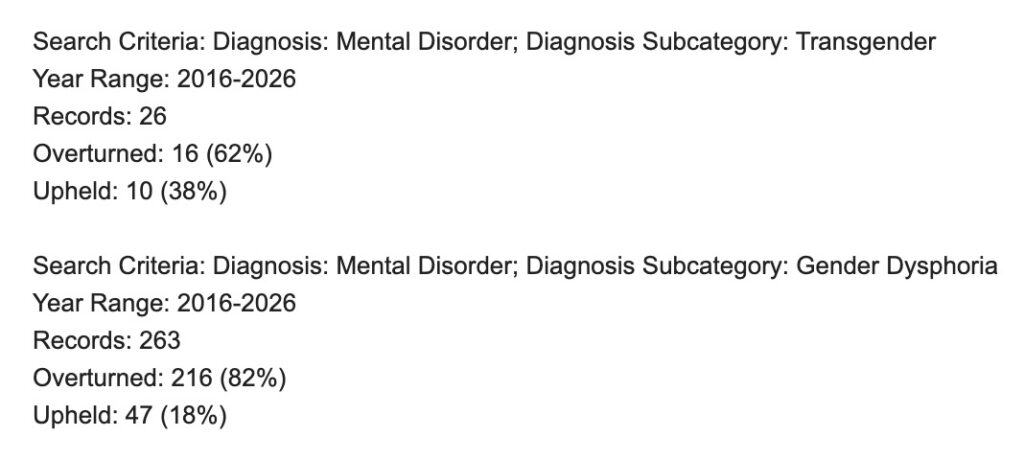
In any case, the statistics provided to The Federalist by California regulators show that a considerable majority of insurer decisions to deny coverage for transgender medical procedures have been overturned through the IMR process.
Similarly disputing Chiea’s description, a psychiatrist who has participated in significant numbers of IMRs for transgender patients in California says he has become more likely to uphold insurance company denials over time as those companies have become more careful about applying California-compliant standards to their decisions. Upheld insurance denials, Dr. Dan Karasic told The Federalist, “now make up a large share of my reviews.”
Although he’s been praised as an activist, Karasic rejects that description. “Just because I believe that appropriate transgender care can be beneficial, does not mean that I am unable to use my expertise to determine whether criteria of medical necessity have been met,” Karasic told The Federalist. “Any determination must be supported by a literature review and citations. My reviews are overseen by an independent company and its medical director.”
In California today, a transgendered surgical patient has a new “vagina” to go with a prescription for anti-psychotic medications. However the details may be contested, the IMR process delivered that outcome.