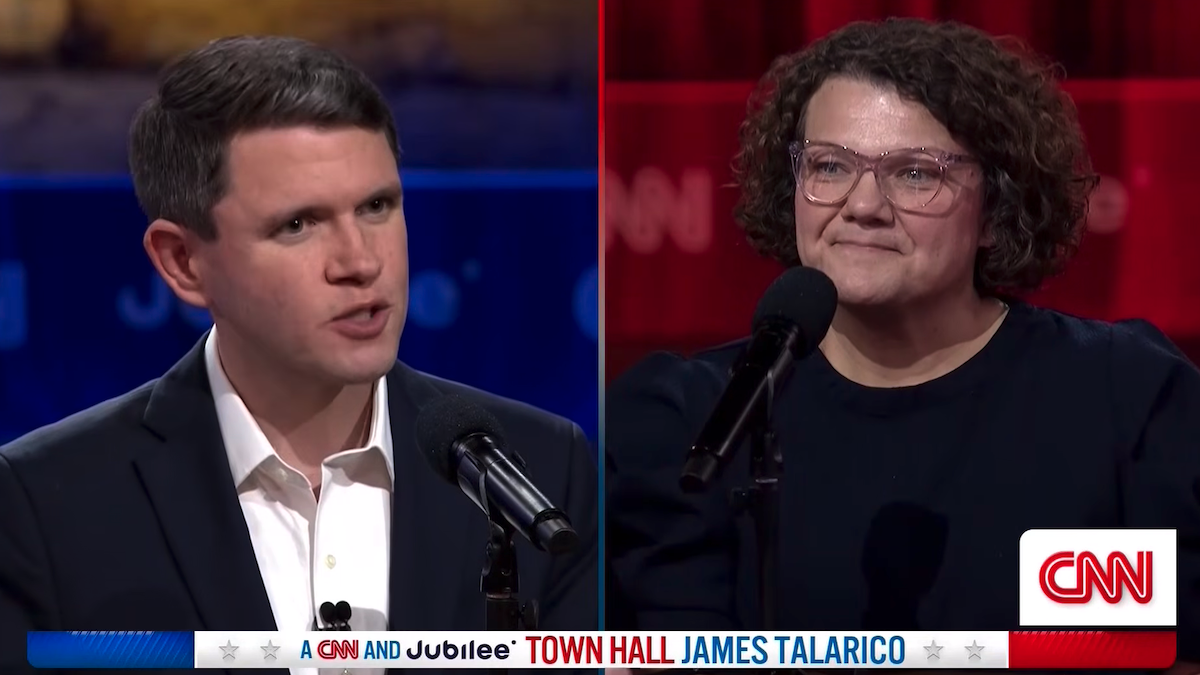

David French was never conservative.
He is currently a Kamala Harris voter who left his church in a huff, supports same-sex marriage, and earns a living by bashing Christian conservatives for The New York Times. Nonetheless, he claims to be conservative, and even many of his critics on the Right would grant that he was once one of us.
However, one of his recent columns illuminates that he was never really a conservative. While critiquing Vice President J.D. Vance, French explained what he thinks conservatism means — and there is nothing conservative about it. Rather, it is a libertarian-infused variety of secular liberalism; though French eschews the label of “libertarian,” he nonetheless describes himself as “libertarianish.”
It shows in his rhetoric, which proclaimed that “there is no one innately better qualified than you to decide your own destiny,” and “Unless I harm someone else, it’s not the government’s job to determine whether I’m virtuous enough to enjoy liberty, including economic liberty.” In French’s view, conservatism is not about conserving, but about expanding personal freedom. He claimed that before Trump the “standard conservative understanding of the American experiment” was that the “role of conservatives was often to nudge (and sometimes try to shove) our nation in the direction of more freedom and more choice.”
In this view government must avoid judging between different visions of the good, true, and beautiful, for it is not competent to do so, let alone push people toward the right way to live. People must figure out virtue and the good life without the government nudging, let alone shoving, them toward it. Government should be neutral on such matters and instead focus on protecting everyone’s liberty, which is done by protecting everyone’s rights.
French argued that, in contrast, the vice president is eager to throw liberty under the bus to advance a more sectarian vision: “If liberty conflicts with Vance’s view of the common good. … Then, liberty must give way. We see this impulse everywhere on the New Right. Free speech is a vital American value, until it’s exercised by drag queens.” French is apparently still irate over being criticized for asserting that it is “one of the blessings of liberty” that “a person can get a room in a library and hold a Drag Queen Story Hour and get people to come.” But his attempts to vindicate his old comments only further reveal his failure to understand what conservatism is.
After all, no one at the time of the ratification of the Constitution, or when relevant amendments were added, thought that they protected a right to anything like drag queen story hours. Americans at those times, and indeed for nearly all of our history, were comfortable with government legislating some moral views — from blue laws to sodomy bans — and would have prohibited drag queen story hours as indecent and obscene if anyone had attempted to hold them.
Unlike French, conservatives know that government will always impose some morality, because that is what law is. Government always comes with at least a partial vision of the good, true, and beautiful; it is always choosing between good and evil, truth and lies. Moral neutrality is impossible even for a small, limited government, let alone one as large as ours has grown. For example, education can never really be value- and viewpoint-neutral; the point of education is not just to impart discrete facts, but to form character and to impart a view of the world. That there may still be a broad tolerance for various viewpoints does not mean that anything goes or that government has to pretend that all views are equally valid.
Furthermore, the rights that French emphasizes are not neutral. Rather, they are historically and culturally conditioned, and come with assumptions and implications about what is, and is not, good, true, and beautiful. French ought to know this; he has often touted his military service in Iraq, and one of the most important lessons of that occupation is that Americanism cannot be transplanted into an alien soil. It is not enough to kick the dictator out and declare a new pluralistic democracy that recognizes everyone’s rights.
Our form of government has many cultural prerequisites. It also depends on a high standard of character from its citizens as well as its politicians. French likes to harp on the importance of character, especially when bashing President Trump and his supporters. But the importance of character is, as conservatives have long pointed out, why the sort of value-neutral liberalism French endorses is incapable of sustaining itself.
This is the real issue, and French does not address it. He sneered at anyone from the Trump administration touting the importance of moral character and mocked the supposed moral rectitude of years gone by, but he never substantively addressed Vance’s claim that the American system will not work without citizens possessed of the right culture and ethos, and that the government therefore has a legitimate interest in cultivating them.
Yet the vice president is obviously correct about this. Though the government should often be cautious and restrained, that does not mean strict neutrality about what is good and true and what is not. Indeed, such neutrality is utterly alien to the history of American culture and law. That we do not have a state church does not mean that the government must pretend that there is no difference between a man and a woman, a baptism and a drag show, or God and Satan.
The government has a legitimate interest in the character and culture of its citizens. Or, more precisely, the citizens of a democratic republic, acting through their elected representatives and appointed officials, do not have to be neutral about these matters. And an ostensibly conservative pundit, especially one at a prominent outlet such as The New York Times, ought to know there is nothing conservative about a value-neutral maximization of individual choice and autonomy.
The charitable explanation may be that French is just out of his depth. After all, he began in the conservative movement as a campus free speech and religious liberty litigator. He had to use arguments that would secure wins for his clients, and at the time those arguments tended to be libertarian readings of liberal precedents. French spent years trying to get liberals to agree to allow Christian conservatives the same rights that they were giving flag burners and pornographers.
This was good and necessary work, but French’s reasoning was tailored to a particular set of cases and circumstances. Though this won some court cases, it was not conservative in its principles — it was just a makeshift shield for a defensive-crouch Christian conservatism. But French took these sorts of “libertarianish” arguments and put them at the heart of his ersatz conservatism as he shifted into punditry.
Now the tumult on the right over the last decade has left French intellectually adrift and confused. He wants to insist that he is the last true conservative — he didn’t leave the right, the right left him. But the more he tries to act as the arbiter of conservatism, the clearer it is that he never understood what American conservatism is trying to preserve.