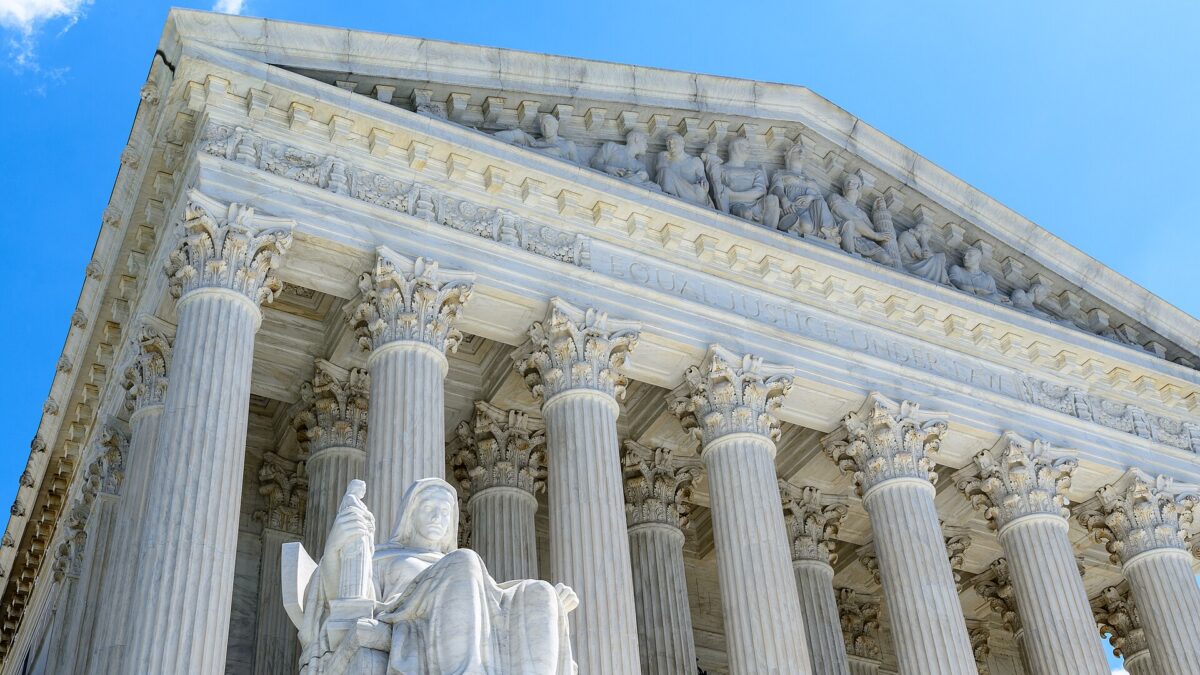

The phenomenon of rogue judges ignoring the Constitution and the Supreme Court in favor of partisan outcomes is growing every day. And it looks like Justices Clarence Thomas and Samuel Alito have taken notice.
Across a pair of decisions issued Thursday (both authored by Alito), the two senior justices separately rebuked several lower courts for sidestepping immigration law and the high court’s past rulings. The cases were Mullin v. Doe and Mullin v. Al Otro Lado, in which the court upheld President Trump’s revocation of Temporary Protected Status for foreign nationals and affirmed that asylum seekers do not “arriv[e] in the United States” when they’re standing on the Mexican side of the border, respectively.
In his Al Otro Lado concurrence, Thomas noted how the federal immigration law at issue (“Immigration and Nationality Act”) bars federal courts from having jurisdiction over and the authority to “‘enjoin or restrain the operation of ‘ certain parts of the INA.” Citing a past related SCOTUS ruling (Garland v. Aleman Gonzalez), he further highlighted how the law’s exception “only for relief granted on an individual basis” takes away lower courts’ “‘jurisdiction or authority’ to ‘enjoin or restrain the operation of ’” these parts of the INA on a classwide basis.”
Put another, lower courts cannot certify a class of individuals and then issue an injunction covering those individuals under these provisions of the INA.
Thomas noted how the challengers in Al Otro Lado nevertheless “sought relief” that the statute explicitly “prohibits.” What’s more, he added, is that the district court granted their request to certify a “proposed class of ‘”all noncitizens who seek or will seek to access the U.S. asylum process by presenting themselves”‘ at a port of entry at the U. S. Mexico border and who ‘”were or will be denied access to the U.S. asylum process by or at the instruction of “‘ border officials.”
“The District Court acknowledged that our interpretation of §1252(f )(1) in Aleman Gonzalez barred this relief … Nonetheless, the District Court effectively gave Respondents all that they asked for in the form of nominally declaratory relief,” Thomas wrote. “In a future case, this Court should address this apparent end-run around §1252(f )(1) and Aleman Gonzalez. I am skeptical that the relief that the District Court ordered complies with §1252(f )(1).”
The current court’s longest-serving justice further argued that “the relief that the District Court provided may well have unconstitutionally infringed on the President’s inherent authority to exclude aliens from the country.”
Meanwhile, Alito’s critique of rogue lower courts and their indulgence of leftists’ judicial coup against the president was much more subtle.
In Doe, the Bush 43 appointee detailed how several TPS designations for some foreign countries have been permitted to continue for several decades, while others have not. In an apparent indirect reference to the wave of lawfare waged against the Trump administration, he noted in a footnote how Presidents Clinton, Bush (43), and Obama all “terminated some TPS designations much more promptly” but that “[n]one of these terminations were challenged in court.”
“Legal challenges to [President Trump’s] decisions,” however, “began almost immediately,” Alito wrote.
Alito went on to note how the Trump administration previously asked SCOTUS to pause lower court injunctions barring Trump from ending TPS for Venezuelan nationals in the United States last year. As noted by the justice and previously reported by The Federalist, the high court granted those requests on two separate occasions.
“Nevertheless,” Alito wrote, “lower courts, including those in the cases now before us, have continued to block the Secretary’s attempted terminations of other TPS designations.”
The decisions weren’t the first in which some of the justices have rebuked lower courts for refusing to stay in their lane.
In an interim docket case last year, Justice Neil Gorsuch (joined by Justice Brett Kavanaugh) blasted lower court judges for disregarding the Supreme Court’s guidance on issues before the bench — which he noted has become a recurring pattern throughout the judiciary.
“All these interventions should have been unnecessary, but together they underscore a basic tenet of our judicial system: Whatever their own views, judges are duty-bound to respect ‘the hierarchy of the federal court system created by the Constitution and Congress,’” Gorsuch wrote.