

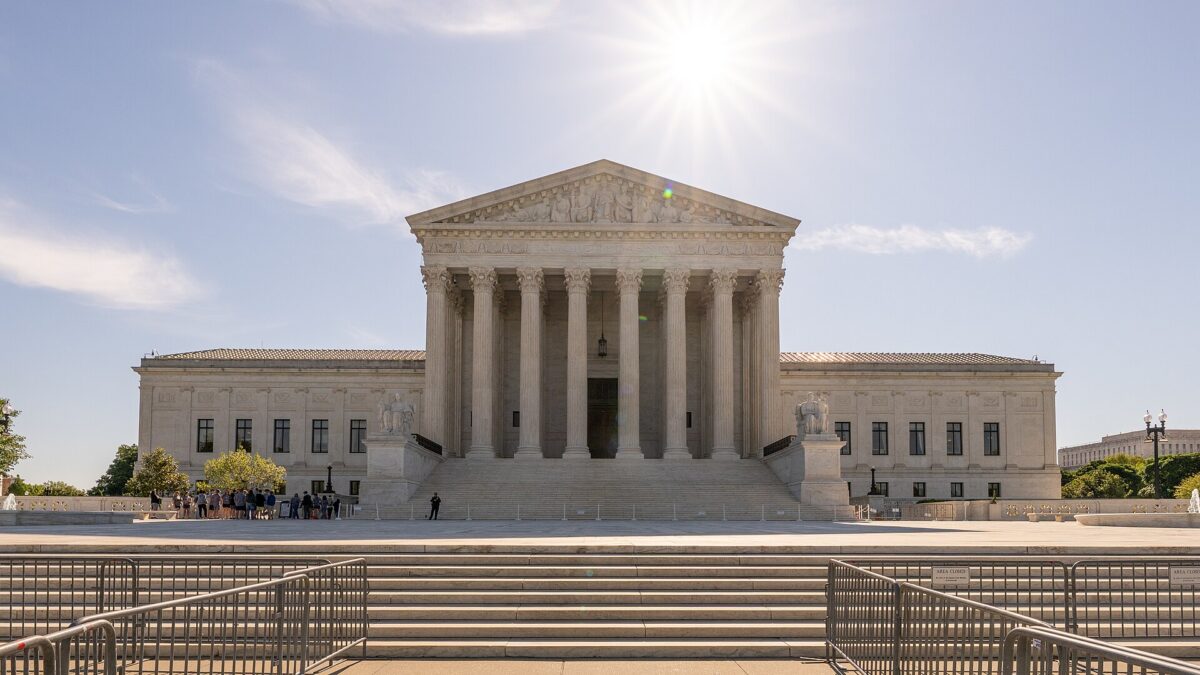
The U.S. Supreme Court sided with the Trump administration on Thursday in a dispute over an immigration policy critical to combating migrant surges at America’s southern border. The decision was 6-3, with Justices Sonia Sotomayor, Elena Kagan, and Ketanji Brown Jackson in the dissent.
Known as Mullin v. Al Otro Lado, the case centers around a previously used border policy called “metering,” which involves U.S. immigration officials turning away asylum seekers before they reach the U.S.-Mexico border. The left-wing Alt Otro Lado and a group of asylum seekers challenged the policy under the Immigration and Nationality Act, which authorizes an individual who “arrives in the United States” to apply for asylum status and undergo examination by U.S. border officials.
The appellate court sided with the challengers by ruling that “arrives in the United States” applies to asylum seekers encountering border officials on either side of the border — including those stopped in Mexico.
Writing for the majority, Justice Samuel Alito ruled that an illegal alien does not, in fact, “arriv[e] in the United States” “when he or she is still in Mexico.” The 9th Circuit’s decision to the contrary, he wrote, “is wrong.”
“In ordinary speech, no one would say that a person ‘arrives in’ a place — for example, a house, a city, or a country — before the person enters that place,” Alito wrote. “The context in which the phrase ‘arrives in the United States’ is used in the immigration statutes at issue here supports an ordinary-meaning reading. So does the presumption against extraterritoriality. We therefore reverse.”
Writing for the principal dissent, Sotomayor accused the majority of “ignor[ing] the statutory context and history, not to mention the longstanding position of the Executive Branch.” Taken together, she argued, “show that any noncitizen arriving at our doorstep and seeking admission must be inspected and allowed to apply for asylum, regardless of whether her foot has crossed the threshold.”
While agreeing with Sotomayor’s opinion in full, Jackson authored a solo dissent arguing that SCOTUS never should have taken up the case to begin with. She claimed that it has “potential mootness problems and [lacks] a factual record establishing how metering works in practice.”
In addition to joining Alito’s opinion, Justice Clarence Thomas authored his own concurrence underscoring “two further problems” with the district court’s ruling on the matter. He argued that the lower court “appeared to effectively grant the classwide injunctive relief that Congress has prohibited in this context,” and that the relief it provided “may well have unconstitutionally infringed on the President’s inherent authority to exclude aliens from the country.”
The high court’s decision reverses the 9th Circuit’s ruling and remands the case back to the lower court for further proceedings consistent with the majority decision.






.jpg)