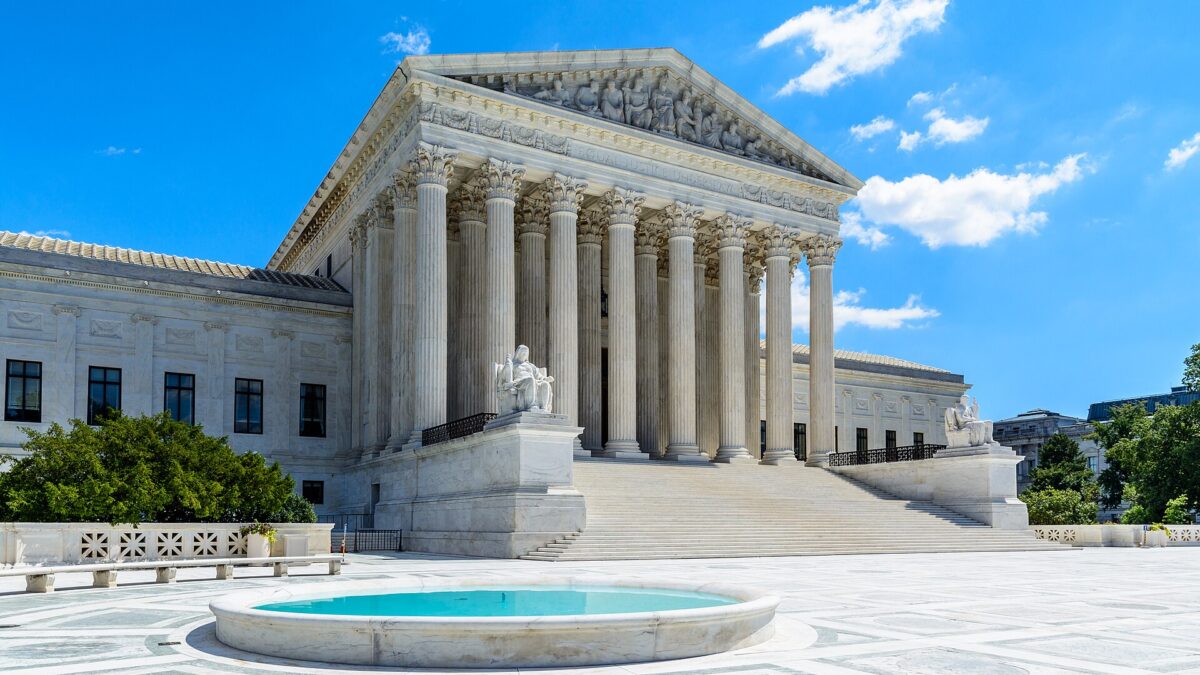

Democrats far and wide quickly revived their efforts to pack the U.S. Supreme Court with left-wing activists shortly after the court handed down its ruling smacking down race-based redistricting. But is that a policy the party’s most vulnerable representatives support heading into the 2026 midterms?
From former Vice President Kamala Harris to House Minority Leader Hakeem Jeffries, the party’s most vocal partisans have not been shy about indicating their desire to increase the number of justices on the court upon retaking power. While often pretending otherwise, the obvious goal of this strategy is to add enough new members to give Democrats favorable decisions in cases before the bench.
To combat these sinister efforts, Republicans have introduced a constitutional amendment proposal (HJR 1) that would require SCOTUS to “be composed of nine justices.” The measure recently passed the House Judiciary Committee in a party-line vote and is expected to be considered by the full House in the near future.
While amending the Constitution is easier said than done, the hope among the amendment’s backers is that, if enough vulnerable Democrats support it, it could help dissuade a future Democrat Congress from wasting energy on court-packing if they know they don’t have the numbers to pass it.
As such, The Federalist reached out to 16 House Democrats in competitive districts to see where they stand on their party’s efforts to pack the Supreme Court and whether they will support HJR 1 when it comes to the House floor. As of this article’s publication, only one of them responded.
In a statement to The Federalist, Texas Rep. Henry Cuellar said that he does “not support increasing the number of justices on the U.S. Supreme Court,” and “believe[s] the Supreme Court should remain at nine justices, as it has for more than 150 years.”
“Maintaining a nine-member Court helps preserve stability and public confidence in one of our nation’s most important institutions,” Cuellar said.
Cuellar did not say how he will vote on HJR 1 when it comes to the House floor, however.
Meanwhile, Democrat Reps. Adam Gray of California; Darren Soto, Kathy Castor, and Jared Evan Moskowitz of Florida; Kristen McDonald Rivet of Michigan; Susie Lee of Nevada; Gabriel Vasquez of New Mexico; Tom Suozzi, Laura Gillen, and Josh Riley of New York; Donald Davis of North Carolina; Greg Landsman and Marcy Kaptur of Ohio; Vicente Gonzalez Jr. of Texas; and Marie Gluesenkamp Perez of Washington did not respond to The Federalist’s request for comment.
While not answering The Federalist’s query, Suozzi stated in a 2021 Fox News interview, “I don’t like the idea of increasing the size of the Supreme Court. I never have.” Whether he maintains that stance and will support HJR 1 to keep the high court at nine justices is unknown.
Some of these members have thrown their support behind other measures seemingly introduced as a result of Democrat dissatisfaction with the Supreme Court’s constitutional rulings.
Both Riley and Landsman have sponsored legislation that would impose 18-year term limits on Supreme Court justices — a policy taken from a bill spearheaded by Rep. Hank Johnson, D-Ga., a court-packing advocate. Landsman more recently introduced a measure seeking to ban SCOTUS justices, their staff, and other federal officials from partaking in prediction markets and stock trading.
Soto similarly co-sponsored legislation during the 116th Congress (2019-2020) that would impose term limits on Supreme Court justices.
Many of these Democrats notably lashed out at the Supreme Court’s conservative majority following the overturning of Roe v. Wade. Castor claimed in a 2022 press release that the court’s decision was “ripping away our rights and freedoms,” is “un-American,” and “downright dangerous.” She continued her rant by saying, “Today is a dark day in our nation’s history,” and “[the court’s] decision will be devastating for Floridians, especially our neighbors of color.”
Nevada’s Lee has also joined in on the left’s online tirade against the court’s Dobbs ruling. On the four-year anniversary of the decision last month, she tweeted, “Extremists in all branches of government are slowly stripping away access to basic, lifesaving health care. … I’ll continue to fight these extremists and protect women’s right[s] to make their own medical decisions” (emphasis added).
Meanwhile, Soto openly called for Congress to “retake our authority aggressively” when the Supreme Court temporarily ruled that the president can remove Federal Trade Commission (FTC) commissioners at will last year. The high court recently upheld that decision on the merits in its landmark Trump v. Slaughter ruling.
“With this FTC termination decision, the US Supreme Court adds to Trump’s imperial presidency AGAIN,” Soto tweeted in September 2025.
Moskowitz whined about the Supreme Court’s 2024 Garland v. Cargill ruling that struck down the regulatory ban on bump stocks, which absorb shock when shooting rifles to increase the rate of fire. The Florida Democrat claimed in an X post that the “Supreme Court Justices [Trump] appointed are radically and dangerously wrong.”
When Trump moved to replace deceased Justice Ruth Bader Ginsburg with Amy Coney Barrett in 2020, Kaptur issued a press release claiming the Supreme Court’s recent decisions are “deeply out of touch … with public opinion.” She further proclaimed that, with Barrett’s confirmation, issues like abortion and “LGBTQ+ rights” have “never been more threatened than they are now.”
The Ohio Democrat also espoused support for then-presidential candidate Joe Biden’s call to create a commission to study “how to reform the court system.”
Gillen fearmongered in a press release last month that the Supreme Court put “our friends and neighbors’ lives at risk” after its “cruel and harmful decision” in Mullin v. Doe. In its 6-3 ruling along ideological lines, the court ruled that the president has the authority to end the Temporary Protected Status for hundreds of thousands of foreign nationals residing in the United States under the program.