“I ignored the written description of filtering the other night,” Molly Gaston messaged her fellow federal prosecutor, J.P. Cooney, in the early days of the post-2020 election targeting of President Donald Trump, documents obtained exclusively by The Federalist reveal. “Me too,” Cooney replied, showing that two of the attorneys whom Jack Smith would later choose to lead the special counsel team disregarded rules when judged “not tenable.” And additional documents whistleblowers provided Sen. Chuck Grassley, R-Iowa, confirm the special counsel office ignored the protocol established to protect privileged documents.
Monday afternoon, in advance of Jack Smith’s Tuesday testimony before the Senate Judiciary Committee, The Federalist is publishing a cache of documents it obtained exclusively from Grassley, in advance of their public release. These new documents provide further evidence that the Biden Administration and Special Counsel Jack Smith weaponized the Justice Department.
The first incriminating document consists of what a representative from Grassley’s office confirmed included text exchanges between two prosecutors in the D.C. U.S. attorney’s office from February of 2021. Those communications came soon after Biden’s inauguration and while Tim Thibault remained a key player pushing for an investigation into Trump.
Cooney opened the relevant exchange by asking Gaston “how confusing/bad was the filter guidance? I’m sitting in another call, but am getting pinged that it is a bit of a cluster.”
The referenced “filter guidance” concerned the DOJ’s directions to prosecutors and agents for the handling of documents being reviewed as part of their investigation, where the materials included — or potentially included — privileged materials, such as communications with an attorney. To properly protect privileged communications, when documents may include privileged material, the DOJ requires those documents to be sequestered from the investigative and prosecuting team, with a “filter” or “taint” team reviewing the documents to redact or withhold any protected communications from prosecutors.
The documents provided The Federalist indicate that during the initial stages of the Arctic Frost investigation, the FBI and prosecutors operating out of the D.C. office did not use a taint team, and instead had “filter guidance” telling them how to handle privileged communications. According to Gaston, the guidance “basically said, if you come across potentially privileged material (without defining), stop and freeze.”
In her text to Cooney, Gaston admits she “ignored the written description of filtering the other night,” explaining it is “not tenable.”
“Me too,” Cooney responded showing he also disregarded the directions for handling potentially privileged materials.
While Cooney told Gaston that someone named “Liz” was working on fixing the process — something he called a “cluster” — it is unclear when or how the pre-Smith Arctic Frost team filtered evidence in the early stages of the investigation. However, one slide from a presentation included in the documents suggests the ad hoc filtering continued for nearly a year-and-a-half, with the presentation materials stating “[o]ver 50 Department of Justice Personnel (DOJ and FBI) have participated in the Filter Team Since June 2022,” and noting the first document was coded on “June 17, 2022.”
That Cooney and Gaston initially ignored the filter guidance and then apparently took more than a year to establish a filter team contrasts sharply with the norm in the D.C. U.S. attorney and FBI field offices, as documents provided by whistleblowers and released today show. Those emails capture the seriousness and care the DOJ normally exercises to protect constitutional privileges, with some of the key players in investigating Trump involved in those email exchanges — showing they knew full well the importance of using a taint team and not viewing unfiltered documents.
For instance, an email exchange from late October 2021 between Cooney and Tim Thibault — the agent who opened the Arctic Frost investigation — discussed the Washington Field Office’s plan for handling evidence, including providing additional agents “should a filter team be necessary.” Other emails exchanged with Thibault stressed the need for investigative teams not to “discuss anything related to filter,” as well as the problems caused when an agent in another case delayed a taint review.
An email thread from late January 2022, also documented DOJ folks “redoing” a scrub to ensure they pulled all privileged material.” That email thread noted that it might take “as much as 60 days” for a full scrub but that an employee in the meantime would be able to help prosecutors “access the case file in ways that will keep them out of anything they shouldn’t see in the interim …” And, significantly, an assistant U.S. attorney forwarded that thread to Tim Thibault, who was entrenched in Arctic Frost until August 2022, when he was removed from the team after Sens. Grassley and Ron Johnson, R-Wis., highlighted Thibault’s “social media postings, comments, and ‘likes’” which “demonstrate[d] a pattern of improper commentary related to, for example, ongoing FBI investigations including those under his purview.”
Likewise, Cooney and Gaston appeared on other emails involving filter teams, with Cooney in one stating “[w]e now have records that we are going to need to put through a filter. We are meeting with the attorneys on our filter team tomorrow.” Gaston was copied on that email.
Another email thread from an assistant U.S. attorney further demonstrates the normal and proper approach to handling privileged communications, with that federal prosecutor noting that “[i]n looking through information from the electronic devices we noticed a text message chain on one of the devices that potentially may involve an attorney.” At that point, according to the AUSA, they “did not conduct any further review.” The email then told FBI agents and DOJ officials that two steps were required. Specifically:
No one should conduct any further review or analysis of any of the electronic devices. We are engaging with our filter review coordinator for getting a filter review assigned. Nothing should happen with the devices until that team has determined the scope of the issue and completed its work.
Find for us a filter agent or agents from FBI and HHS that are separate and apart from your squads. Please provide us those names as soon as possible so they can work with the filter AUSA on the matter. This is extremely time sensitive.
That note ended by asking the email recipients to “[p]lease confirm you have received this email and have stopped any review of the devices.”
Walter Giardina, who was heavily involved in the get-Trump enterprise, was also included in two other emails discussing another case and the proper filter protocol. In one of those emails, the FBI’s Washington Field Office made clear that interview notes and records could not be discussed or shared with the investigative team until they were filtered by DOJ-PIN and the DOJ-PIN filter attorney approved the release.
In contrast to the DOJ and FBI’s handling of potentially privileged material in other cases, in the investigation targeting Trump both Cooney and Gaston apparently ignored the filter guidance and analyzed materials without a taint team first clearing the documents. Further, even after the establishment of a taint team and protocol in June of 2022, and following Attorney General Merrick Garland’s appointment of Special Counsel Jack Smith, investigators failed to implement even the most basic filtering protocol.
Grassley exposed this reality in mid-July, when he released documents showing that in June of 2023 the Special Counsel’s Office subpoenaed text messages from the National Archives and Records Administration (NARA), for communications “from October 2020 through January 20, 2021, from phones associated with a long list of personnel serving in the White House during President Trump’s first term, including Trump himself …”
As the Iowa senator explained, on August 21, 2023, NARA provided the texts to one of Smith’s senior lawyers, Thomas Windom, and that within one hour “other members of Smith’s investigative team downloaded and began reviewing the texts. It appears the review was done without waiting for the Filter Team to evaluate and segregate privileged information.”
Not only did Smith’s team apparently not wait for a filter team to review the materials for attorney-client privilege, it appears that the special counsel’s team completely ignored the constitutional Speech or Debate Clause privilege members of Congress held, with no mention of the subpoenaed documents being review for protected legislative materials.
Grassley, the Chair of the Senate Judiciary Committee, told The Federalist that “[t]he filter review process is an essential investigative step that ensures privileged material is appropriately excluded from an investigation and doesn’t make its way into the hands of case agents and prosecutors.” Yet, as the Iowa senator stressed, the available records indicate “Jack Smith’s team failed to faithfully adhere to the filter process while investigating President Trump, allowing them to access the contents of text messages from me, Sen. Johnson and 42 other senators relating to our core constitutional duties. Their reckless disregard for constitutional parameters ought to concern everyone.”
Sen. Johnson, who has been investigating the weaponization of the DOJ and FBI in tandem with Grassley, agreed, telling The Federalist “[i]t is apparent now more than ever that Jack Smith has been blatantly dishonest. This kind of constitutional overreach should not be tolerated, especially not from a former Justice Department official.”
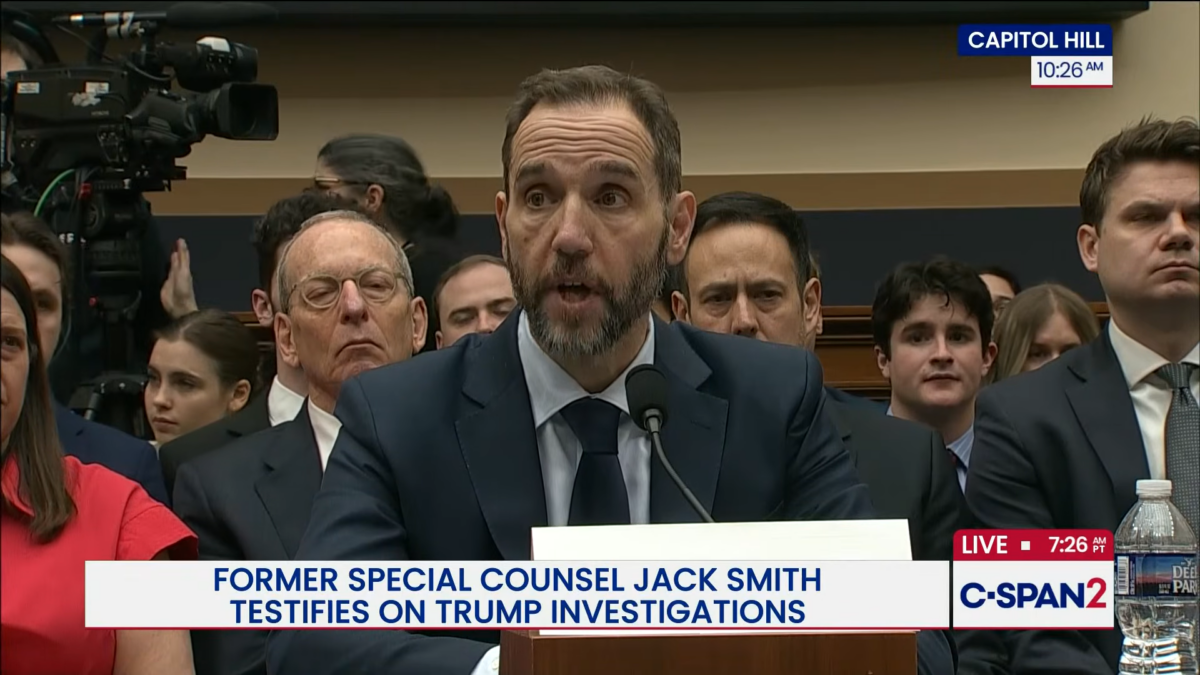
When Smith appears before the Senate Judiciary Committee on Tuesday, he should be pushed to explain why he failed to ensure his team adopted and applied proper filter protocols — something the D.C. U.S. attorney’s office did in other cases not involving Donald Trump.