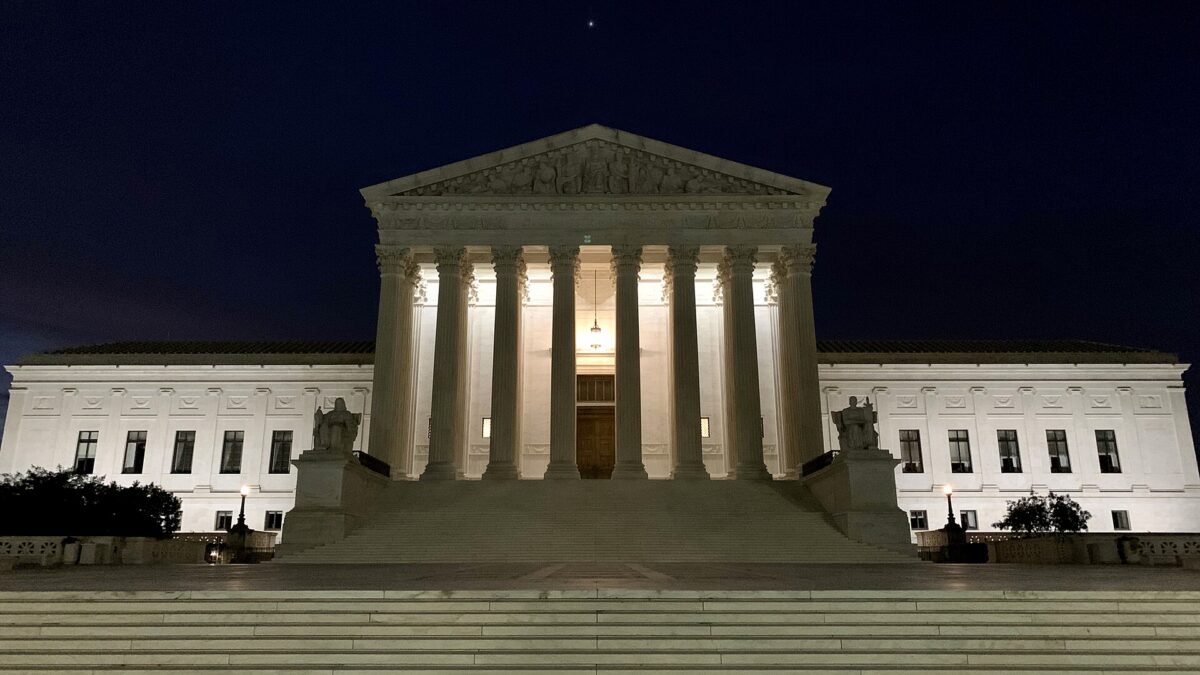

The U.S. Supreme Court blocked Missouri from using its GOP-backed 2025 congressional map for the upcoming midterm elections on Friday. There were no noted dissents.
In its per curiam opinion, the high court granted an emergency application to pause a recent ruling by Missouri-based Chief District Judge Stephen Clark. The Trump appointee issued a permanent injunction requiring the Show Me State to use the GOP-friendly map earlier this week at the direction of the 8th Circuit Court of Appeals.
The entire legal battle can be traced back to a Missouri Supreme Court decision that mandated state officials to use the state’s 2022 six Republican-two Democrat map instead of the seven Republican-one Democrat map enacted last year. The ruling also said that a statewide referendum on the new map — which was pushed by left-wing activists — must appear on Missouri’s 2026 fall ballot.
Clark issued a temporary restraining order days later in a federal challenge brought by several congressional candidates, mandating the Show Me State to use the 2025 map for the midterms. That ruling came moments after U.S. Supreme Court Justice Brett Kavanaugh rejected an emergency request by Missouri officials to pause the Missouri Supreme Court’s decision.
SCOTUS ultimately froze Clark’s TRO without explanation the following day, leaving the matter to be further litigated in the lower courts. The 8th Circuit subsequently issued a ruling on Monday directing Clark to issue a permanent injunction allowing the state to use the 2025 map in the midterms. The three-judge panel highlighted how some Missouri voters would be voting for a different slate of candidates in the general election than the ones they voted on in the primaries.
“Missouri cannot deprive more than 1.4 million of its residents of their choice in half of [the election] process without violating Article I, Section 2” of the U.S. Constitution, the appellate court ruled.
The Supreme Court noted in its Friday ruling how its Sept. 10 stay order “meant that the 2022 map would be used in the 2026 congressional election in Missouri, absent further order of this Court,” and that “the election has now begun under the 2022 map.” The justices further decried the 8th Circuit’s order to Clark to issue an injunction as being at odds with what the high court had previously ruled.
“Given this Court’s two prior orders in this litigation, our conclusion that this was error should come as no surprise,” the ruling reads.
The Supreme Court went on to say that — “putting [its] prior orders aside” — the traditional stay factors used by the justices to determine whether to grant emergency relief warrant pausing the lower courts’ orders.
On the merits, the high court pushed back on the 8th Circuit’s assertions that there were violations of Article I, Section 2 of the U.S. Constitution. The justices wrote that the court’s “precedents have not previously stated that Article I, Section 2 requires a state to use the primary election map in a general election, and given that the equities heavily favor staying this late-breaking intervention, it suffices that the merits are not entirely clearcut.”
The high court further argued that the equities favor pausing the lower courts’ orders, and that the Purcell principle — which cautions federal courts against changing state election rules too close to an election — “applies with even greater force here.” The justices observed how the midterm elections have already begun in Missouri under the 2022 map, with ballots having already been printed and absentee and overseas voting having started.
“At this late date, ordering reversion to the 2025 map in the midst of an ongoing election would usher in electoral chaos. Purcell protects against such disorder,” Friday’s decision reads. “The Eighth Circuit’s application of Purcell was incorrect. Even though ‘federal courts should not impose changes close to an election, States are free to decide for themselves whether last-minute changes to an election are in their best interests’ — subject, of course, to certain limited constraints imposed by federal law.”
The Supreme Court concluded its opinion by arguing that the Missouri Supreme Court “was not responsible for the late-breaking changes.” Referencing a May opinion by the Show Me State court that purportedly stated “that the 2025 map would not take effect until approved by the voters in an intervening referendum” if the petition for a referendum was legal, the high court said that Missouri’s election chief “was well aware that conducting the August primary election with the 2025 map carried significant risks.”
“The Secretary [of State] nonetheless chose to proceed with the 2025 map for the primary,” the court wrote.
According to Friday’s ruling, the Supreme Court’s orders barring the lower federal courts from permitting Missouri to use its 2025 map remain in effect pending further action lifting those orders from SCOTUS. The justices further affirmed that the lower courts should not “enjoin or otherwise prohibit the use of the 2022 map” nor “order or otherwise require Missouri to use the 2025 map” in the 2026 fall elections.