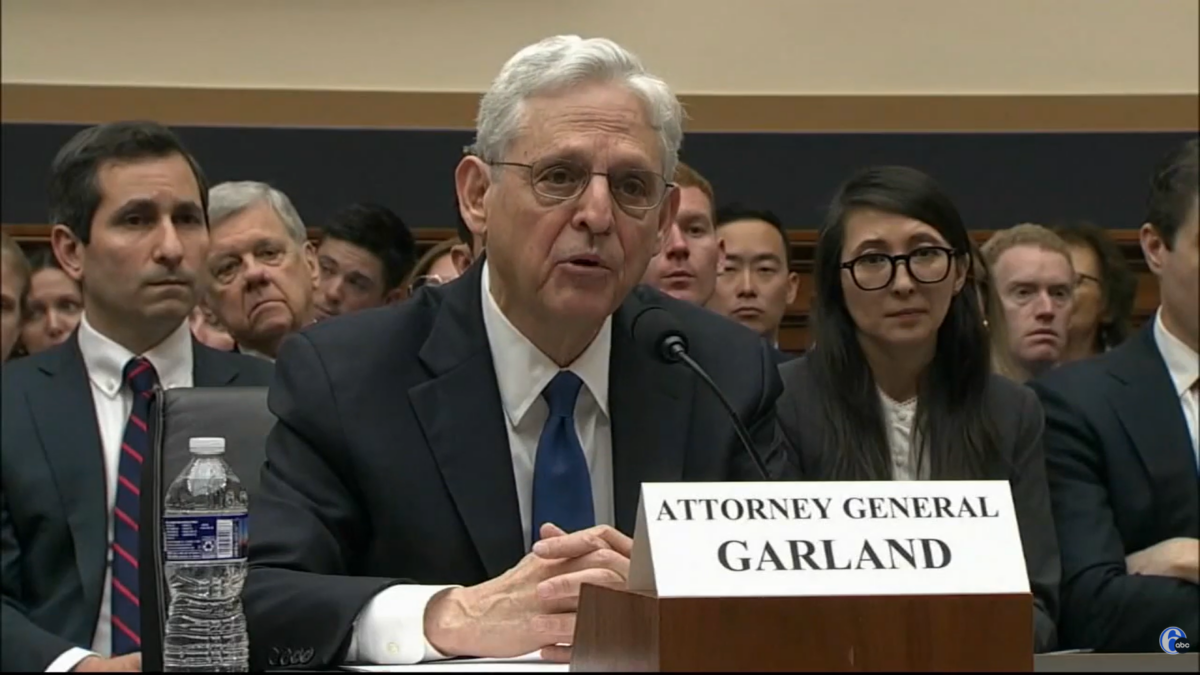

The Public Integrity Section (“PIN”) of the Department of Justice told Arctic Frost investigators to notify the deputy attorney general “via urgent report” of the FBI’s plans to subpoena Republican Rep. Jim Jordan’s toll records, repeating that directive a month later when agents sought to issue another subpoena for Rep. Chip Roy’s records. And when questioned under oath by the House Judiciary Committee, agents acknowledged they would have followed the PIN directive, indicating the Biden administration and Attorney General Merrick Garland knew of the FBI’s gross disregard of constitutional separation of powers and the Speech or Debate Clause protection afforded congressional leaders.
Wednesday morning, House Judiciary Committee Chair Jim Jordan released a 56-page interim report on “How Jack Smith and the Biden-Harris Department of Justice Disregarded the Separation of Powers to Spy on Their Political Opposition.” While the report summarized previously known details of the Arctic Frost investigation and Special Counsel Jack Smith’s unlawful subpoenaing of congressional toll records, Wednesday’s release reveals for the first time evidence that, prior to Smith’s appointment, a top DOJ official under the Biden administration knew of the plot to seize the records of congressional Republicans.
According to the report, “[b]eginning in May 2022, prosecutors under the leadership of U.S. Attorney for the District of Columbia Matthew Graves issued several subpoenas demanding telephone toll records for Members of Congress to identify individuals with whom they spoke around major votes in Congress . . .” Graves previously garnered headlines when news broke that he had refused to partner with the now-former U.S. attorney for Delaware, David Weiss, to bring criminal charges against Hunter Biden.
However, before subpoenaing Jordan’s toll records, Timothy Duree, then an assistant chief in the Criminal Division, reached out to PIN for guidance on the propriety of the requested subpoena. On April 26, 2022, Jennifer Clarke, a deputy chief in the PIN Section, responded by email, positing that the subpoena “arguably” does not violate the Speech or Debate Clause because it is directed to a “third-party” and involves a personal account. Clarke, however, then acknowledged D.C. Circuit precedent — because that is where the subpoena would issue from — has held that “[w]here the Clause applies its protection is absolute,” and therefore there was some “litigation risk” to the subpoena. The email then concluded: “You should also notify [the Office of Deputy Attorney General] via urgent report about legal process related to Jordan.”
According to the House Report, in a May 19, 2022 email, the PIN Section repeated its recommendation that prosecutors issue an “urgent report” to notify the Office of Deputy Attorney General (ODAG) about its intent to subpoena records related to Rep. Chip Roy.
During a transcribed interview, when asked “about notifying ODAG, Duree said he did not have a specific recollection of the interaction,” but that “[i]f [PIN] told us to notify ODAG, then I feel confident that . . . someone on my team, I or someone else, would have notified ODAG.”
These details prove explosive because they indicate high-level political appointees in the Biden administration’s DOJ actually knew of — and allowed — prosecutors to subpoena records from congressional Republicans before the appointment of Smith as special counsel. And while the Arctic Frost team sought to justify the subpoenas and hide behind the PIN approval, the controlling decision in the Rayburn case established that members of Congress have a right to be given the opportunity to assert their Speech or Debate privilege and that the Speech or Debate Clause prohibits the mere disclosure of protected legislative materials.
While case law in other circuits only protects members of Congress from the use of legislative materials in a proceeding against them, that is not the law in D.C., where the subpoena issued.
The prosecutors responsible for subpoenaing both Jordan and Roy’s records ignored that controlling precedent and obtained nondisclosure orders, which prevented the two congressmen from asserting their Speech or Debate rights. And then-President Biden’s administration condoned that constitutional violation.
Further, Duree would later join Special Counsel Jack Smith’s team, and on January 9, 2023, according to the report, “proposed a major expansion of the Biden-Harris DOJ’s investigation into Congressional Republicans, advocating for a new batch of toll record subpoenas for nine Members of Congress and one staffer.” Another member of Smith’s team, Ray Hulser — who has his only problems with weaponization — “approved Duree’s subpoena request within an hour — before Duree told him which Members would be targeted or what specific predication made the subpoenas necessary.”
Smith’s team would again seek approval from PIN for the subpoenas, with another member of that section, John Keller, again noting that the D.C. Circuit in Rayburn had held “the bar on compelled disclosure is absolute.” However, PIN again approved the subpoenas because the “litigation risk was minimal” because the various members of Congress were not targets of the criminal probe — President Trump was. That pragmatic assessment does not lessen the constitutional infringement of the Speech or Debate Clause rights of members of Congress.
With Wednesday’s release we now know that PIN recommended that same course of action multiple times and also, at least before Special Counsel Smith’s appointment, prosecutors were directed to seek guidance from top DOJ political appointees. Smith also appears to have alerted then-Attorney General Merrick Garland of his plans, with a January 13, 2023 “AG Briefing,” stating: “In the coming week or so, we intend to issue subpoenas for the toll records of certain members of Congress for the period between the 2020 election and January 20 to investigate those communications — and to establish logical evidentiary inferences regarding Trump and his surrogates’ actions and intent.”
That Smith and the PIN Section both believed it important enough to advise the attorney general and/or deputy attorney general of the planned subpoenas, shows they knew how significant their seizure of the toll records was. Yet, they declined to inform the judges from whom they obtained the nondisclosure orders that the subpoenas targeted records for members of Congress. That omission speaks volumes of the bad faith of the players involved, up to and including Attorney General Garland.