For more than four years, independent investigative journalist Catherine Herridge has been fighting to maintain the confidentiality of her sources in a case Yanping Chen filed against the Federal Bureau of Investigation, the Department of Justice, the Department of Defense, and the Department of Homeland Security. And presiding over the case is a federal judge whose wife represented (or represents) multiple high-profile subjects whose misconduct Herridge exposed in her reporting, such as Lisa Page and Joe Biden.
Making matters worse, in holding Herridge in contempt for refusing to divulge her sources, the lower court has kept key documents under seal, thereby preventing the public from both assessing the propriety of the contempt decision and learning the DoD’s basis for canceling a Memorandum of Understanding it had entered into with the University of Management and Technology (“UMT”) — a university founded by Yanping Chen.
On Monday, the United States Supreme Court will conference on a Motion attorneys for Herridge filed before the high court seeking “leave to file a petition for a writ of certiorari under seal with redacted copies for the public record filed.” What precisely that Motion argues, however, is unknown because it currently remains under seal too. And that is one of the problems with the entire case again Herridge.
That case didn’t begin against Herridge, but against the FBI, DOJ, DoD and DHS, when Chen on December 21, 2018, filed a Privacy Act claim against those federal defendants. Chen had previously sought sanctions against the government for its alleged violations of the Privacy Act in a case docketed United States v. 2122 21st Road North Arlington, VA, in a federal court in Virginia following the FBI’s submission of a search warrant application and affidavit for Chen’s business and residence. The judge in that case, however, rejected Chen’s request for sanctions, concluding “a proceeding for the issuance of a search warrant cannot provide the relief sought by the movant under the Privacy Act.”
Thereafter, Chen filed her Privacy Act Claim against the FBI, DOJ, DoD, and DHS, alleging “one or more agents of the Defendants, who possessed or had access to confidential FBI records pertaining to the investigation, caused the Leaked Records to be disclosed to one or more employees or agents of Fox News.” Chen alleged that as a result of the allegedly “illegal leak or leaks of Dr. Chen’s private information to Fox News, three Fox News reports were published and broadcast, leading to the destruction of Dr. Chen’s livelihood and the termination of the University of Management and Technology’s participation in DOD’s Tuition Assistance program.”
At the time, Herridge served as Fox News’ Chief Intelligence Correspondent, and she was the lead reporter on the series covering Chen and UMT. Among other things, a February 24, 2017, Fox News segment reported “Chen had lied on her immigration forms about whether she had previously worked for the Chinese military.” Chen’s Privacy Act claim alleged that “Fox News report revealed information derived from, and images of, an FBI FD-302 Form, bearing file number ‘200D-WF240088,’ that purported to memorialize an FBI interview of Dr. Chen’s daughter.” Chen further alleged the “Fox News Report also displayed images of personal photographs seized from Dr. Chen’s home during the FBI search” and “data taken from, and images of, Dr. Chen’s immigration and naturalization forms; . . .” Additionally, Chen’s complaint cited additional “exclusive” reports from Fox News dated April 28, 2017 and June 28, 2017 that again, according to Chen, included material in leaked government records.
Among other things, to prove her Privacy Act claim, Chen needs to prove one (or more) of the Defendants willfully or intentionally disclosed a record protected by the Privacy Act. Chen, however, failed to learn from discovery how Fox News and its reporters obtained some of the information included in the coverage. On June 2022, Chen served Herridge with a subpoena for documents and a deposition to seek the identity of any source of the materials underlying her Privacy Act claim.
Since then, Herridge has been fighting the subpoena — before a federal judge whose wife represents (or represented) clients whose misconduct the top investigative journalist’s reporting exposed.
Judge Christopher Cooper, the presiding judge in Chen’s case, is married to attorney Amy Jeffress — “one of the country’s most prominent national security” lawyers — and he has ordered Herridge, one of the country’s most prominent national security journalists, to divulge her sources or pay a fine of $800 per day for every day she refuses. (The fine has been stayed pending decision by the Supreme Court.)
In short, Judge Cooper’s wife represents precisely the types of clients on whom Herridge reports.
But in this case, the potential conflicting interests between Jeffress and Herridge goes beyond the theoretical: Jeffress represented Lisa Page, whose misconduct related to the Russia collusion hoax Herridge reported in detail. In fact, in one Fox News segment, Herridge quoted Jeffress’ explanation for why Page failed to appear for questioning before the House.
Further, according to Politico, in July of 2025, former President Joe Biden hired Jeffress as his personal attorney, “replacing longtime Obama-Biden ally Bob Bauer.” And just this summer, Jeffress appeared on behalf of Biden in an attempt to block the FOIA release of Special Counsel Robert Hur’s recording of his interview with the former president — an interview that prompted Hur to opt against charging “the sympathetic, well-meaning, elderly man with a poor memory.”
Not only does Herridge report extensively on issues related to the former president, but she was also the only legacy media journalist to seriously and substantively report on the IRS whistleblower allegations against Hunter Biden. At the time, and until 2024, Herridge served as a senior investigative correspondent for CBS News in Washington, D.C.
Herridge’s extensive reporting on Joe Biden and the Biden family and Judge Cooper’s wife’s legal representation of the former president creates a significant appearance of bias because denial of Herridge’s Motion to Quash the subpoena — so far upheld by the D.C. Circuit Court — chills every D.C. reporter’s Free Speech rights, as well as whistleblowers who would seek out Herridge or other reporters to disclose wrongdoing by Biden.
It isn’t merely the contempt order, however, that threatens free speech rights. Throughout the proceedings, Judge Cooper has kept under seal records related to Chen and the DoD’s decision to end tuition reimbursement for the university on national security grounds. Not even two weeks ago, Judge Cooper denied Herridge’s request to unseal DoD records, meaning the public is left with a briefing that looks like this:
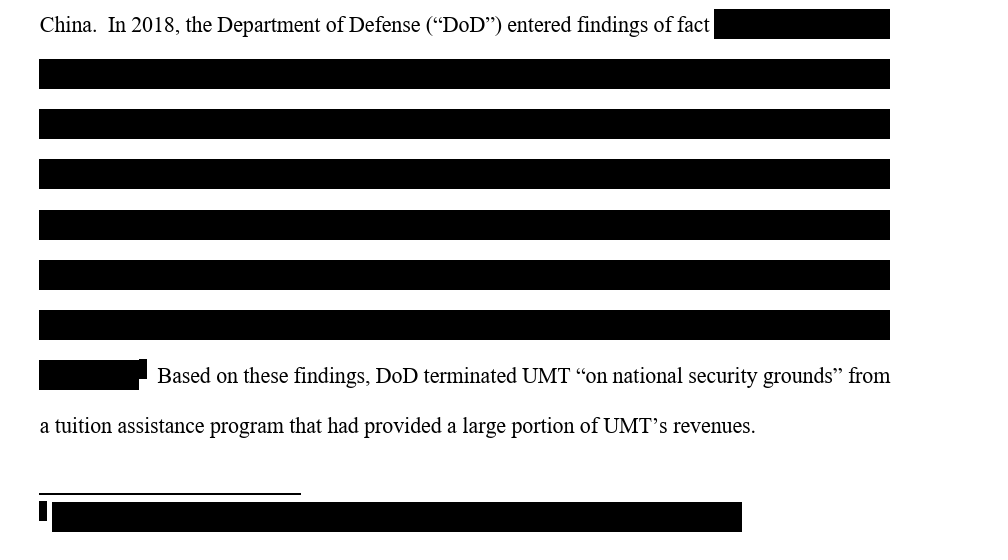
In a letter to the Deputy Secretary of Defense, Chen, through her attorney, had previously argued the DoD’s decision to terminate the university’s participation in the tuition assistance program on national security grounds was based on “a near-verbatim recital of inaccurate and outdated claims provided by the Federal Bureau of Investigation.” The public has a right to know if those claims were in fact, “inaccurate,” because the affidavit filed by the FBI in support of its search warrant is extremely concerning. Yet Chen was never charged with a crime.
If Chen was wrongly accused, the public should know that, but if not, and if instead, after six years of investigation, the Biden administration decided not to bring charges against Chen, that would also be a matter of public interest — and another reason why the representation of Joe Biden by Judge Cooper’s wife matters.
There has been little reporting on Herridge’s fight to protect her sources, and that too shows the chilling effect of Judge Cooper’s denial of her Motion to Quash the subpoena. The ball is now in the Supreme Court, but again, with the public having, as of now, no visibility on what the petition for certiorari argues — because it too is being held under seal.