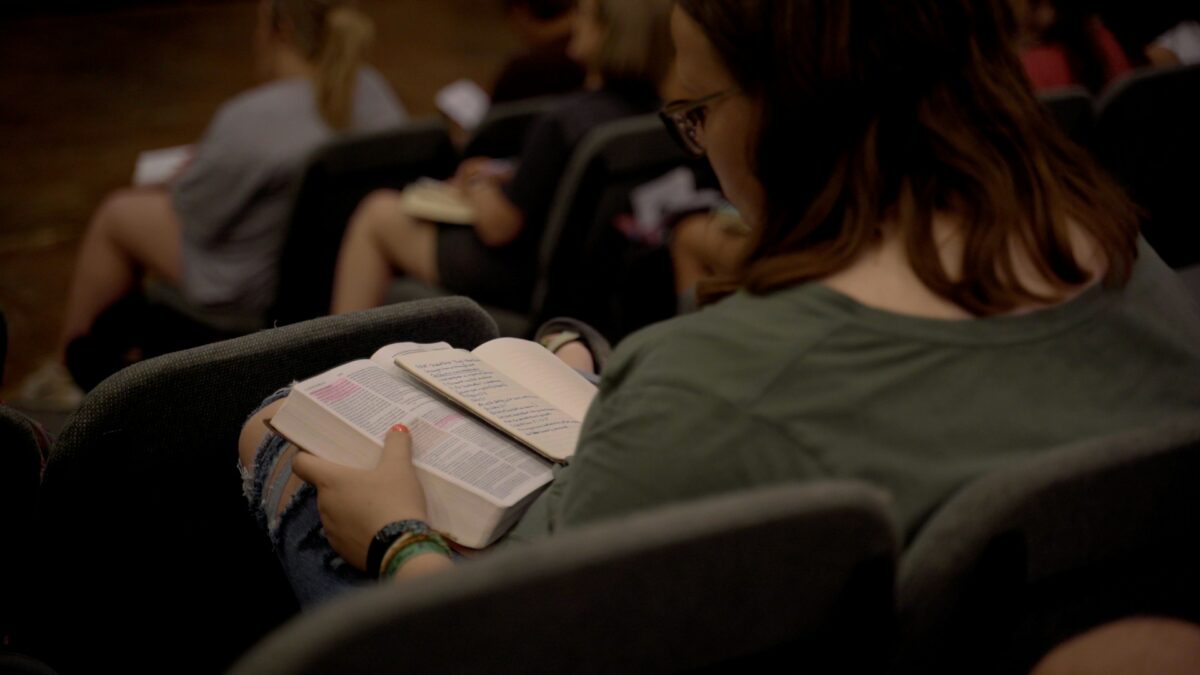

One of the most unexpected cultural developments in the U.S. has been the recent stabilization of religious affiliation. From 1972 until 2020, the percentage of American adults identifying as Christian dropped steadily from 90 percent to 63 percent, while those saying they did not belong to any faith tradition went from 5 percent to 29 percent. But in February of 2025, it suddenly became clear that this decades-long decline had actually been flat for some time.
That was when the Pew Research Center published its most recent Religious Landscape Study, the largest of the foundation’s ongoing surveys. Based on answers from more than 35,000 respondents, Pew had discovered that over the previous five years, from 2019 to 2024, the Christian share of the U.S. population had been “relatively stable, hovering between 60 percent and 64 percent” for both Catholics and Protestants, while the percentage of unaffiliated had also leveled off. (Mainline Protestants continued their decline, but other Protestant denominations balanced them out.)
With the Public Religion Research Institute (PRRI) and the U.S. Religious Census recently confirming the Pew findings, a number of religious podcasters, social media influencers, and otherwise reliable news outlets have taken to exaggerating the data, declaring a modern Great Awakening, especially among young men. But even a “mere leveling” of religious affiliation is a dramatic enough development for more serious observers to try and explain it.
The reason originally given by Pew’s own analysts was that the decreasing strength in religious affiliation from one generation to the next had finally begun to narrow. In other words, while each generation since World War II has been less interested in communal worship than the one before it, the most recent gaps have shrunk to the point where each new cohort no longer impacts the overall percentages in a significant way.
Other researchers, such as Cornell University associate professor of sociology Landon Schnabel, have offered an alternative explanation. They believe that over the last half-century Americans have increasingly learned how to shape their spiritual lives according to their personal values, not institutional creeds. With the result that nearly everyone today who might have a problem with the requirements of organized religion has stopped attending worship services, causing the historical decline to, in Schnabel’s words, “naturally level off.”
And then there is the theory suggested by University of Tampa professor Ryan T. Cragun and Western Michigan University’s Jesse M. Smith, which argues that the psychological distance between the religiously affiliated and unaffiliated is not nearly as far as many think, since a majority of the latter still believe in God or some kind of spiritual reality. And since the difference between the two groups is more elastic than absolute, their separation has finally been stretched to the limit.
Without taking away from the possibility that any of these explanations could account for some of Christian worship’s recent strength, what is surprising is that no interpreter has as yet considered the impact of the declining prestige of what until recently has been its most influential critic: higher education. Although no more than 61 percent of Americans over age 25 have ever attended college — and even fewer (38 percent) have ever received an associate’s degree or higher — the American media have long conditioned audiences to regard professors as the most reliable source of insight on important subjects. So much so that many people have traditionally relied on an author’s academic credentials to decide whether or not to buy someone’s non-fiction book.
But today, the same colleges and universities which have historically promoted unflattering portrayals of communal worship — depicting it as everything from repressed sexuality and racial prejudice to cult fanaticism and capitalist exploitation — are themselves experiencing a serious image problem. Campus developments such as banning speakers on ideological grounds, supporting transgender men in women’s sports and in their bathrooms, equating of free market economics with colonialism, and regarding conventional family life as white supremacy have clearly lowered the average citizen’s opinion of the academic world. So have calls to “defund the police” … “replace gender-based identifiers with self-selected pronouns” … “blame Israel for the terrorist attacks on itself” … “pay reparations for long-ago slavery that 364,000 Union soldiers died to end” … and “give illegal immigrants the right to vote.”
And while it may have first appeared that professors and administrators were just doing what they always have — allowing students to express (and hopefully get over) whatever bizarre trends momentarily intrigue them — the growing impression now is of a deeper academic rejection of the most basic American values: the belief in personal responsibility, in the importance of delaying short-term gratification for higher gain, and in the wisdom of siding with individual freedom over bureaucratic governance. Republicans and conservatives are predictably the most vocal in condemning this development, but surveys from the Pew Research Center and Gallup show that even Democrats and liberals have become similarly concerned.
If more and more people have come to mistrust the educational institution, which has turned against their fundamental beliefs, is it really a coincidence that they would simultaneously return to the religious institution which has continued to uphold them? One could try to explain the pause in declining church membership as a temporary coping response to pandemic-inspired fear of a few years back but, if that were true, why didn’t the decline resume when the danger passed?
The influence of higher education’s tarnished reputation on the unexpected leveling of religious identification should not continue to be overlooked. For when the institution most responsible for discrediting the authority of organized religion over the last century has so clearly discredited its own, some kind of shift in favor of the latter is almost inevitable.