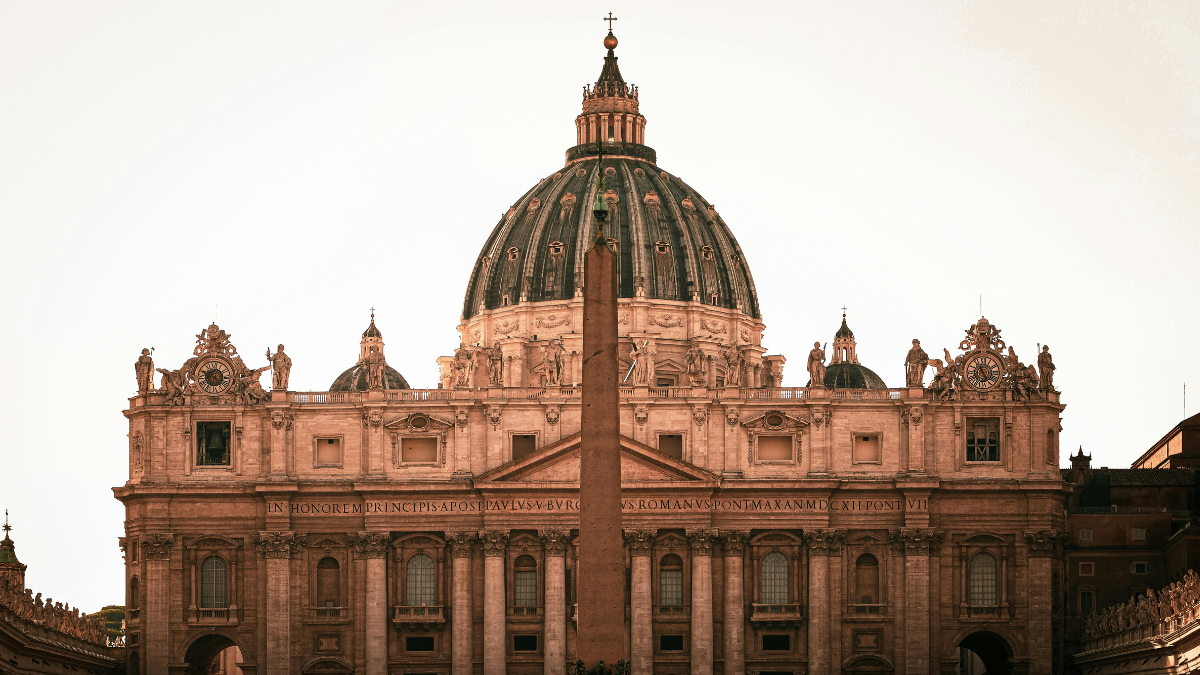
The Vatican’s decision to publish a synod study group’s report that includes testimonies of two men in same-sex “marriages” who claim to have been wounded by the church’s teaching that homosexuality is “contrary to the natural law” is drawing outrage among faithful Catholics.
Earlier this month the Vatican’s General Secretariat of the Synod published the 32-page report, prepared by Study Group No. 9 — one of those initiated by Pope Francis in 2024.
While originally tasked with examining issues considered to be “controversial” within the church, the group apparently decided on its own to switch “paradigms” by framing these issues as “emerging.” That move, explained early on in the report, set the stage for suggesting a shift from sound Catholic doctrine about marriage and sexuality to what canon lawyer and pastor Father Gerald Murray called a “full-fledged endorsement of the homosexual lifestyle.”
The authors of the jargon-infused report employed the linguistic tactics so common among those attempting to lead people to question their closely held beliefs.
Whereas Catholic teaching asserts marriage can only be between a man and a woman, the study group went so far as to say they find it “necessary” to be bold and suggest that Catholics can talk about same-sex “marriage” in a way that is equal to marriage between a man and a woman. “Applying principles,” the study group argues, suggests a “rigid manner,” while “engaging with the lived experience of faith” helps to promote “a living encounter” with Jesus “in relation to the diverse situations of life and the many cultural contexts.”
In order to bolster their suggestion that the teachings of the Church be less “rigid,” the group brought in witnesses — two men, both proud to be in same-sex unions and both arguing that the church’s teachings about marriage and sexuality have hurt them. The report’s authors cite the testimony of one witness, claiming his account “bears witness to the discovery that sin, at its root, does not consist in the (same-sex) couple relationship, but in a lack of faith in a God who desires our fulfilment.”
The statement suggests that choosing a same-sex union is not sinful itself, but doubting that God wants us to be fulfilled is.
In the end, the study group’s theme is that current Catholic teaching is “controversial,” “rigid,” and hurtful, while “emerging” toward an acceptance of same-sex unions suggests openness to “the diverse situations of life,” and enabling one to enjoy “a living encounter” with Jesus.
Faithful Catholics — among them prelates, priests, and veteran journalists — are calling the report another cave to moral relativism and a danger, due to the authors’ attempt to invite the faithful to consider a mindset that strays from established Catholic teaching. Indeed, the report — if allowed to stand as is — will likely bring about further confusion instead of much-needed clarity.
Writing at The Catholic Thing, Murray, pastor of St. Joseph’s Church in New York City, asked a key question: “Why would the Synod of Bishops publish interviews with men who reject Catholic teaching on the nature of marriage, inspired as it is by the Holy Spirit, as part of its effort to discern the workings of the Holy Spirit in the Church today?”
The answer, he observed, lies in the study group’s report itself, and that is, “the Synod considers so-called homosexual marriage to be an open question” — not already long-decided as diverging from Catholic teaching.
Bishop Joseph Strickland, bishop emeritus of Tyler, Texas, called the report an “emergency in the Church,” a “direct assault on Catholic moral doctrine,” and an “attempt to normalize or redefine homosexual relationships” for the sake of having the church appear “more acceptable to the modern world.”
“But the Church does not belong to the modern world,” the bishop asserted. “The Church belongs to Jesus Christ.”
Auxiliary Bishop Athanasius Schneider of Kazakhstan warned that the report serves the Vatican only in advancing the church toward “total moral relativism,” and echoed the dangers of heresy “infecting the Body of the Church.”
Schneider told Vatican journalist Diane Montagna that the Secretariat of the Synod of Bishops “has stooped to promoting the propaganda of a global sexual ideology that is being aggressively pushed in politics and the media worldwide.” The bishop also cited well-known LGBT activist Jesuit Father James Martin as “merely a clerical henchman of this anti-Christian and blasphemous ideology.”
In a subsequent piece published Thursday, Montagna revealed Martin as a “key figure” in the move to include the testimonies of the men in same-sex unions in the study group’s report.
The first testimony, according to Montagna, was provided by “a Portuguese layman” disclosed in the Spanish-language online publication Página Católica to have ties to Martin. Montagna further reported that the author of the second testimony was identified as Jason Steidl Jack, who appeared in 2023 with his “husband” in The New York Times as both were blessed by Martin just “one day after the release of Fiducia Supplicans.”
Indeed, Martin was pleased with the Vatican study group’s report.
“As far as I know, this marks the first time that a Vatican report has included such detailed stories from LGBTQ Catholics,” he wrote at Outreach upon the document’s release. “As such, it marks a significant step forward in the church’s relationship with the LGBTQ community.”
Schneider said homosexual and gender ideology activists “are seeking the Church’s moral and doctrinal approval” of their activity and lifestyles — all “conduct that is contrary to God’s creation and the natural order” of two sexes — male and female.
Veteran Catholic journalist Phil Lawler considered the idea that there are Vatican officials seeking to promote a homosexual agenda within the church. But the founder of Catholic World News reminded Catholics that the study group’s report “is just that: a report, with no magisterial authority” that would change the teachings of the church. Still, another danger lies in the report’s “hostile portrayal” of faithful Catholics — one perspective many in the establishment media will easily carry forward, Lawler warned.
In a statement to LifeSiteNews, German Cardinal Gerhard Müller, the former prefect of the Congregation for the Doctrine of the Faith, commented that all the synod groups are “fatally similar” in that they are skeptical of the central tenets of Catholic teachings and attempt to show themselves as joining with identified groups in order to earn the attention of their ideological heroes. The study groups, Müller said, “do not openly deny revealed truths. But they leave them aside and build alongside them their own edifice of a comfortable Christianity that is conformed to the world.”
Dutch Cardinal Willem Eijk, the archbishop of Utrecht, Holland, wrote that the study group’s report is a “troubling departure from the Catholic Church’s consistent moral teaching” and one that “demands a forceful response” due to its creation of “dangerous ambiguity.” Eijk assured faithful Catholics that “a number of cardinals and bishops will make their objections known to the Roman Magisterium.”
“The Church’s teaching is not obscure, nor is it subject to revision through synodal processes,” the cardinal said. “It is the truth that sets us free.”