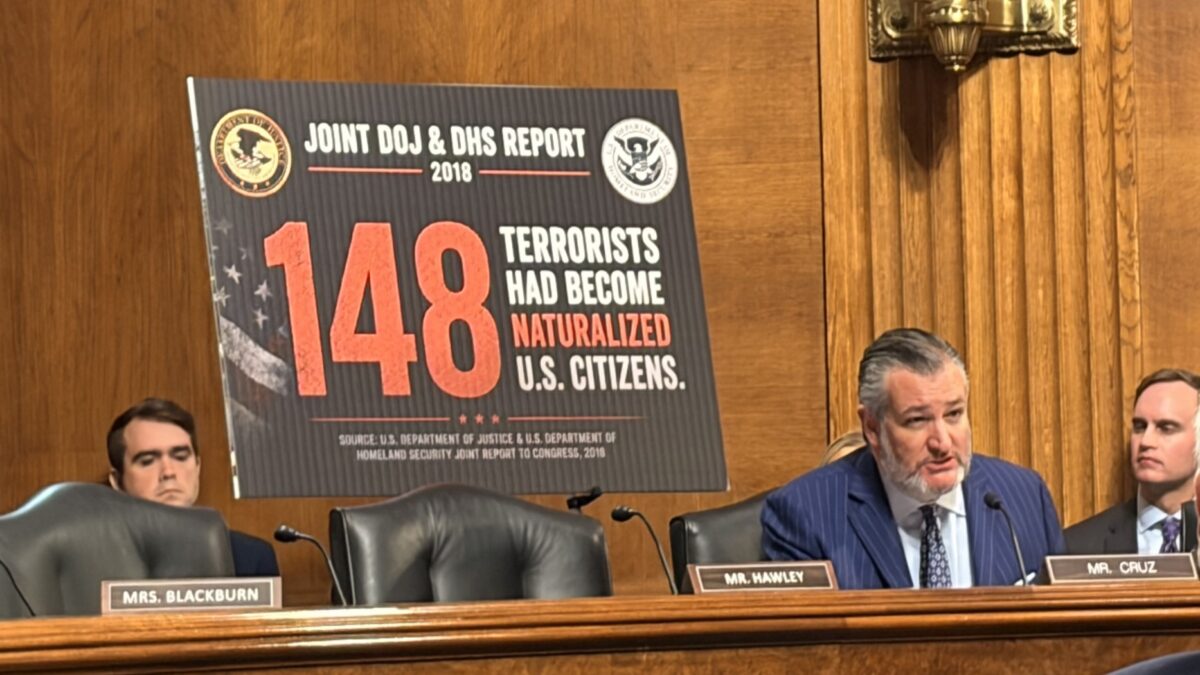

American citizenship for naturalized immigrants is a privilege that should be revoked if someone betrays their oath of allegiance to the United States, according to an argument from Sen. Eric Schmitt, R-Mo., when discussing his SCAM Act before the Senate Judiciary Subcommittee on the Constitution on Wednesday.
Schmitt, who chaired the subcommittee, used the hearing to promote his Stop Citizenship Abuse and Misrepresentation (SCAM) Act, which would do two major things: it would expand from five to 10 years the window of time after naturalization in which individuals who commit crimes that violate their oath of allegiance to the United States or who lied to get their citizenship can be denaturalized and deported, and it expands the scope of crimes that meet that standard.
“Across the country, we’re seeing the consequences of a broken naturalization system that loosely granted citizenship, and then refused to revoke it from those who stole it,” Schmitt said. “The American people are tired of a government that treats their citizenship as cheap, their laws as optional, and their generosity as an invitation to be exploited. If the government never revoked citizenship obtained by fraud, the oath becomes theater, the application becomes a game, the American citizen becomes a sucker in his own country.”
Schmitt called upon a Department of Justice review which found that naturalized citizens made up over 25% of international terrorism convictions from 9/11 through 2016, and witnesses cited recent examples of naturalized citizens committing acts of terror, espionage, and fraud.
One such example was the “Old Dominion Shooter” who shot and killed Lt. Col. Brandon Shah and injured two others in March. The gunman was a naturalized citizen named Mohamed Bailor Jalloh, who had been previously convicted for trying to aid ISIS.
Majority witness Ken Cuccinelli, a former director of U.S. Citizenship and Immigration Services (USCIS), pointed out that despite his terrorism conviction, Jalloh was never denaturalized and deported. If the law had been followed more strictly, he never would have been in the United States to commit that murder.
USCIS’ Operation Janus also uncovered 315,000 cases of missing fingerprint data for naturalized citizens, and at least 858 people who had deportation orders that all obtained citizenship anyway with false identities.
Schmitt used examples like these to promote the SCAM Act as a remedy for these situations, which he feels are an indication that the naturalization process makes it far too easy for people who should not be in the United States to obtain citizenship.
“The SCAM Act gives the government stronger tools when serious conduct shortly after naturalization reveals the truth that was hiding during the process,” Schmitt said. “We need a serious, nationwide denaturalization effort against fraudsters, felons, terrorists, spies, and anyone who obtained American citizenship by deceit.”
As Sen. Ted Cruz, R-Texas, pointed out, there are specific requirements to be naturalized as a citizen. One must swear the oath of allegiance, pass a civics test, and prove “good moral character,” that they are “attached to the principles of the Constitution,” and that they are “well-disposed to the good order and happiness of the United States.”
Majority witness George Fishman, senior legal fellow at the Center for Immigration Studies, traced the weakening of vetting requirements back to the Clinton Administration’s desire to increase its voter base.
“There was a concerted effort to get as many people naturalized as possible because [the Clinton Administration] were promised by advocacy groups that they’d all vote in the 1996 election for the president and vice president.”
Cruz also pointed to Biden and Obama’s failure to properly vet naturalization applicants, noting that such “failures ripple forward in time.” He cited the Austin mass shooting in March 2026, whose perpetrator was a Senegalese national with several arrests who was naturalized under the Obama administration. Wearing a sweatshirt that read “Property of Allah,” the man killed three people and injured fifteen more in the shooting.
Both Republicans and Democrats on the subcommittee agreed that the naturalization vetting process has major flaws that allow for abuse and fraud. But that still did not stop Democrats from pushing the idea that citizenship is a privilege for immigrants rather than something to be earned.
The major point of disagreement was the idea put forward by the SCAM Act that citizenship for immigrants is a privilege, and people who commit certain crimes after the five-year naturalization window should still be punished as immigrants, not like American-born citizens.
Sen. Mazie Hirono, D-Hawaii, noted that naturalized citizens can be prosecuted under the same laws as any other American citizen, so to punish them by denaturalization is to make them “second-class citizens.” She smeared the SCAM Act as an effort to “terrorize immigrant communities” and tell “24 million Americans that their citizenship can be questioned.”
As previously mentioned, Cuccinelli did point out the dangers of failing to denaturalize immigrant criminals before it is too late. However, he also argued that it would be much simpler for Congress to fix the vetting problems that allowed terrorists and fraudsters to become naturalized citizens in the first place than to expand denaturalization power via the SCAM Act. He argued that such power is very narrow and subject to the Supreme Court.
“There’s this factory line mentality that, in fact, the burden of proof is on the government to deny people, and that is not what the law says. The law says the burden is on the prospective immigrant to prove … that they will participate and contribute to the well-being and good order of the United States. We do not hold them to that proof.”
The SCAM Act was introduced in the Senate in January 2026, and this week’s Senate Judiciary Subcommittee Hearing on the Constitution effectively weighed the merits of the denaturalization bill before it moves to Senate discussion.