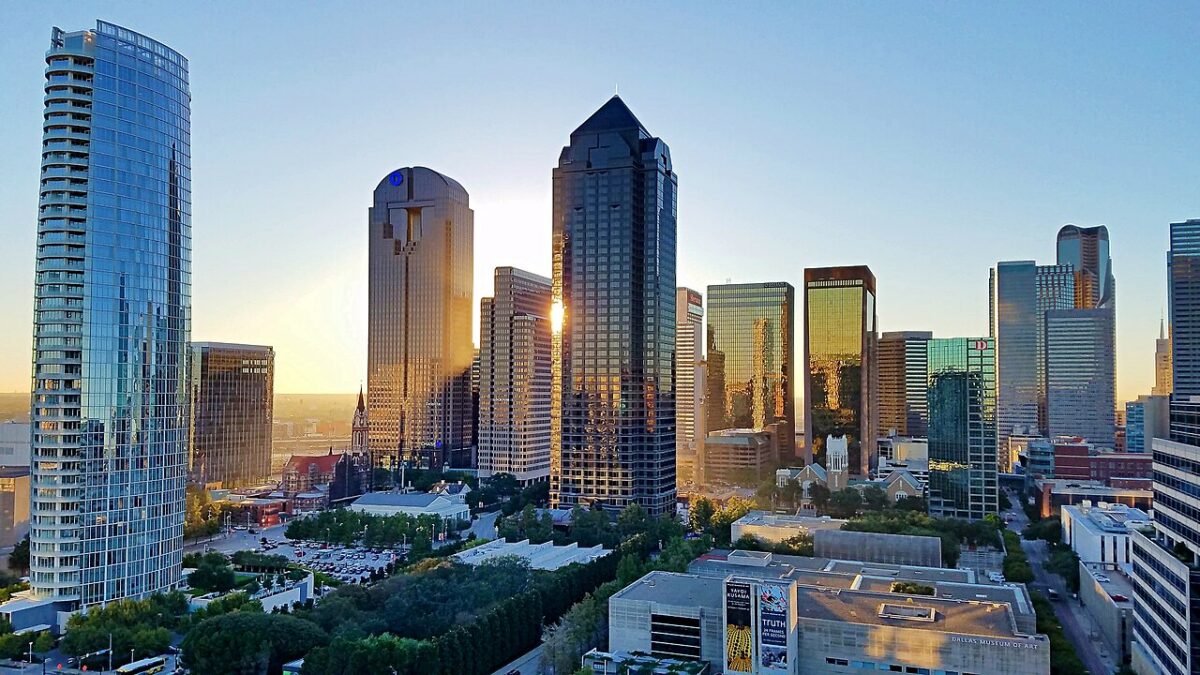

According to a recent viral essay in The Dallas Morning News by economics professor J.H. Cullum Clark, the great city of Dallas has joined the ranks of other declining American cities and become a donut hole. As the city itself has contracted and lost population, its suburbs and exurbs have grown and multiplied. Even though domestic and foreign migrants from outside of Dallas have arrived in large numbers, residents in the city have left the city in even greater numbers. Thus, for the first time since the Civil War, “Dallas County is likely to lose population” in the current decade.
Those in the suburbs may not think much of this is change — it mirrors the same demographic changes of most large American cities — yet Clark warns that “economic weakness in core cities tends to spread to nearby suburbs.” This can already be observed in the moribund growth of neighboring suburbs Irving and Carrollton in the last few years. Meanwhile, there is endless new residential sprawl creeping northward in exurbs like Prosper, Melissa, and Argyle, all showing that growth is happening somewhere.
Clark calls for filling in the donut hole and bringing people back to Dallas. Unfortunately, this is where his analysis falls apart. Unable, or unwilling, to criticize the main culprits of Dallas’ decline in the first place, his solutions are unrealistic and unserious. He suggests “creating an ever richer restaurant and cultural scene,” “building walkable urban neighborhoods appealing to city lovers,” “investing relentlessly in quality-of-life assets like parks and trails,” and “get better at adaptively reusing great old buildings.” He also recommends “making it easier to build housing of all kinds,” even though Dallas already does this.
In other words, Clark offers the same advice as any other progressive urbanist, even citing New York City, Washington D.C., and Boston as positive examples on how to grow. Ironically, it was this kind of thinking that has now made Dallas a less desirable place to live. Instead of properly dealing with the challenges of its rapidly growing population, Dallas’ leaders ignore these issues as they pursue new gimmicks to make the city a culture and lifestyle hub.
Leftists Ruining Neighborhoods
For the first half of my life, I lived in Dallas, but eventually migrated northward and made my home in what used to be a small suburb consisting of residential subdivisions and a strip mall, surrounded by vast empty fields. Since then, there has been endless development and construction all around me, transforming a primarily white, conservative, middle-class town of modest single-family homes into an increasingly diverse, progressive city filled with McMansions, large apartment complexes, and boutique retail stores along with a cornucopia of dining options.
The reasons I moved away from Dallas were the same reasons I would consider moving away from my home now: leftists have come in and ruined the place. As a kid, I mainly experienced this in the public schools: academic standards were generally low in most classes and grades meant little. Most campuses, including mine, were majority-minority schools with large contingents of ESL (English as a Second Language) students from Mexico and Central America. Fights, drug abuse, and criminal activity were common, and many of the school’s alumni went on to form a permanent underclass living in various barrios around the city.
Curiously, down the street from my school were elite private schools where the students played lacrosse and lived in the city’s most affluent neighborhoods. These kids would usually go on to attend an Ivy League and then come back to form the social upper crust of the city. Insulated from the rougher elements of the city, these Dallasites were generally progressive in their thinking, though they would insist on identifying as moderates.
As for those of us in the shrinking middle class, we either stayed on the narrow advanced track at our schools or our parents moved to one of the suburbs that had better public schools and less delinquency.
When I began teaching almost 20 years ago in South Dallas, I encountered the same issues I did as a student, only more so: more poverty, more dysfunction, and more leftist policies designed to accommodate unmotivated youths. School leaders and their cronies would continually complain about funding, yet spent most of the budget on more technology and educational specialists.
Nothing much has changed about Dallas since then, except one thing: the price of living there. Unlike most other big cities, Dallas cannot bring people in with its cultural scene, natural beauty, good weather, or storied history. For the longest time, Dallas only grew because it was affordable and there were jobs. Economists like Clark might blithely declare that “America’s most successful core cities are growing by outcompeting suburbs as fun places to live more than they are by sustaining traditional job centers,” but if Dallas doesn’t have jobs and affordable housing, it has nothing.
Get the Basics Right
Rather than pin their hopes on building more museums, parks, and craft breweries, Dallasites need to focus on the basics: good schools, low crime, cheaper housing, and low taxes. This could happen through systemic efforts to raise academic and behavioral requirements at school, arrest and punish criminals, deport illegal migrants and empty out the barrios where they live, crack down on homeless vagrants, and cut the bureaucratic bloat in public services that drains tax revenue. In all decisions, the welfare of the middle-class family must be prioritized. Put another way, if Dallas’ leaders simply implemented conservative reforms — and this goes for leaders of other American cities — they could revitalize growth.
Only then would it be a good idea for city officials to engage in cultural projects, celebrate the Dallas’ cosmopolitan atmosphere, and invest in leisurely pastimes. Relative to its suburbs, Dallas still has a major advantage in this regard, making it ideal for visits. It needs to become an ideal for place for living and working once again. This means ditching the complacent leftist attitude that growth is guaranteed no matter what the local governments does, and returning to common sense and safeguarding order and prosperity.