

One of the policy goals conservatives most want the Trump administration to accomplish is mass deportations. Not just for illegals or those who have committed crimes, but also for those who have been granted citizenship and have proven themselves civilizationally unequipped to retain the privilege.
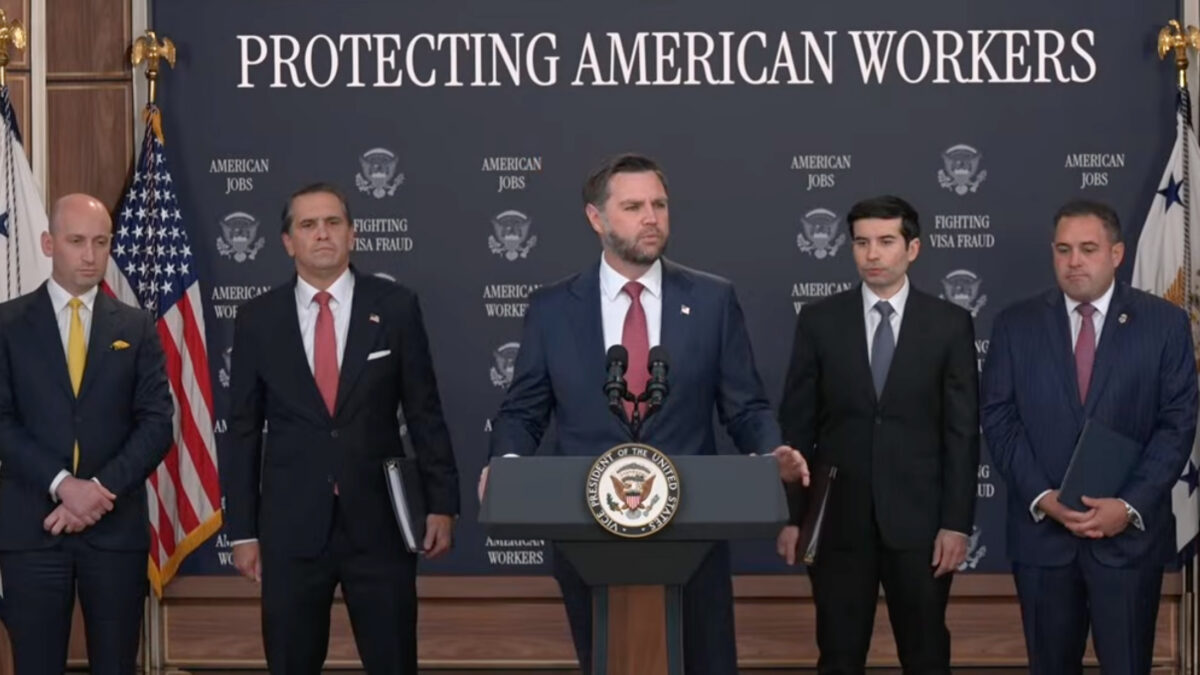
Earlier this week, the Department of Justice announced denaturalization actions against 17 persons “accused of serious offenses.” Almost all of the cases involve either some kind of fraud or the sexual abuse of a minor. In May, the department announced similar actions against 12 people accused of “terrorist support, war crimes, espionage, sexual abuse, and more.”
While it is important to remove every single person that matches those criteria in the country, periodical numbers like 17 and 12 do not seem to match expectations of the many more who might be — or should be — eligible for denaturalization and, ultimately, deportation.
Between 1907 and 1967, 22,000 citizens were denaturalized (an average of about 367 per year), which is reportedly more than any other democracy in the world at the time. There were other rules governing citizenship as well, such as women marrying foreign men automatically losing citizenship or anyone voting in a foreign election being stripped of the privilege as well. One could be denaturalized for supporting government regimes antithetical to the American constitutional order.
But none of that is the case anymore. From 1990 to 2018, only 130 denaturalization proceedings had been filed (or, seven per year on average). The downturn on denaturalization came at a time when there are exponentially more persons granted citizenship who have proven themselves unworthy of it.
[READ: Deporting Illegal Immigrants Is Not Enough]
Throughout American history, “the use of denaturalizing people has ebbed and flowed — it’s not quick, it’s not easy to do,” Lora Ries, Director of the Border Security and Immigration Center at the Heritage Foundation, told The Federalist. Ries explained that judges will often decide not to denaturalize citizens, even when they deserve it.
Denaturalization decisions are determined by federal courts, not immigration courts. However, similar to the way that immigration judges are “loath to deport aliens with green cards, even though lawful permanent residents are indeed deportable,” Ries said, “imagine the resistance to strip citizenship away.”
Denaturalizing was not always as difficult as it is now. Clear-cut cases of fraud or sexual abuse like the ones highlighted by the Department of Justice are the most likely to succeed in denaturalization, but that is mostly because a Supreme Court case from 1967 effectively removed the sovereign right of the United States government to strip citizenship, except in certain cases like fraud and abuse.
In Afroyim v. Rusk, a 5-4 majority of the Warren Court decided that the U.S. does not have the authority to revoke anyone’s citizenship involuntarily. The case derived from a man of Polish birth, naturalized in 1926, who voted in the Israeli election in 1951, directly violating the Nationality Act of 1940.
The court held:
Congress has no power under the Constitution to divest a person of his United States citizenship absent his voluntary renunciation thereof.
(a) Congress has no express power under the Constitution to strip a person of citizenship, and no such power can be sustained as an implied attribute of sovereignty, as was recognized by Congress before the passage of the Fourteenth Amendment. …
(b) The Fourteenth Amendment’s provision that “All persons born or naturalized in the United States . . . are citizens of the United States …” completely controls the status of citizenship, and prevents the cancellation of petitioner’s citizenship.
The result gave naturalized citizens sovereignty over their citizenship as opposed to the government.
In its ruling, the high court essentially decided it had the power to overrule Article I, Section 8 of the U.S. Constitution, which states that “The Congress shall have Power … To establish an uniform Rule of Naturalization.” Rules about “naturalization” clearly also means setting rules about denaturalization, Ries said.
There have been subsequent cases that chip away slightly at the dramatic ruling in Afroyim. For example, Fedorenko v. United States in 1981 allowed denaturalization to occur if the original naturalization was obtained fraudulently — such as through falsifying documents or bogus claims of refugee or asylum. The overall effect of Afroyim, however, has been to make denaturalization extremely difficult to achieve, and under specific, arduous circumstances.
President Bill Clinton’s “Citizenship USA” initiative, which was a 1996 scheme to fast-track as many naturalizations as possible in order to swamp the ballot box with foreigners in favor of Clinton’s reelection, resulted in at least 6,000 foreigners being naturalized despite having criminal histories or other disqualifying factors.
When the Immigration and Naturalization Service (INS) attempted to pursue administrative denaturalizations, they were stopped by a federal judge, and by 2001, the Department of Justice decided not to challenge for denaturalization in court because of how difficult achieving the seemingly simple task had become.
[READ: We Need To Deport 1 Million Illegal Immigrants A Month]
Naturalization and denaturalization is a sovereign right of any government. As a basic rule, a naturalized citizen is a citizen in every way that one native to a country is, but with one major caveat: The country that granted citizenship retains the sovereign right to denaturalize that person if they prove to be detrimental to that country’s welfare.
“Each nation gets to decide who gets to come in, why, under what terms, for how long, when you have to leave, and to enforce it — and whether it’s a temporary visa or a green card or citizenship of the nation,” Ries said. She also explained that denaturalization does not automatically mean deportation, and that it generally reverts the person back to their prior immigration status. A subsequent removal proceeding needs to be started for them to be removed.
Although fraud and other crimes cited by the Department of Justice can be grounds for denaturalization, Afroyim effectively neutered many of the promises and attestations those being naturalized must swear to upon being granted the privilege of citizenship.
In fact, it renders almost all parts of the U.S. citizenship oath meaningless:
I hereby declare, on oath, that I absolutely and entirely renounce and abjure all allegiance and fidelity to any foreign prince, potentate, state, or sovereignty, of whom or which I have heretofore been a subject or citizen; that I will support and defend the Constitution and laws of the United States of America against all enemies, foreign and domestic; that I will bear true faith and allegiance to the same; that I will bear arms on behalf of the United States when required by the law; that I will perform noncombatant service in the Armed Forces of the United States when required by the law; that I will perform work of national importance under civilian direction when required by the law; and that I take this obligation freely, without any mental reservation or purpose of evasion; so help me God.
Moreover, federal statute requires any applicant for citizenship display “attach[ment] to the principles of the Constitution of the United States and well disposed to the good order and happiness of the United States.”
“‘Attachment’ is a stronger term than ‘well disposed’ and implies a depth of conviction, which would lead to active support of the Constitution,” it continues. “Attachment includes both an understanding and a mental attitude including willingness to be attached to the principles of the Constitution. An applicant who is hostile to the basic form of government of the United States, or who does not believe in the principles of the Constitution, is not eligible for naturalization.”
Under the current Afroyim regime, none of that is binding if it turns out someone has lost that “attachment” after becoming a citizen — or, because it is not fraudulent technical paperwork, lied about it from the very beginning.
At the same time, the application itself is outdated. Right now, it asks about support for Nazism, communism, and terrorism, Ries said, but it does not sufficiently address the modern threat posed by Third-Worlders to the homeland.
There are some efforts in Congress to update both the qualifications for naturalization and the parameters for denaturalization.
Rep. Chip Roy, R-Texas, introduced the Measures Against Marxism’s Dangerous Adherents and Noxious Islamists (MAMDANI) Act, which would enact “enacts sweeping immigration law changes that would deport, denaturalize, deny U.S. citizenship, or entry to any alien who is a member of a socialist party, a communist party, the Chinese Communist Party, or Islamic fundamentalist party, or advocates for socialism, communism, Marxism, or Islamic fundamentalism.”
It includes more specific definitions for what qualifies as those ideologies and stops chain migration and fraudulent claims.
U.S. citizenship, “our most precious immigration benefit,” Ries said, can no longer be the “transactional” process of checking boxes, holding a green card for a number of years, and promising to uphold the Constitution in an oath that only holds water in a high-trust society populated by Westerners who take civilization seriously.
Not only should there be an extreme vetting procedure ensuring Western-minded bona fides before obtaining citizenship, there needs to be a massive denaturalization effort to rectify the mistaken awards of citizenship over the past 60 years.