
Let’s just get this out of the way — I like Ryan Holiday.
In case you’re not aware of who he is, Holiday is a popular author who’s become a popular author by being famous on the internet. Unlike a lot of internet influencers, his chosen domain of expertise is somewhat unusual, however. For more than a decade, he’s been the public face of Stoicism — the ancient Roman philosophy that advocates regulating your emotions and being resilient in the face of external challenges.
Essentially, Holiday has repackaged the words of Marcus Aurelius, Seneca, Epictetus, et al. into various modern contexts, and pitched stoicism as a panacea to the anxieties of the 21st century. There are some problems with the way Holiday’s denatured stoicism to make it palatable for the masses, and let’s be honest, very profitable. Aside from selling millions of books, Holiday is huge on the lucrative corporate lecture circuit. Still, when you survey the landscape of what his fellow self-help gurus are selling, Holiday’s stoic advice, which frequently amounts to telling people to toughen up and not be a slave to their desires, has a much better chance of actually helping people than most.
Beyond that, his huge email lists and popular podcast have become an important vehicle for promoting other authors who write on a wide variety of topics that go well beyond stoicism. Holiday owns a bookstore and is constantly touting books he likes on his YouTube channel, which is also admirable.
Unfortunately, the problem with being the world’s most famous advocate of stoicism is that the world expects you to be, well, stoic. And recent events involving Holiday’s somewhat incongruous advocacy of left-wing politics have revealed that Holiday can definitely let his emotions get the better of him in a very public fashion.
Like I said, I like much of what Holiday does, and I’m not judging him too harshly for this. As a somewhat public figure, I’ve been angry on the internet myself. But what’s happened to Holiday is fairly ironic. If it involved someone else, it might be the kind of thing he himself would characterize as a teachable moment stoicism was made to address.
‘Plato’s Reserves’
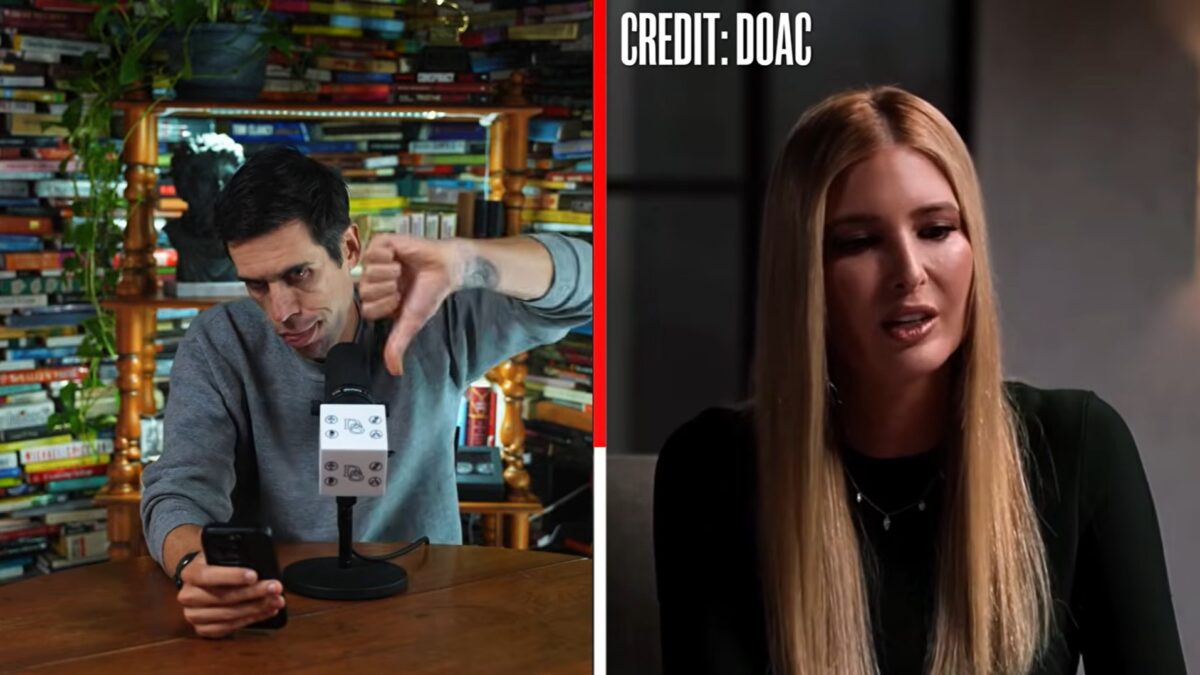
The proximate cause for Holiday’s bout of internet infamy began just over a week ago, when he posted a short reaction video to Ivanka Trump talking about some of the positive things she had learned from reading Marcus Aurelius’ Meditations. If you watch the video, from the very beginning Holiday is smirking and rolling his eyes, and at one point he literally sticks his tongue out and makes a big thumbs down gesture on the split screen as Ivanka is talking — even though everything she says about Aurelius is uncontroversial and anodyne.
As soon as she’s done talking Holiday renders his judgment. “Here’s the thing: She’s totally right,” he says. “That’s exactly what Marcus Aurelius said. That’s exactly what stoicism is about. She’s just not living or acting in accordance with it in any way. If you did, you’d have an intervention with your dad, whose life would be dyed with his horrible, negative, mean bullying thoughts all the time.” It devolves from there.
I think we can agree that in many very obvious respects Donald Trump has whatever the opposite of a stoic temperament is supposed to be, but how is it a matter of stoicism to necessarily make this his daughter’s problem? Especially when she’s out in public espousing “exactly” what Holiday says is good about stoicism. Nothing about this, starting with sticking his tongue out at someone and ending with criticizing her for someone else’s behavior is recognizably stoic.
It’s impossible to say what measure of influence Ivanka Trump has over her father or whether or not she is using any influence she has to make him a better person than he might otherwise be. Aside from Holiday’s evident anti-Trump political animus, I don’t want to speculate about any personal motivations he might have.
But since he went there, I’ll just note that Holiday wrote a piece back in 2016 entitled “Dear Dad, Please Don’t Vote For Donald Trump.” That piece was originally supposed to be published in The New York Observer, where Holiday was an editor and columnist. But the Observer rejected that column, perhaps because the owner of The New York Observer was Jared Kushner, Ivanka Trump’s husband.
It took a few days for his video calling out Ivanka to cycle through the internet, before turning into a controversy. At that point, people started snarking at other bits of unflattering content, like this baleful exchange in one of his podcast discussions with a New York Times science writer. Holiday states that as secular leftists they have to be more intentional about inculcating morals in their children because they can’t rely on a religious faith to do it for them. The New York Times writer counters, “I watch Ted Lasso with my son, and there’s just so much in there to talk about.” And Holiday presumptively agrees with her.
Setting aside the fact that Ted Lasso is a self-celebratory mess where “the moral rot behind the decisions of well-meaning characters should be painfully easy to see, but no one within spitting distance of the writers’ room has any deep personal convictions about sin” — surely Holiday, who has written a book on and has a newsletter dedicated to instructing people on the finer points of fatherhood, has to see how insulting and superficial this is to people who do take their faith and morals seriously. And that was before it was pointed out that Holiday has hosted a “drag queen story hour” in his bookstore.
Anyway, for most of his public career, Holiday has been a broadly agreeable figure who’s routinely gotten very favorable press from the corporate media. I can relate to his evident trouble at suddenly being ridiculed online, and speaking from experience, I would have told him to step away from the keyboard. But he was all over X doubling down, posting footage of himself speaking at an anti-ICE rally, attacking “MAGA,” criticizing Elon Musk by taking his words out of context, and calling one of his critics “a f—king goober.”
For a guy who has 800,000 followers on X and 2 million YouTube subscribers, all of his pushback landed with a predictable thud. In this respect, maybe the relevant Roman here isn’t some stoic, but Cicero, who once observed: “I like modesty in speech. The Stoics say that nothing is shameful or obscene in the saying of it. Wise men will call a spade a spade. Well, I shall keep as I always have, to Plato’s reserves.”
The Limits of Stoicism
But I began this by saying I like Ryan Holiday, and I meant it. At least part of that affinity for him is putting a brave face on my jealousy — making lots of money writing for a huge popular audience and owning a quaint bookstore is about as close to an ideal lifestyle as most writers such as myself can envision.
Besides, for the most part Holiday’s alienating forays into politics are incidental to what he does. As for Holiday’s main focus, well, the world needs popularizers to keep history and philosophy alive. Popularizers are by their very nature controversial; making things popular inevitably involves sanding off the rough edges of things. If you go looking for it, you will find no shortage of critics of Holiday, who claim that he has dumbed stoicism down into a lifestyle brand for affluent Americans, who wouldn’t otherwise find the philosophy’s true ascetic ideals at all appealing. And then there’s the fact that Holiday knows neither Latin nor Greek, and more scholarly critics say his attempt to repackage existing translations into commercial products devoid of context bulldozes over important nuance.
These are not unfounded criticisms, and Holiday is hardly the first to face them. A couple of generations ago, Edith Hamilton was a Baltimore school headmistress who became one of America’s biggest authors by selling the reading public on the glories of ancient Greek thought. Her book Mythology is still widely taught to school kids (though these days I fear it’s probably more confined to private and religious schools).
It became a favorite book of RFK’s after Jackie gave it to him following his brother’s assassination in the hopes that he would find some comfort in it. It left such an impression on Bobby Kennedy that he actually quoted Edith Hamilton from memory in his iconic, and apparently extemporaneous, remarks given when he was informed Martin Luther King Jr. was assassinated. More specifically, he quoted Hamilton’s idiosyncratic translation of Aeschylus. Unlike Holiday, Hamilton had degrees in classics back when that meant something — her master’s thesis was on the stoic Seneca, no less — and was quite fluent in Greek and Latin:
[W]e have to make an effort in the United States, we have to make an effort to understand, to go beyond these rather difficult times.
My favorite poet was Aeschylus. He wrote: “In our sleep, pain which cannot forget falls drop by drop upon the heart until, in our own despair, against our will, comes wisdom through the awful grace of God.”
That single line cuts right to the heart of why Hamilton was both flawed and great in a way that I hope is instructive to Holiday. Many self-respecting classics scholars would be aghast at the notion of a Greek referring to a monotheistic God; but Hamilton understood the line would have more resonance with a midcentury American audience if she rendered it that way, and indeed it wound its way, inaccuracy and all, into one of America’s finest moments of oratory.
It typifies how, in all of her writings, Hamilton makes an explicit assumption that what was bequeathed to us by the Greeks and Romans exists within a broader Western tradition. And this subsequent and more expansive view of Western thought, which rather notably includes Judeo-Christianity, should also influence our moral interpretation of 2,000-year-old philosophers and statesmen. Flawed translations be damned, in this respect Hamilton got the big picture regarding the Greeks and Romans right, where the myopic literalism of classics scholars missed what it is about ancient wisdom that might appeal to ordinary people. (For what it’s worth, the previous Cicero translation also comes from Hamilton’s The Roman Way, so I’ll let the Latin scholars out there object if necessary.)
Holiday’s a smart and very talented man, so it’s my hope that he eventually comes to understand that maybe some of the recent frustration he’s expressed, politically and otherwise, is a result of hitting the limit of what stoicism can do, especially since the only other moral guide he uses to interpret it is contemporary secular liberalism. Until he can marry the wisdom of the stoics to some recognizable vision of transcendence — and I would note that Hamilton was a very unorthodox Christian, and I don’t think she was proselytizing per se — he’s not going to find a way to reach and persuade people the way that he wants to.
Again, the reason I follow Holiday and like much of what he’s done is that I have a lot of admiration for the stoic philosophers and their practical insights, and he has a talent for explaining them. At the same time, I would never call myself a stoic. I am first and foremost a Christian, in part because Christians have a much better understanding of human nature than the stoics ever did. Being resilient and in control of our emotions is a goal to strive for, but perfect self-mastery is unattainable, and as such, admonitions about being a better person are useless without forgiveness and redemption when we inevitably fail at self-improvement. Seneca said a lot of wise things, but a moral philosophy that tells people if things go badly you can always kill yourself isn’t one I would rely on.
In Christian terms, the problem with Holiday’s video attacking Ivanka Trump and his subsequent minor crashout is that it all amounts to works righteousness. He’s asking for others to adhere to a standard of public morality regarding their political choices that he himself not only doesn’t hold, but given the vagaries of modern American politics, is impossible for anyone to adhere to.
If Holiday wants to forsake his normal audience and rail against Trump’s corruption, well, as someone who voted for the guy, I’m far more receptive to the criticisms of the shady crypto dealings and the pay-for-pardons than he probably realizes. What Holiday doesn’t realize is that it’s hard to make that argument when you’re also willing to go on, say, Gavin Newsom’s podcast. Do I get to stick out my tongue and hold Holiday accountable for not staging stoic intervention with a guy who lied about going to rehab to explain away sleeping with his campaign manager’s wife, and is at this point knowingly enabling public corruption in his state on a level that far surpasses concerns about the Trump campaign’s self-dealing?
And as bad as all this contemporary corruption seems, I wonder what Holiday would make of burnishing the historical legacy of a leader who, despite his celebrated and well-intended rhetoric, was responsible for killing thousands of harmless people whose only crime was believing in the wrong thing? Because that’s Marcus Aurelius and Christians, and Holiday has forged a career using superlatives to describe a rather problematic politician.
Yet, Meditations is still a great book, and acknowledging this simple fact amply demonstrates that having to make necessary judgments that do not entirely align with our own moral standards is hardly a new political phenomenon. In his better moments, Holiday would probably ponder this unfortunate fact of life and remind us that per Epictetus, “The chief task in life is simply this: to identify and separate matters so that I can say clearly to myself which are externals not under my control, and which have to do with the choices I actually control.”
And I would agree, with the caveat that once we are clear on our actual concerns, political progress will be made by seizing on opportunities to talk to those we disagree with, and hoping a shared desire for forgiveness forges a new understanding. In times of political turmoil, we should look beyond the stoics to Aeschylus, who, by way of Hamilton, got it right when he said wisdom only comes through the grace of God.