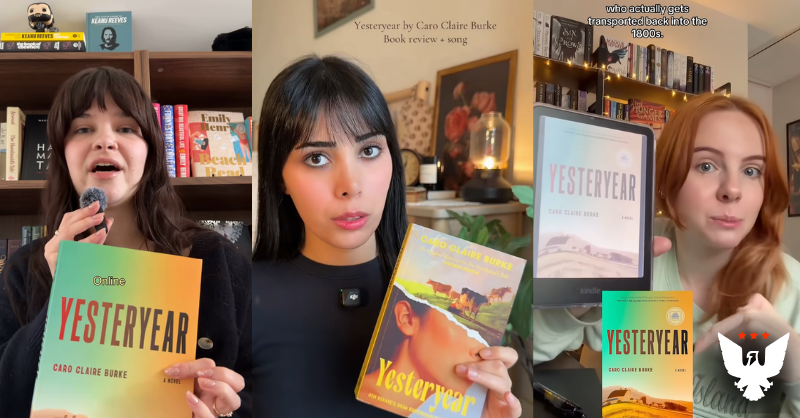

The newly released novel, Yesteryear, by Caro Claire Burke, features a tradwife who gets transported back to the 19th century to live a truly trad life. Deeply humbled by her experience, the tradwife desires to return to the present day, replete with the luxuries afforded to her by the feminists she disdains. Already a New York Times bestseller, the novel is set to be adapted for film by Anne Hathaway.
It takes little imagination to anticipate how the film adaptation will go: Much like the dystopian vision of The Handmaid’s Tale, it will amount to a scolding for those lacking gratitude for feminism. The implicit message is exactly what feminists have always insisted: conservative women who embrace domesticity are either frauds, victims, or too dim to know the difference.
I’ve been writing about feminism for more than a decade. The main opposition is almost always the same: tedious clichés and skimpy narratives. I’m told that I want women to be subjected to vile men with no way to escape or that I don’t think women should work or vote. And then, there is some effort to remind me how I have personally benefited from feminism — usually because of my doctorate, or public voice. These tired arguments, gracing comment boxes, social media, and a wide array of publications, are repetitive, unthinking, self-righteous.
Few realize that these exhausted sound bites were established decades ago to protect feminism from criticism. Media, academia, and vocal influencers pushed these talking points deeply into the culture. They’ve become so entrenched that they’ve scarcely needed adjusting from outside pressure and remain so dominant that Hollywood can bank on them. This novel and soon-to-be-movie will follow the same playbook.
What is not generally grasped is that, despite its self-assured bravado, feminism is actually a fragile ideology. Because it is not based on a solid foundation of truth, it can only survive through power, so it relies on perception, PR, and political force. In the face of decades of its corrosive effects, it can’t draw from scientific studies or even principled arguments to defend itself. All it has is a broad defensive perimeter of clichés and a tidy narrative of protection. Western women and men have been unwittingly supplying it for decades, allowing feminism to expand unchecked.
The effect has been that most people genuinely believe they are protecting something good, buying into the largely fictional narrative that feminism “is just about helping women.” Few realize its connection to the havoc now on display in the culture.
What Is Feminism?
In its simplest form, feminism is the belief in two things: Men are contemptible, and women should be just like them.
This definition isn’t a one-off found in some obscure, unknown feminist. Rather, it can be seen in the work of every major feminist leader for the last 200 years: Mary Wollstonecraft, Elizabeth Cady Stanton, Simone de Beauvoir, Betty Friedan, Kate Millett, and Gloria Steinem. What is their biggest enemy? The patriarchy. And what do they want? To have the power they believe the patriarchy has.
These two ideas — men are contemptible, and women should be just like them — have been cemented together to form the bedrock of western women’s views on sex and marriage, resulting in highly destructive consequences: an ever-widening gap between men and women and steep decline in marriages, women’s battle with their fertility and bodies, increased abortions, the birth dearth, the push for same-sex marriage, surrogacy, gender fluidity and the trans movement, and the rise of anxiety and depression.
Contrast this feminist cornerstone with the Judeo-Christian anthropology rooted in Genesis. The older point of view offers the beautiful and life-giving ideas that men and women are good, created in the image and likeness of God, and are made to be fruitful and serve each other. The feminist starting point, where one sex holds the other in contempt while simultaneously trying to become it, is never going to be a recipe for flourishing. But as the feminists have learned, to win, they don’t have to have better arguments, just the capacity to tear down their opponents.
New Feminism
Around the 1990s, in the face of the feminist juggernaut, Catholic thought leaders in the United States decided to engage feminist language, hoping to pivot it back to biblical principles based on the work of Pope John Paul II.
This “New Feminism” differentiated itself from the Old by embracing the gifts of both men and women and emphasizing maternity. Helen Alvaré recently made clear this vision: “This is the opposite of bad ‘autonomy,’ yet it requires a woman to be strong and courageous in order to take responsibility for the tasks that come with her gifts. It is the opposite of man-hating, but requires men and women alike not to hinder God’s will for women.” Certainly, she has the Genesis anthropology in mind.
What may be clear to Alvaré quickly became muddy in the minds of many of the women following her approach, and the New Feminism slowly morphed into the Old Feminism. The beautiful and life-giving vision of Genesis and John Paul were easily drowned out by trendier and more attractive ideas that better fit the popular narratives. First-wave women, such as Mary Wollstonecraft, Lucretia Mott, and Susan B. Anthony, were lionized and offered as “new” models for Christian women, particularly in Erica Bachiochi’s book The Rights of Women: Reclaiming a Lost Vision. Bachiochi and others claim the John Paul mantle while also subscribing deeply to Old Feminism, unaware of the fundamental philosophical incompatibility. They want it both ways.
The result has been deeply detrimental to conservatives who, prior to this “New” shift, were naturally against the language of feminism (think Edmund Burke up to Phyllis Schlafly and her Eagles). Today, conservatives have ultimately surrendered to the Old Feminism after decades of trying to reform it. And, as day follows night, the so-called conservative New Feminist women have built a high defensive wall against their critics, cranking out articles that rely on the same tired clichés and irrational panic of the Old Feminists: Women will be sent back to the kitchen! Women won’t be allowed to work! Women will lose the right to vote! Even Schlafly is being recast as a feminist, something she would have clearly rejected as just another “feminist fantasy.” Those who oppose feminism, including Schlafly, are cast as inevitable historical gnats working through mommy issues, their reasonable objections dismissed.
This deep New/Old Feminist fusion has prevented most conservatives from questioning the anti-Christian foundations. Left unchecked, this anthropological confusion has seeped into ostensibly “conservative” institutions, universities, public policy, education, and even the vital messaging of the pro-life movement, which has been crushed by numerous political defeats since the overturn of Roe. Conservatives have been absorbed into the overgrown feminist monoculture.
Today, as the culture has slowly started moving away from feminism toward a healthier view of marriage, motherhood, and authentic human nature, the New Feminists are working to thwart the trend. The very things envisioned by those who proposed a New Feminism alternative in the 1990s — the restoration of faith and family — are now being circumvented by the New Feminists who are unwilling to part with their disdain for the patriarchy, their status as victims, and their access to power through government funding and DEI quotas and mandates.
If we want to truly help women, the best place to start is by abandoning the clichés and thin feminist narratives and returning to real discussion without feminist framing. The future of humanity needs to be built on much more than tired tropes and cubicle aspirations. Love, life, meaning, sacrifice, adventure, hope, trust, friendship, discussion, and beauty suddenly open up when an authentic vision of male and female, rooted in Genesis, is the ruling vision. These are the things that have the capacity to allow flourishing, not just for women, but for everyone.