

If you go to Washington, D.C., this year to celebrate America’s 250th anniversary, you’ll probably visit the Capitol Building or the Lincoln Memorial. I’d hope you’d go and see the signed copy of the Declaration of Independence in the National Archives. And, if your tour guides on the National Mall are worth their salt, they’ll remind you of the unique blessings of our representative form of government. To all of these, we owe a debt of gratitude to the Greeks.
Thomas Jefferson declared that “every citizen” should be a soldier, because “this was the case with the Greeks & Romans and must be that of every free state.” The Federalist Papers are filled with references to the Greeks, both as examples of what to do and not to do. As bestselling, Pulitzer Prize-winning author Thomas E. Ricks argues: “The classical world was far closer to the makers of the American Revolution and the founders of the United States than it is to us today.” This semiquincentennial, we would do well, like our founding fathers, to remember the Greeks.
The Beginnings of Representative Government
As classical historian Adrian Goldsworthy argues in his excellent new book, Athens and Sparta: The Rivalry That Shaped Ancient Greece, democracy, a political system that until recent history was uncommonly rare, emerged among the Greeks. Today, woke critics who exemplify what C.S. Lewis called “chronological snobbery” complain that the Greek democracies were exclusionary based on sex or status. Goldsworthy labels this complaint “sterile.” From one city to another, which citizens enjoyed political rights varied based on nobility of birth or wealth, and could include, as in Athens, all free males. Compared to just about every other polity on the planet in the ancient world, this system of government was remarkable and unprecedented. Greeks assembled to make all manner of political decisions, including going to war.
In Athens, the reforms of Cleisthenes (c. 508-507 B.C.) meant proposals were submitted to an assembly of the people. “In the process the basis of the Athenian political system for the best part of two centuries was established, placing the people — the demos — at the centre of public life as the ultimate authority,” Goldsworthy writes. “This was democracy (demokratia), the rule of the people, or at least so it would be remembered and called by later generations proud of what Athens went on to achieve.” The results will sound familiar to anyone who understands the constitutional order established by the framers: While aristocrats were permitted to retain their property, they were also required to persuade a significant percentage of the populace if they wanted to realize any of their political objectives.
Such reforms, for a time, initiated unparalleled prosperity. Military leaders, for example, were more often chosen not based on social privilege but on their actual martial ability. Aristocratic rivalries were checked, as factions were forced to negotiate and debate in the public square.
A Common People Sharing a Common Story
Our debt to the Greeks goes far beyond sowing the seeds of representative government. The Greeks were a deeply localist and self-sufficient people. “The community was everything,” writes Goldsworthy, who explains that citizenship and kinship networks were deeply tied to ownership of property. Unlike other large kingdoms founded by dynasties common in other ancient civilizations, “lots of communities developed, culturally close but politically separate.” These communities prized citizenship based on kinship, so much so that it was rare for outsiders to move into a settled Greek community and acquire citizenship and thus political rights.
The Greeks also shared a common language, religion, and mythology that bound them together as a greater people, even if separated into a preponderance of unique city-states. This is evident in the great epic poems of the Iliad and Odyssey, the oracle at Delphi, and the Olympic and Pythian Games to honor Zeus and Apollo, respectively. The fact that we still read of and honor such cultural markers, thousands of years removed from the ancient Greeks, points to their striking ability to speak to universal qualities of the human condition. The power of these share cultural anchors is also echoed in John Jay’s assertion in Federalist No. 2 that “Providence has been pleased to give this one connected country to one united people — a people descended from the same ancestors, speaking the same language, professing the same religion, attached to the same principles of government, very similar in their manners and customs.”
Unlike their foes the Persians, who relied on conscripts and mercenaries, the Greek military was truly a citizen army, “teenagers standing shoulder to shoulder with men in their sixties.” Greek armies included “aristocrats, farmers, former slaves, and … craftsmen.” These men were bound by a code of honor that was also unique in the ancient world, and certainly in contrast to the Persians, who, during their attempted conquest of Greece, murdered captured Greek soldiers to bring good fortune. The Greek victories over the invading Persians at places such as Salamis and Marathon — and even the courageous defeat at Thermopylae — were, for them, defining civilizational moments not dissimilar to Lexington and Concord or Washington crossing the Delaware, which are foundational moments in our own national “creation narrative.”
A Civilization of Beauty
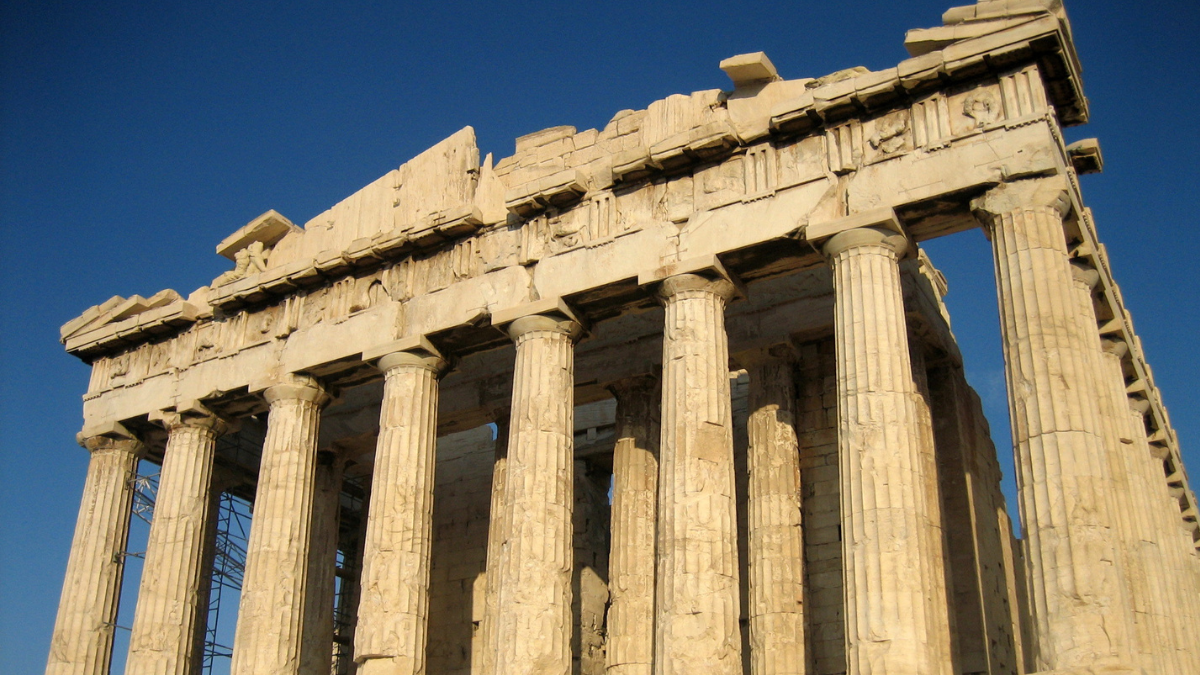
Returning to qualities widely visible in our own nation’s capital, the Greeks created marvels of aesthetic glory that still inspire today. The Parthenon (and other celebrated Greek architecture) was not only beautiful but brilliant, its columns, walls, and joints built in such a way that their angles appear perfectly aligned when, in fact, they are not. Centuries later, a Roman architect would describe texts written by the Greek architects explaining how they accomplished such a magnificent feat; sadly, those texts have not survived for historians today to study.
“The Athenians’ greatest and most famous monument, the Parthenon, celebrated the glories of their city and its democratic system, not some abstract sense of Hellenic culture,” writes Goldsworthy. “While in design and decoration this monument — at which we still marvel today — drew upon concepts and taste shared with other Greeks, it was meant to parade the glory of the Athenians as greater and better than everyone else.” It is an argument in marble and stone that stands to this day, and whose influence is ubiquitous across our national architecture, not only in D.C. Playwrights such as Aeschylus, Sophocles, Aristophanes, and Euripides in turn developed Greek comedy both to delight and to provoke discourse and debate politics.
All of these played a decisive, indelible role in the political and cultural consensus of our founding generation, who quite self-consciously drew upon ancient wisdom. They borrowed not only the political principles and aesthetic beauty of the ancient Greeks, but their appreciation for what set them apart culturally and morally from other peoples. We would be foolish (and ungrateful) to overlook that wisdom in shaping our own national heritage.