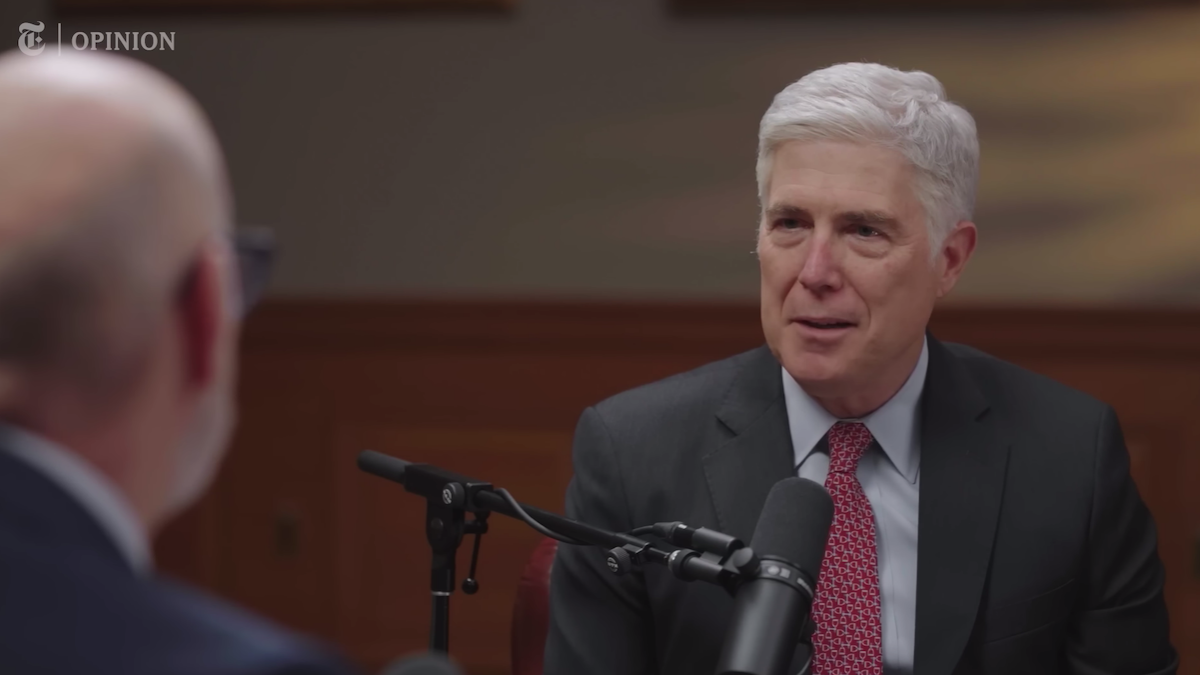

Supreme Court Justice Neil Gorsuch has done a series of interviews this week to promote his new children’s book about the Declaration of Independence and very clearly has a set of talking points, including a familiar liberal trope that’s no less false and incoherent for being familiar. America, says Gorsuch, is a “creedal nation,” essentially a set of ideas that anyone can subscribe to and become an American. What’s more, Gorsuch claims America was founded as a creedal nation — a creed that enshrines the three ideals of equality, inalienable rights, and the right of self-government.
“What unites us is not a religion, it’s not a race, it’s a belief in those three ideals,” Gorsuch told NRO in a recent podcast. To Nick Gillespie of Reason he said, “Our nation is not founded on a religion. It’s not based on a common culture even, or heritage. It’s based on those ideas. We’re a creedal nation.”
For conservative-minded Americans of a certain age, repeating this mantra that we’re a creedal nation, not a blood-and-soil nation like bad old Europe, has become something of a reflex — a defensive posture meant to deflect charges of racism and xenophobia from the left.
But it’s obviously false. One way you can tell it’s false is that no one who espouses this America-as-creed idea would ever follow through on its implications. If we were really a creedal nation, and in order to be fully American you had to believe and live by a certain civic creed derived from the Declaration and the Constitution, enshrining those three ideals Gorsuch mentions, then millions of our fellow citizens today would not be considered true Americans — to say nothing of the millions of recent immigrants who have never even heard of the ideals supposedly at the heart of our creed.
If we’re a creedal nation, such people cannot be our countrymen. If we were serious about our creed, we would denaturalize and deport them. We would expel heretics and unbelievers as readily as King Ferdinand and Queen Isabella expelled all unconverted Jews from their kingdoms in 1492. That’s what creedal nations do.
It’s telling that those most likely to invoke this notion of a creedal nation are the least likely to support something like mass deportation and denaturalization. They will declare that we’re a creedal nation but recoil if you suggest we should act like one. That’s because they either don’t understand what they’re arguing or don’t really believe it, and instead believe America isn’t a nation at all but an economic opportunity zone where anyone from anywhere can, with enough determination and skill, strike it rich.
But what of Gorsuch’s claim that we have always been a creedal nation? That our Founding Fathers in the late eighteenth century understood themselves to be creating a nation based on abstract ideals rather than a common culture or civilizational patrimony? This is fundamentally a liberal and ahistorical view of America that dates roughly from the middle of the last century. Before the 1950s, almost nothing in our history suggests that Americans thought of their country as a “creedal nation,” unmoored from a common culture and heritage, as Gorsuch insists.
As for our Founders, there is a mountain of evidence that they understood themselves in precisely these terms — as one united people derived from a common (English) culture, from which our civic creed, or principle of governance, flowed and on which it relied for its vitality. Indeed, it was the cultural homogeneity of the Founding generation that allowed for a scheme of government based on individual rights, consent, and common law.
John Jay said this explicitly in a famous passage from Federalist No. 2, that “Providence has been pleased to give us this one connected country to one united people — a people descended from the same ancestors, speaking the same language, professing the same religion, attached to the same principles of government, very similar in their manners and customs, and who, by their joint counsels, arms, and efforts, fighting side by side throughout a long and bloody war, have nobly established general liberty and independence.”
That was published in 1787. English colonists had been in the Americas for 180 years by then, and had forged a unique culture up and down the Atlantic seaboard that varied based on the areas of England from which they came. In Virginia, it was the Cavaliers from the south and west of England. In Massachusetts, the Puritans from East Anglia. Yes, they differed in many of their religious views and folkways, but so did the English counties from which they all came. What they shared in common, in addition to the English language and customs that Jay mentioned, was a Christian civilization that dated from the Roman occupation of Britain and an 800-year-old tradition of English common law.
They were in short, one united people — united not by assent to abstract Enlightenment ideals, which were assumed, but by a common culture and heritage in both America and England. Certainly, there were divisions and factions. The authors of the Federalist Papers wrote extensively about the danger of factions and how to mitigate them. But factions within that common culture were not the same as competing ethnic blocs of the kind you had in, say, the Austro-Hungarian Empire, and which the Hapsburg monarchy had to manage in a way that precluded things like unalienable rights and self-government.
In other words, the ideals that make up the “American creed” that Gorsuch invokes as the basis of our nation were themselves products of a culture derived wholly from Christian England. As one commentator on X put it: “Gorsuch misses the harder point: America’s constitutional creed was not designed to float above culture. It was built by an individualist people and assumed citizens capable of living under common, impersonal rules.”
How do we know? Because countries that have constitutions and forms of governance almost identical to ours — creedal nations, in Gorsuch’s telling — are often Third-World hellholes. Liberia, which in 1847 adopted a constitution explicitly modeled on ours, including the Bill of Rights and the separation of powers. But Liberia didn’t turn out like the United States. Why? In a post about Liberia, Jeremy Carl this week said, “Ideal constitutions flow organically from the experiences of particular peoples and can’t simply be randomly engrafted almost whole onto different peoples. Successful nations must build constitutions rooted in their own experience, history, and values.”
So if our creed isn’t exportable (and it obviously isn’t), then how could it be the basis of our nation? Mustn’t there be something else, before and above the creed, that actually forms the basis of a nation?
In a word, yes. Culture and religion are the real basis of the American nation, both of which came directly from England and found a unique expression in the American colonies. Without that heritage and history, without our civilizational patrimony, we would not be America. The creed, if that’s what you want to call it, is necessary but not sufficient to establish a nation like ours. On some deep level, elites like Gorsuch know this, but for whatever reason they’re afraid to say it, so they retreat into these nonsense arguments about a “creedal nation.”
Such arguments would be incoherent and dangerous in any era of American history, but in our time, an era of mass immigration from every corner of the world, they are especially dangerous. They are dangerous because assimilation is impossible under conditions of mass immigration, and assimilation is what’s required to avoid America devolving into a mass of competing nationalities and ethnic groups.
Moreover, it’s simply not true that anyone from anywhere can come to America and achieve anything, as Secretary of State Marco Rubio said recently in response to a question about what his hope is for this country. The reason it’s not true is that some cultures are incompatible with our American civilization, and in order to assimilate, the immigrant must discard his culture of origin and fully adopt our own. That’s possible, but it’s much harder than we often like to admit, and it never occurs on a mass scale, which is one of the strongest arguments for a limited, tightly-controlled immigration policy that prioritizes migration from countries that are close to ours culturally.
None of this is in the least racist or radical. Up until a few decades ago, it was a commonplace view, shared by most Americans regardless of party affiliation. Our elites tried to change that, to substitute a traditional (and accurate) understanding of the American nation as being a particular people with a particular culture for this undefined liberal idea that we’re a “creedal nation.”
It’s not going to work — no matter how many times Neil Gorsuch goes on camera and repeats his worn-out talking points.