
The Southern Poverty Law Center (SPLC) used donor funds to pay Ku Klux Klan (KKK) members to remain with the racist organization despite their insistence on wanting to leave, according to a new superseding Justice Department indictment.
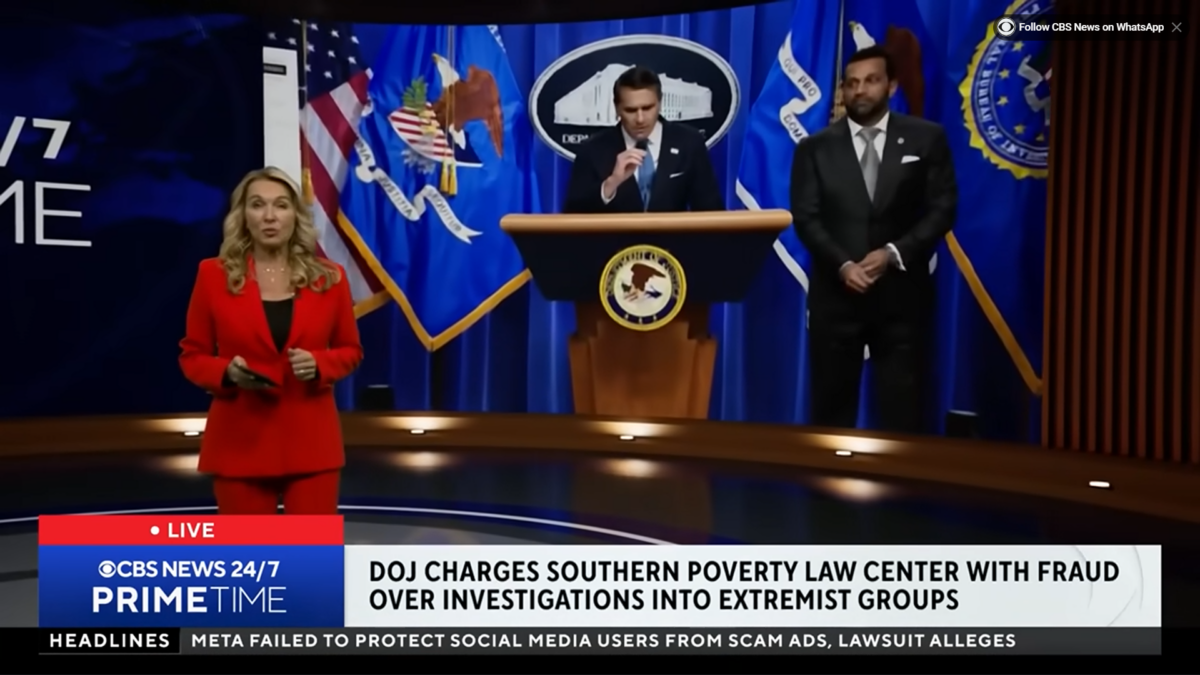
The new bombshell came as part of a new DOJ filing first reported Tuesday evening that expands on the allegations contained in the agency’s April indictment against the SPLC. The department revealed that the SPLC — a far-left group known for putting targets on the backs of conservative organizations by falsely labeling them as “hate groups” — had been charged with 11 counts related to allegedly making fraudulent payments to extremist groups like the KKK as part of a supposedly “covert” informant scheme.
In the Justice Department’s new filing are allegations that the SPLC used donor funds to pay two KKK members who “feared for their safety from other Klan members and wanted out of the movement” to stay with the racist group.
Per the superseding indictment, an individual identified as F-32 saw “media coverage” about how the Southern Poverty Law Center had previously “helped an individual leave an extremist organization.” As a result, F-32 allegedly reached out to the SPLC to ask for assistance in getting “out of the movement.” The individual also requested help on behalf of another individual (“F-31”).
Rather than fulfill their requests, the DOJ alleged that an SPLC employee “encouraged F-31 and F-32 to stay in the movement and offered to pay them a $1,200.00 monthly salary as well as to pay for expenses as incurred.” After being “financially backed by the SPLC to do so,” the two unnamed KKK members “agreed to remain in the movement,” according to the indictment.
It was at that point that an SPLC employee allegedly provided an unidentified bank (“Bank-2”) “with documentation” maintaining that F-32 was a Rare Books employee — a purportedly “materially false representation” the DOJ claimed resulted in F-32 being given “a Rare Books employee pay card.” The agency further contended that an SPLC employee subsequently instructed F-31 and F-32 to tell anyone who “asked where the money came from” that “they worked for Rare Books and that their job was to help college students research and write essays.”
“Neither F-31 nor F-32 ever researched or wrote any essays for any students, college or otherwise,” the indictment reads.
Per the DOJ, while the SPLC asserted that the alleged payment scheme was for the unnamed KKK members’ “safety,” such methods “resulted in F-31 and F-32 being put in the type of dangerous situations that F-32 sought SPLC’s help to get away from in the first place.” What’s more is that F-31 and F-32 allegedly used donors’ money to attend “extremist rallies in multiple states.”
The DOJ also shockingly claimed that the SPLC’s alleged financial activities led to F-31 “rising from merely a group member to a leadership role within an extremist group.” It was in this new post in which the individual purportedly “recruited new members using donors’ money.”
Meanwhile, F-32 similarly employed donor money to recruit new members, with one SPLC employee even knowing that F-32 “used donors’ money to purchase material to make Ku Klux Klan garments for others,” according to the indictment. The DOJ conclusively alleged that the SPLC “reimbursed” both F-31 and F-32 “with donor money for all expenses they incurred for cross-burning events to include the wood and fuel used.”
The SPLC also allegedly deployed similar tactics with a separate individual identified as “F-30.”
According to the DOJ, this person — who “led the National Socialist Party of America, was a member of the Ku Klux Klan, and was the leader of a faction of the Aryan Nations” — purportedly wanted to exit the “white nationalist movement” and sought the SPLC’s help to do so. Similar to F-31 and F-32, the SPLC allegedly paid F-30 more than $70,000 in donor funds from 2010-2016 to stay in the radical group, with F-30 supposedly using these funds to “travel to” and “host” extremist rallies, recruit new members, and “donate money to leaders of other extremist organizations.”
The SPLC pleaded not guilty to the charges brought in April, according to CBS News. The case is currently being litigated in the U.S. District Court for the Middle District of Alabama Northern Division.