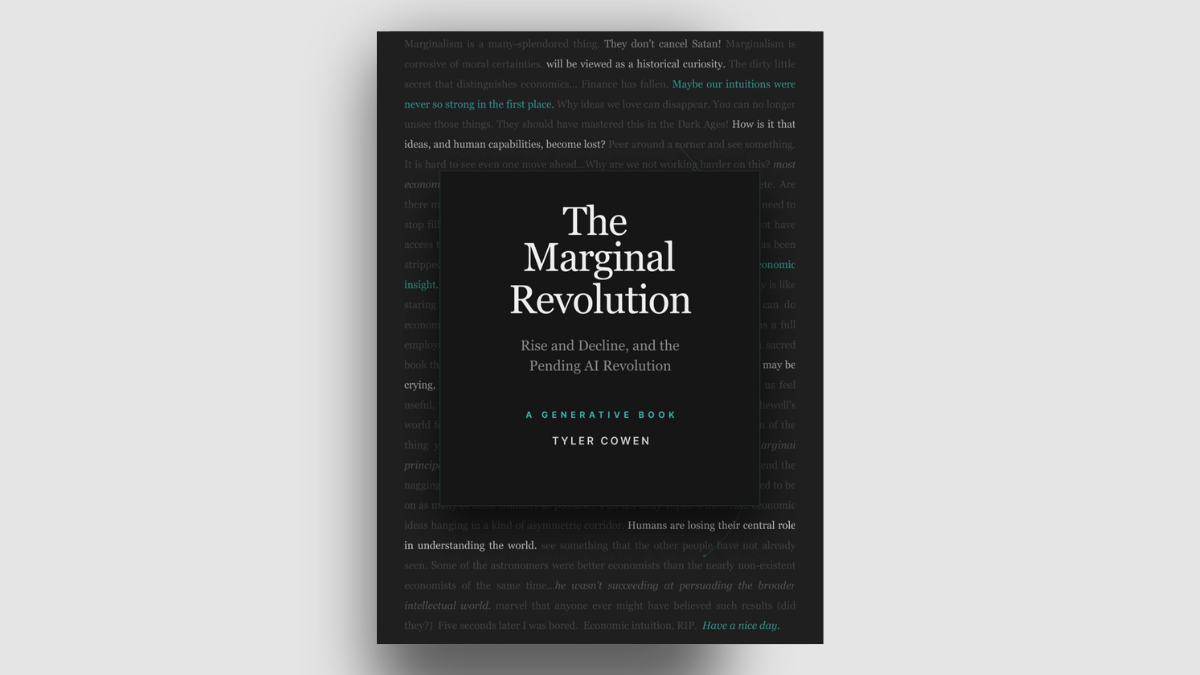

There is a particular pleasure in watching a scholar dismantle the monument he has spent a career admiring. Tyler Cowen named his blog after the Marginal Revolution; he has spent decades explicating, celebrating, and applying marginalist thinking to every aspect of modern life. In Cowen’s compact and astringent book, The Marginal Revolution: Rise and Decline, and the Pending AI Revolution, he turns to survey the edifice and finds it, if not crumbling, then visibly retreating from the frontier where the real intellectual work gets done. The result is one of the more honest performances in recent economic writing: a love letter that doubles as an elegy, delivered without sentimentality.
The book’s method is itself something of a marginalist exercise. Rather than mounting a frontal assault on large questions about the future of economics, Cowen begins at the margin, with the history of a single idea, the doctrine that value is determined not by the total utility of a good but by the utility of an additional unit of it. Many readers arrive at this book knowing that definition. Cowen’s first service is to show how much that belief has concealed. Marginalism is not one thing but several: There is intuitive marginalism, tautological marginalism, engineering marginalism, and social marginalism. The further one presses into the concept, the more it ramifies. Even the ideas we think we understand resist the grip that holds them.
The historical reconstruction occupying the book’s middle sections is patient and illuminating. Jevons, Walras, and Menger published their founding texts within a few years of each other in the 1870s. Cowen is excellent on the question of why the marginalist insight had to wait so long, and why it eventually came in a simultaneous eruption across countries and three intellectual temperaments. The answer involves the slow assembly of preconditions: advances in calculus, the rise of statistical thought, the professionalization of economics as a discipline, and certain changes in the philosophy of science associated with the Victorian debate between inductive and deductive methods. Progress in science, Cowen suggests, is rarely a matter of the lone genius, but rather of the alignment of previously dispersed elements. The genius arrives when the ground has been prepared to receive the insight.
What makes the historical narrative more than antiquarian is the analogy Cowen is building toward. If marginalism was unthinkable until a cluster of preconditions converged, then we should attend carefully to the convergences happening now. If the history of an idea teaches that even paradigm-making insights can retreat, as Cowen shows marginalism retreating from the frontiers of financial economics, empirical research, and even price theory, then we should not assume that the organizing ideas of our current scientific moment are permanent fixtures. The lesson of The Marginal Revolution is that even good ideas have their season.
On the decline of marginalism, Cowen is at his most penetrating. The case study of financial economics is vivid and chastening. The Capital Asset Pricing Model (CAPM) and its descendants, all built on the diminishing marginal utility of money, dominated financial research for decades. Then Eugene Fama and Kenneth French published their 1992 paper showing that Beta, the central variable of the CAPM framework, had essentially no explanatory power over expected returns. That was the beginning. Now, the hedge funds and trading firms that once hired economists with degrees in finance from MIT increasingly hire mathematicians, computer scientists, and physicists. The quants have not merely supplemented marginalist reasoning; they have displaced it, field by field. A 2024 paper in the Journal of Financial Economics found that machine learning feeding on raw price data without any theoretical structure derived from marginalist principles successfully predicted stock returns where conventional economic theory had long since given up hope of doing so. The model had no economic intuitions embedded in it.
The scene Cowen paints is that of an idea being automated. Marginalism will not disappear from the large language models (LLMs) trained on a century of economic writing. The training data contains the idea, Cowen dryly notes, along with the Four Gospels and a great deal else. But the economists of the rising generation cannot think fluently in marginalist terms the way their predecessors could. They can run robustness checks with formidable precision. They cannot, as Cowen discovers when interviewing job candidates from top graduate programs, reason their way through a price theory problem on their feet.
Cowen reports this observation without the despair one might expect from a devotee of price theory. The tone throughout is that of a man who has understood something and accepted it, who knows that the elegance of a marginalist argument about homeless persons gravitating to cities with high amenities is a form of pleasure that the coming machinery cannot replicate but also does not need to.
The book’s final movement, on artificial intelligence, is where Cowen’s argument becomes most searching. LLMs already match human crowds in forecasting tournaments. Machine learning generates hypotheses, e.g., about the features of a defendant’s face that predict a judge’s sentence or the nonlinear structure of asset returns, that no human researcher would have entertained. Researchers at MIT and Harvard have designed a method for what they describe as “fully automated social science,” in which LLMs play the roles of both scientist and experimental subject. An “AI scientist” writes papers, runs simulations, and generates a review process, all without human intervention. These papers are probably not yet publishable in premier journals. They are, Cowen implies, the weakest versions of the thing we will ever see.
What distinguishes this account from the usual techno-prophecy is Cowen’s refusal to make it triumphalist or catastrophist. He does not predict that economics will become obsolete, or that human judgment will shortly be irrelevant. He suggests instead that the transition now underway rhymes with the transition of the 1870s, a moment when a set of preconditions suddenly aligned, a new method proved itself superior to old intuitions, and the intellectual landscape was reconfigured in ways that could not have been foreseen from within the old framework. The original marginalists did not know they were starting something. The researchers building AI systems for economic analysis may not know either.
There is a discomforting codicil to all of this. Perhaps, Cowen suggests near the book’s end, the intuitions of 20th-century microeconomics were always a kind of compensation for a deeper ignorance. Perhaps we elevated intuitive reasoning, with its clean parables of marginal utility, and elegant supply-and-demand diagrams, because they were what we had, and we mistook their availability for adequacy. Machine learning models that find hundreds of thousands of factors in financial data are not exactly refuting marginalism. They are revealing the scale of what marginalism was never equipped to see. Our intuitions were always a small corner of understanding, swimming in a larger froth of epistemic chaos. The illusion has been stripped bare.
This conclusion is not comfortable, and Cowen does not soften it. He is, as in his best work, a clear-eyed observer who has learned to see the world from outside the assumptions he was trained to hold. That capacity, rare in an academic, is what makes this brief and rigorous book more than a footnote to intellectual history. The work is instead a standing invitation to look squarely at the margin where the human and the algorithmic are presently meeting, and to admit that we cannot yet see what lies beyond it.