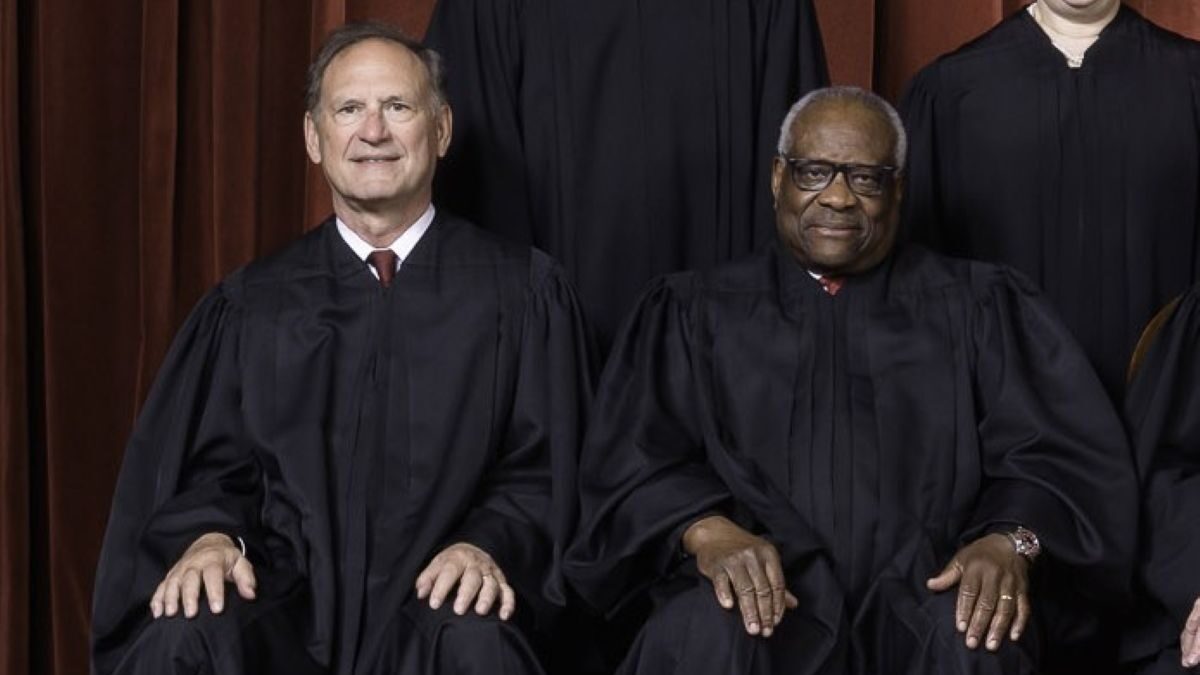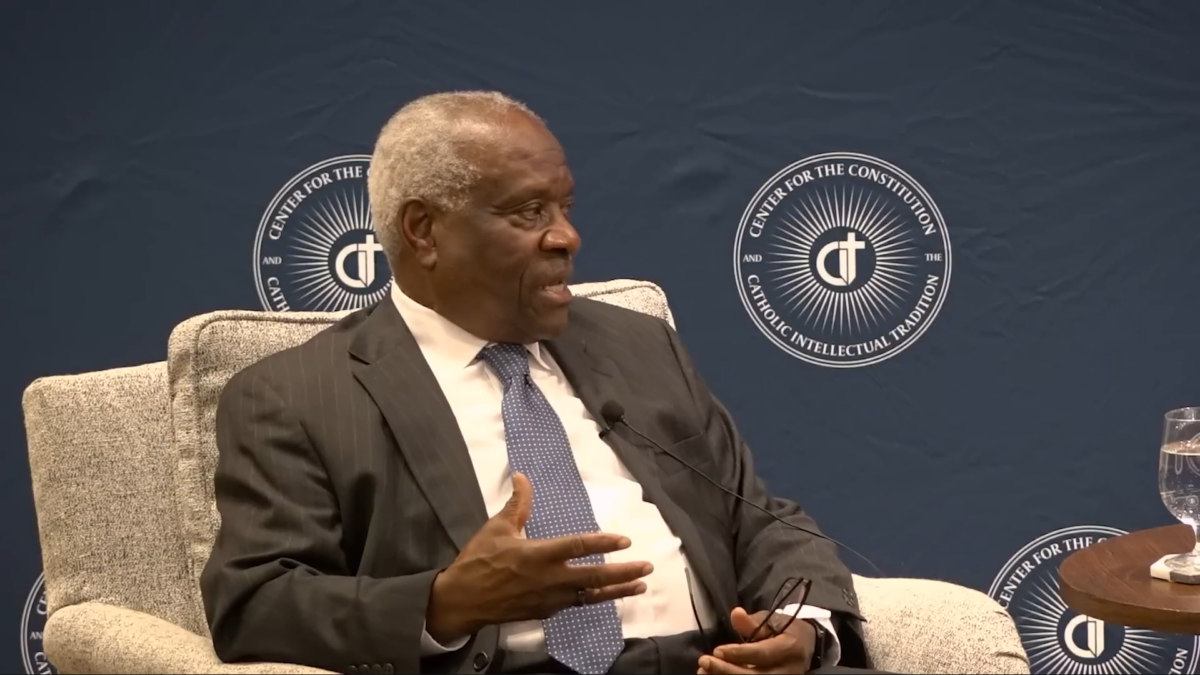
Justice Clarence Thomas is calling for the Supreme Court to examine the constitutionality of state restrictions on guns in “sensitive places.”
The justice’s remarks came in the high court’s Monday order list, in which the court declined to take up and hear arguments in Novotny v. Moore. The case deals with a challenge to Maryland’s prohibitions on gun owners carrying firearms in “sensitive places,” such as public demonstrations, mass transit facilities and vehicles, healthcare facilities, and more.
In his opinion respecting the denial of cert, Thomas said that he agrees with the court’s decision to reject the case because “each Maryland statute implicates a distinct historical tradition of firearm regulation,” and as such, “the breadth of petitioners’ challenge would complicate our review.” The justice added, however, that he is “skeptical” of the restrictions’ constitutionality and encouraged the high court to address the issue in future cases that come before them.
“In an appropriate and more narrowly focused case … we should consider the scope of States’ authority to ban firearms in ‘sensitive places,'” Thomas wrote. “The Second Amendment recognizes the people’s ‘inherent’ right to keep and bear firearms, a right that admits of only historically grounded exceptions. … Thus, when a State seeks to restrict the right to bear arms — including by limiting the places in which a law-abiding citizen may carry his firearm — the State must root its law in the Second Amendment’s ‘historical understanding’ by ‘demonstrat[ing] that the regulation is consistent with this Nation’s historical tradition of firearm regulation.'”
The justice cited the court’s 2022 NYSRPA v. Bruen decision, in which the (6-3) majority affirmed Americans’ constitutional right to carry firearms outside the home for self-defense. The landmark decision created a two-step test that courts must use assessing gun restrictions possession. The majority said courts must first assess whether the regulated conduct is covered by the Second Amendment’s plain text, and if so, determine if that regulation is consistent with the nation’s “historical tradition of firearm regulation.”
Thomas acknowledged that the Supreme Court has previously recognized “a limited tradition of States’ regulating the right to carry firearms in certain ‘sensitive places.'” He underscored, however, that such a tradition “was narrow,” and that “expanding the category of ‘sensitive places’ … to all places of public congregation … would eviscerate the general right to publicly carry arms for self-defense.”
“Nevertheless, States have seized on the idea of ‘sensitive places’ to prohibit the peaceable carry of firearms in locations that bear little resemblance to legislatures, polling places, or courthouses,” Thomas wrote. “These restrictions stand on questionable historical ground. And, their cumulative effect is to prohibit firearms wherever people gather for eating, drinking, recreation, amusement, and free speech — an affront to the right of ‘law-abiding citizens’ to ‘carr[y] arms in public for’ their ‘ordinary self-defense.'”
The senior justice concluded his opinion expressing “serious doubts” about the legality of these restrictions under the country’s “historical tradition of firearm regulation.” “In an appropriate case,” he added, “this Court should consider whether particular sensitive-place laws are consistent with the right to public carry.”
Thomas’ remarks come weeks before the Supreme Court is set to hold oral arguments in Viramontes v. Cook County and Grant v. Higgins. A final decision in the consolidated cases will address the legality of bans on AR-15s and similar semiautomatic rifles.