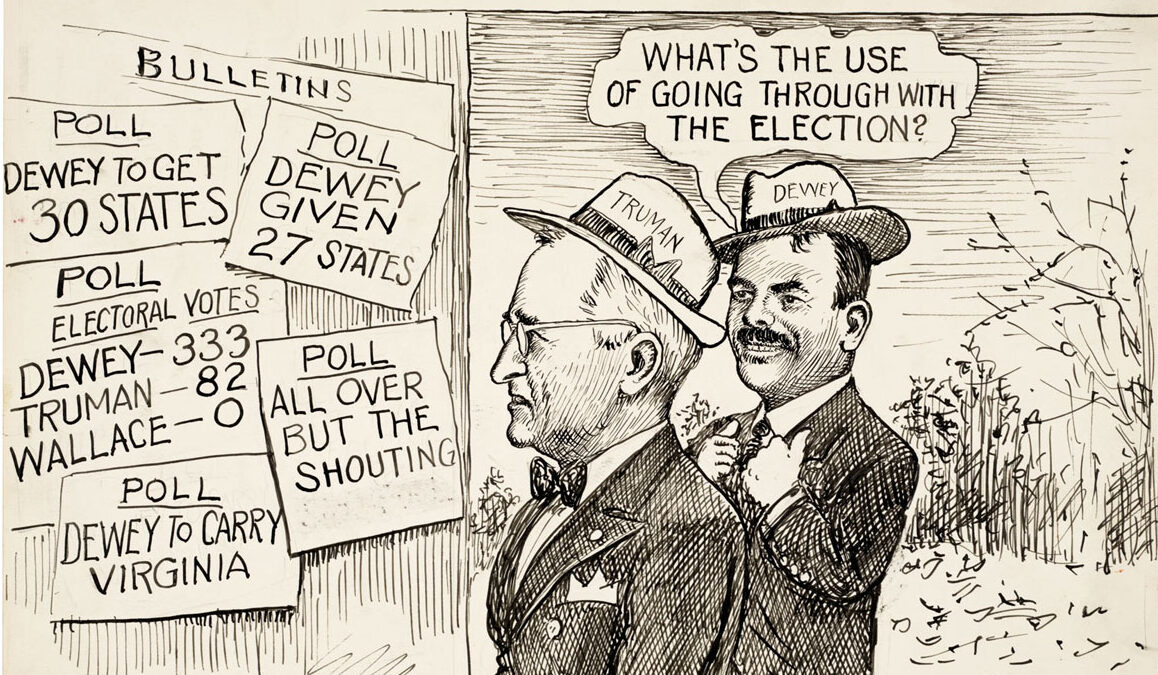

With the midterm election fast approaching, there’s a great deal of speculation about the accuracy of the polls. Democrats are generally hoping that the polling is right, as it suggests they are poised to take control not only of the House of Representatives but probably also the Senate. Correspondingly, Republicans are hoping the polls are wrong. They speculate that conservatives are more distrusting of pollsters and therefore less apt to respond to their inquiries, and that the polls aren’t adequately adjusting for this.
There is no way to know for sure whose hopes are more realistic. At the same time, we aren’t flying completely blind. We now have a track record of Senate polling across five prior federal elections in the Donald Trump era. If we assume that polls will perform as they have typically performed on a state-by-state basis throughout this era, what would that mean for this election?
The 13 states whose 2026 Senate races are generally thought to be the most competitive have each already had at least three Senate elections during the Trump era (from 2016 to 2024). If we take how the two parties’ Senate candidates fared in the final RealClearPolitics (RCP) average of recent polling in those races and compare that with how they fared in the final results, we can see whether polling underestimated one party or another in a given state — and by how much.
Take New Hampshire, for example. In 2022, the RCP average suggested that Democrat Maggie Hassan would win by 1.4 percentage points over Republican Don Bolduc in their Senate race. Hassan actually won by 9.1 points, so the polls underestimated her — and hence the Democrats — by 7.7 points in that race. In 2020, there wasn’t enough Senate polling in New Hampshire to generate an RCP average, but the six polls taken entirely in October or November underestimated the Democrats’ margin of victory by an average of 0.9 points. In 2016 Senate polling, the RCP average underestimated the Democrats’ final winning margin by 1.7 points. So, across the Trump era, polls have undersold the Democrats by an average of 3.4 points per year in Senate elections in the Granite State.
Among the 13 most competitive states this time around, New Hampshire joins Minnesota (where Democrats have fared, on average, 2.3 points better than expected) as the only two states where, in Senate races during the Trump era, the Democrats have done noticeably better than polling indicated they would. In three other states, polling has, on average, been within 1 point of the final margin — underestimating Democrats by 0.3 points in Georgia and underestimating Republicans by 1.0 points in Texas and Ohio. (Unlike most states, Ohio had four Senate elections over this span, but only the three that were competitive enough to produce RCP averages are included in this analysis. In all other states, all Senate races are included.)
In four states, meanwhile, Republicans have fared noticeably better than Senate polling predicted — by an average of 1.7 points in North Carolina, 2.5 points in Michigan, 3.6 points in Iowa, and 4.3 points in Maine. In four other states — Kansas, Nebraska, Alaska, and South Carolina — there hasn’t been enough polling in prior Trump-era Senate races to draw any real conclusions about polls’ specific level of accuracy (although the few polls that have been taken in these states have generally underestimated Republicans).
So, if we adjust the current RCP averages (as of the morning of October 26) to reflect the errors that polling has generally made in each state’s Senate races in this era, we can perhaps see a truer state of play. Applying this approach to the most competitive states in 2026, here is a list of those races in order, from those that most favor the Democrats to those that most favor the Republicans:
- New Hampshire, Democrats by 9.9 points (their 6.5-point lead in the current RCP average is adjusted to reflect that state’s average 3.4-point move toward the Democrats in the final results)
- North Carolina, Democrats by 8.9 points (versus 10.6 in the RCP average)
- Georgia, Democrats by 8.5 points (8.2 at RCP)
- Minnesota, Democrats by 5.7 points (3.4 at RCP)
- Ohio, Democrats by 2.3 points (3.3 at RCP)
- Alaska, Democrats by 1.2 points (because there is no reliable prior polling in Alaska, this merely reflects the existing RCP average)
- Texas, Democrats by 0.5 points (1.5 at RCP)
- Kansas, Republicans by 0.3 points (merely reflects the existing RCP average)
- Michigan, Republicans by 0.6 points (Democrats by 1.9 at RCP)
- South Carolina, Republicans by 2.7 points (merely reflects the existing RCP average)
- Maine, Republicans by 2.9 points (Democrats by 1.4 at RCP)
- Iowa, Republicans by 4.2 points (0.6 at RCP)
In the 13th state, Nebraska, there hasn’t been sufficient polling to generate an RCP average this time around, because Republicans are generally thought to be in the driver’s seat in that race.
With these adjustments, three of the 13 most competitive races don’t really look very competitive at all — as New Hampshire, Georgia, and North Carolina are almost surely headed into the Democrats’ column. Of the 10 other races, all of which look competitive, the Democrats need to win five to take control of the Senate, while Republican need to win six to maintain control. Counting Nebraska, the Republicans currently (as of Oct. 26) have the lead in six — based on this analysis — but in two of those, they lead by less than a point. In other words, control of the Senate is very much up in the air.
This is true because polling is rather close in so many states and also because there’s a wide range of possibilities in a few states. In Maine, the current RCP average (as of Oct. 26) suggests that Republican incumbent Susan Collins will most likely lose narrowly. But in addition to the fact that the average Senate polling error in Maine during the Trump era has been large enough to swing the race in her favor, Collins outperformed polling by about eight points in both of her two most recent races prior to the Trump era as well. If pollsters have finally figured out how to poll her races, she looks to be on track to lose narrowly. If the usual polling errors in her races are repeated again this year, she’ll win comfortably.
In Alaska, there has been little polling this time around and even less polling in the past, so there isn’t much evidence of how reliable Alaska Senate polling is in the Trump era. In Ohio, meanwhile, polling has been quite accurate (always within 2.5 points of the final margin, either way), so the Democrats’ lead there in current polling is presumably more meaningful than it would be in most states. In Texas, polling has been off by more than 3 points in every Senate election in this era, but not always in the same direction. Indeed, control of the Senate could well hinge on whether polling in the Lone Star State underestimates the Democrats, as it did during the last midterm Senate election held there (in 2018), or underestimates the Republicans, as it did during the two most recent Senate elections held there (both during presidential-election years).
In all, it seems likely that Iowa, New Hampshire, and Minnesota aren’t as close as polling suggests. Michigan, however, is likely closer than polling suggests — even without factoring in that Abdulrahman El-Sayed fared notably worse in his party’s primary this year than polls indicated he would. And the candidate with the best chance in Maine is likely the one trailing in the polls.
Prior years’ polling errors won’t necessary be repeated. But in New Hampshire, Minnesota, Michigan, and Iowa, the errors have continued to be in the same direction, and by similar-sized margins, throughout Senate races in the Trump era. Dating back to 2008, something similar has been true in all races involving Susan Collins.
If the Democrats buck Trump-era polling trends and win in Maine or Iowa (or in South Carolina), or if the Republicans do so by winning in Ohio or Minnesota, that will probably give that party control of the Senate when the dust settles. But if Trump-era polling trends continue, control of the Senate will most likely hinge on the results in Texas and Michigan — and on the heavily Republican states of Alaska and Kansas, in which polling doesn’t provide us with much of a guide. Republicans will probably need to win in two of those four states (or in three if they lose in Maine) to avoid giving the Democrats the Senate reins.