
Along with annoying girlbosses, forced diversity, and predictable narratives of class oppression, one major signifier of a wokeified product is the complete inversion of good versus evil. Creators of popular entertainment deconstruct heroes and reimagine them to be privileged jerks with sinister motives, while they redeem villains by imbuing them with justifiable reasons for their villainy. In accordance with this, the creators of the past 15 years have churned out endless slop telling a familiar story from the villain’s perspective or deliberately making the hero flawed to the point of becoming unlikeable.
Naturally, writers will pretend that this treatment adds dimension and nuance to their stories, exploring common tropes and themes from different sides and subverting harmful narratives. In reality, it makes an incoherent, dissatisfying mess of the story and deprives it of any deeper moral meaning or lessons about the human condition. If woke entertainment succeeds in anything, it is to erode clear moral standards and relativize good and evil. No one is good or bad, nothing is right or wrong, and everything is a matter of perspective.
Not only has this mindset ruined modern entertainment, but it has also done the same to political and cultural discourse and in the same way. No one is simply good or evil — except Donald Trump, of course — they are simply acting according to their beliefs or “their truth.” Consequently, it becomes impossible to judge people with power and influence. Even if what they do is horribly unjust and destructive, they can never be called evil.
But what if these individuals really are evil? What if they knowingly do harm in the interest of enriching themselves, amassing power, and picking on those who are weaker than them? Would it not be more appropriate to label such people villains — even supervillains — to be clear on who means to destroy the country and make life miserable for everyone? And wouldn’t this be good to know before voting in the midterm elections this coming November?
Today’s Worst People
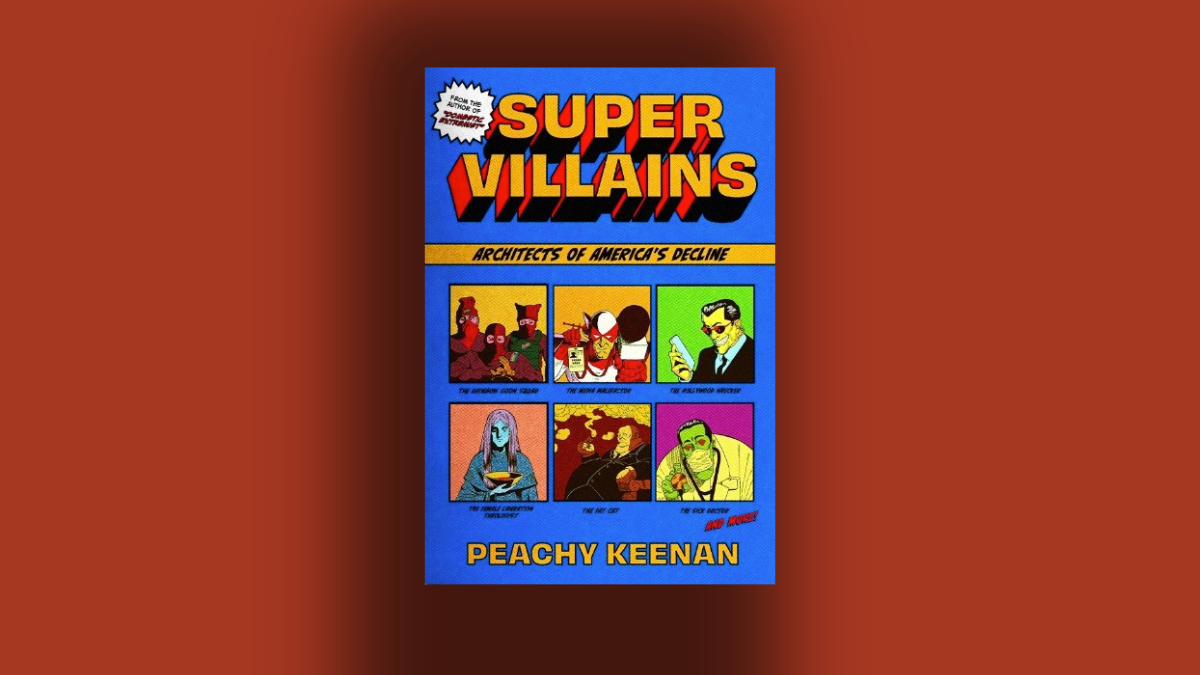
It most certainly would, which is why writer Peachy Keenan has written Supervillains: Architects of America’s Decline. With her usual wit, Keenan catalogues today’s worst people actively destroying the country. The list is long and includes well-known figures from science, politics, business, culture, and academia. Although leftists are usually the ones deeming their opponents evil, Keenan demonstrates that conservatives have the much stronger case. Moreover, these problems will only worsen if conservatives remain ignorant about their perpetrators.
In the interest of relevance and keeping her book to a manageable length (290 pages instead of 2,900 pages), Keenan limits her review to the present day, although many of the names got their start during the dark days of Covid six years ago.
As such, she begins with the public health officials, the oxymoronically labeled “Sick Doctors” who swore up and down that the Covid virus came from a Chinese wet market and that the vaccine was safe and necessary. Before they were doing this, though, they were leveraging their unquestioned medical authority to push transgender interventions on vulnerable minors. In retrospect, it should not have been a surprise to see these unaccountable “medical professionals” with no discernible conscience capitalize on a serious health crisis for nefarious purposes.
This dynamic of using their elite status to exploit crises or fabricate them altogether is repeated endlessly with the other supervillains. There are the “Great Replacers” who flood the country with immigrants and demonize critics as bigots; the “Female Liberation Theologists” who promote toxic feminism, abortion, sexual promiscuity, and transgenderism, all for the purpose of ruining men and making women as miserable as themselves; the proud members of the “American Injustice System” who do their utmost to keep criminals on the streets, punish do-gooders, meddle in elections, and shake down organizations that aren’t sufficiently woke; and the “DEI Hards” who have drained away all competency and fairness from every institution, elevating race hustlers and career criminals while silencing and suing conservatives who call this out.
Not surprisingly, Keenan particularly shines in her criticism of today’s cultural supervillains “executing a hostile takeover of our cultural output” since this is the world she comes from. The first of these are the “Illiterati,” the ultra-woke leftists who rule the literary world with a rainbow-colored iron fist. Keenan is hilariously candid about what has become of today’s literature because of these people:
A tiresome array of stale, postmodern tropes are still going strong in the publishing industry: gender confusion, trans kids, abortion memoirs, threesome memoirs, divorce memoirs, the cozy story your abuela told you before she handed you over to human traffickers, the evils of slavery, “growing up brown in a racist world,” “growing up female in a misogynist country,” the plight of the immigrants and the refugee, the evils of white men, the struggle of angst ridden teenage asexual werewolves: it’s all there between the covers.
Naturally, she follows this up with a plethora of receipts to prove that this is intentional and just as bad as it sounds. Although the Illiterati turned away the majority of potential readers from contemporary literature, they were a major influence on the group responsible for wokeifying popular entertainment: the “Hollywood Wreckers.”
These are the genius producers and filmmakers who destroyed popular franchises in the name of female empowerment and diversity — Star Wars, Marvel, The Lord of the Rings, Disney Princess movies, and now The Chronicles of Narnia. They also ruined popular books adapted to film like Little Women, A Song of Ice and Fire, and The Three-Body Problem. It’s clear that these people are the ones most responsible for the current miserable state of Hollywood.
My favorite chapter in the book concerns the crazy-rich ex-wives and widows of the world’s richest men. As Keenan rightly notes, “The former wives of billionaires may make up the tiniest demographic of supervillains, but together they are doing more damage than all the male supervillains combined.” She goes on to discuss the odd phenomenon of divorcees Melinda Gates, MacKenzie Scott Bezos, and widow Laurene Powell Jobs shoveling billions of dollars to leftist organizations devoted to destroying the West.
My other favorite chapter, “Biohackers,” describes a group of mad scientists who could stand to have a little more attention. These are the eugenicists at Orchid, trying to “have a ‘cure’ for genetic abnormalities and disease” by killing live embryos; the “‘bodyoid’ researchers” who manufacture “cloned humans, grown in artificial wombs, genetically modified to lack brain stems, and kept alive for their owner’s organ needs”; and the “Baby Merchants” who run surrogacy clinics where babies are essentially manufactured as sellable merchandise to homosexual couples. Once again, Keenan’s incisive honesty about these individuals helps bring out the unappreciated truth that what they are doing is almost unfathomably evil.
Keenan also discusses the “Media Malefactors” who are the demagogues and shills who use their platforms to inform their sheep-like audiences about politics, the “Fat Cats” who use their immense capital to influence society and bankroll underhanded political projects, and the laughably incompetent leaders and representatives of “Motel California.”
Before moving into her conclusion, Keenan devotes two brief chapters to the “Supervillain Dynasties” and “Lesser Villains,” which respectively consist of elite families with legacies of failure and corruption and non-elites who nevertheless partake in destructive and disreputable behavior. For readers interested in talking sense to these lesser villains, many of whom they probably encounter daily, Keenan provides a helpful lexicon to dispel some of the confusion that tends to arise in these conversations.
Laughing at Evil
Finally, the book ends with some suggestions on how to deal with this large cast of supervillains. This mainly consists of seeing past their propaganda, bravely speaking the truth, and following the pro-family, just-be-normal advice of her book Domestic Extremist. Rather than seeking to understand, accommodate, and even imitate these elites, people should recognize such types as the supervillains they are and thwart them as much as possible. After all, “they’re essential to the timeline. To the story. … You can’t have a great hero unless he’s got a great bad guy to fight. It is our fate, I’m afraid, to always be locked in a war with people who think they’re the good guys and just exterminate the other side and they’ll reach their version of the Promised Land. Tale as old as time!”
Overall, Keenan is funny, concise, and surprisingly profound (see the quote above) in her analysis. She wisely avoids simply dishing out red meat to a conservative audience or making glib equivocations between both sides in the vain attempt to seek out common ground. Yes, this conflict largely takes place beyond the right-left political and cultural spectrum, and it stems from certain fallenness in human nature, but at the moment, the worst offenses are overwhelmingly coming from the leftist worldview. While all human beings have the capacity to become villains, and some even have the means to become supervillains, it is undeniable that leftism is facilitating and encouraging the bulk of today’s evils.
With the midterms coming up, American voters would do well to read Supervillains and remind themselves of how far we have come as a society and how far we have to go. Sometimes, life isn’t so morally gray and indeterminate. Sometimes, the evil is so apparent that one can’t help but laugh at it like Peachy Keenan does. And sometimes, there comes a moment when one hears the call to heroism, dispenses with the usual misgivings, and proceeds to save his world from the villains destroying his country.