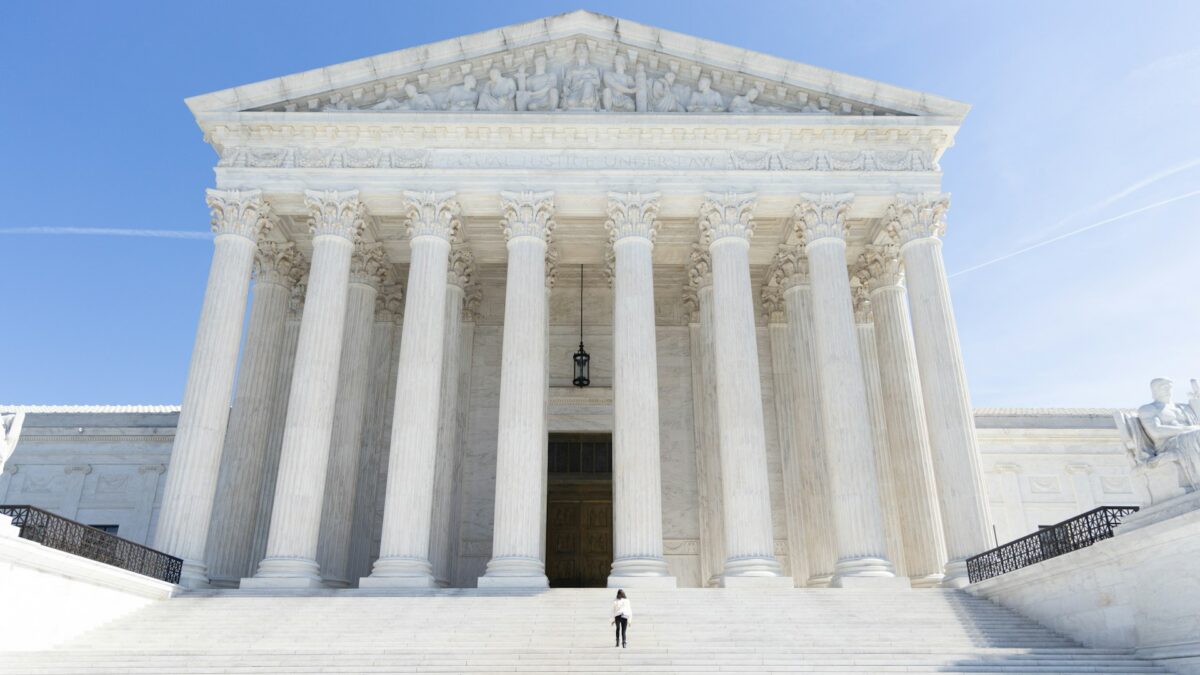

On Monday, the Roberts Court struck a massive blow against the administrative state when, in a majority opinion drafted by the chief justice, the court affirmed in Trump v. Slaughter that “the President may remove his subordinates” within so-called independent agencies “at will.”
It should have been a given that in agencies subject to executive control and exercising executive authority by way of executive-appointed principals, the executive would be free not only to hire but to fire such principals — that “independent agencies are not ‘independent’ in the sense that they are free of the President,” as the court declared. But for more than 90 years, precedent in Humphrey’s Executor shielded the likes of the plaintiff, Rebecca Kelly Slaughter, a Democrat-appointed Federal Trade Commissioner, and other leaders in the alphabet soup of multimember agencies from accountability.
Now, it seemed, the justices were putting an end to the chimera of agencies possessing a mix of powers of the three branches of government, untethered from democratic control, and unaccounted for in the Constitution.
Yet in classic Roberts Court form, it snatched partial defeat from the jaws of total victory, when on Monday it also handed down a confounding and contradictory counterpart ruling — suggesting our Constitution abides a fourth branch of government on self-evidently political grounds.
While in Slaughter the court declared that the president could remove his independent agency subordinates for any reason at all, in Trump v. Cook the majority, again led by Chief Justice Roberts, carved out an exception for the Federal Reserve.
Like other independent agencies, the Federal Reserve’s Board of Governors has substantial regulatory and other executive powers. Like other independent agencies, the board consists of presidentially appointed members. And like other independent agencies, the board’s originating statute says the president may remove such members “for cause” — a condition that Slaughter would seem to have invalidated. Yet the court found that in the case of the president’s attempted firing of Democrat-appointed board member Lisa Cook — on grounds that this principal with awesome power over monetary policy and the financial system appeared to have committed mortgage fraud — he in fact was not free to fire her at will.
Far from it.
The court instead found that the judiciary had the power to review her removal; that “cause” is more than just the president’s concern about her conduct or fitness for the position; that, despite the Federal Reserve Act’s silence on the process for removal, and having never before created such a right for an equivalently situated appointee, Cook was due official notice and hearing prior to removal; and that she could remain in office while litigation was pending — the immediate matter before the court. Cook had secured a preliminary injunction halting her removal that the Trump administration had appealed all the way up to the Supremes. In upholding that injunction, keeping a fired executive officer in her seat, the court apparently acted in unprecedented fashion.
Why? Because in the views of five justices, The Fed is “special.”
In the court’s telling, our central bank is the salve to the financial chaos and calamity that marked America prior to its establishment; it is apparently wholly apolitical; and to permit a president to remove members at will would at minimum create the appearance of corruption.
The Founders “knew from experience…of the calamities that could arise from even the ‘suspicion’ of political manipulation of monetary policy,” Chief Justice Roberts wrote.
“So when they established the First Bank of the United States, they guaranteed its independence from Presidential control. Their successors did the same for the Second Bank. That enabled both banks to serve as the ‘great regulating wheel’ of the early American financial system…”
“What matters,” the chief justice concluded, “is that the Federal Reserve remains ‘consistent with the principles that underpin’ the First and Second Banks — namely, that monetary policy should not be subject to political interference.”
To have ruled otherwise in Cook then “would in effect transform the Federal Reserve’s for-cause protection into at-will employment — an interpretive leap out of step with the statute Congress enacted and our Nation’s tradition of central banking protected from political interference.”
And to have refused to weigh in as the court did would be “to sow doubt as to the status of one of our Nation’s (and the world’s) most important financial institutions.”
All of which is to say that the court’s majority, led by Chief Justice Roberts, acted politically, not on the merits. It did not explain how and why the Federal Reserve Board of Governors is constitutionally distinct from other independent agencies, and thus why its appointed members should get special treatment. Instead, it relied upon “history” or “tradition,” and purportedly not wanting to create potential volatility in the economy and financial markets.
The Roberts Court was not similarly concerned with the volatility and broader economic and geopolitical consequences of upending a global tariff regime and associated negotiations; or our adversaries’ sending of their citizens en masse to the U.S. to have children; or legitimizing the destruction of a health care system representing more than one-sixth of the U.S. GDP.
But that is the least of its issues, as Justice Thomas exposed in a blistering dissent.
While Justice Thomas’s arguments on the demerits of Cook’s case for an injunction, and various other deficiencies in the court’s reasoning are all worth reading, it is his constitutional argument that is most significant.
The Fed, as Thomas details, was effectively a German import modeled on the Reichsbank, flowing naturally from then-President Woodrow Wilson’s progressive ideology calling for centralized administration of virtually everything, including monetary and banking policy. Thomas takes issue with the court’s apparently pollyannaish view as to The Fed’s purported successes, and its elitist view that it has protected us from “the ‘common people’ who play the antagonist in the court’s account of the 19th century.”
But more importantly, he explains, the Federal Reserve Board of Governors was endowed with executive powers. And, contrary to the majority’s narrative, it fundamentally differs in nature and design from our first two national banks, which neither set monetary policy nor regulated, held reserves for, nor served as the lender of the last resort for other financial institutions.
Given that it holds such powers, he says, the court’s insulation of the Federal Reserve Board of Governors from firing conflicts with the president’s Article II powers.
“[I]f the Court prefers an independent Federal Reserve Board,” he writes, “then its issue is not with the President but with the Constitution. Regardless of whether unaccountable executive officers like Cook would better govern the economy, the Framers rejected such a ‘promised land of technocratic governance…’ They instead chose government by the people. As a court, our duty is not to second-guess that decision, but to uphold it.”
As Justice Amy Coney Barrett put it in another dissent, “the Court’s holding is in serious tension with Trump v. Slaughter.”
And as Justice Samuel Alito noted in his dissent, the court’s handling of the case was “impruden[t].”
“What is before us is simply an application for a stay pending appeal, and the Court should have granted or denied that application in a brief order last fall. The nascency of this lawsuit and the novelty of the issues that it presents militated against holding oral argument and issuing a comprehensive opinion at this juncture,” he added.
Instead, Barrett wrote, the court dealt with a whole slew of complex issues, including “the constitutional status of the Federal Reserve,” which was “entirely outside the scope of this case,” settling the matter with just “a few paragraphs.”
It is rumored that Chief Justice Roberts was calculating even in the timing of the release of his Cook decision.
How to explain the release of two seemingly irreconcilable opinions, the Court’s ruling on hugely consequential matters despite the early posture and narrow scope of the case at hand, and other alleged machinations?
One can only conclude that as is the Roberts Court’s hallmark, it acted politically in a bid to “defend the institution” of the court at the cost of the Constitution.
In turn, ironically, it has once again undermined its own legitimacy.