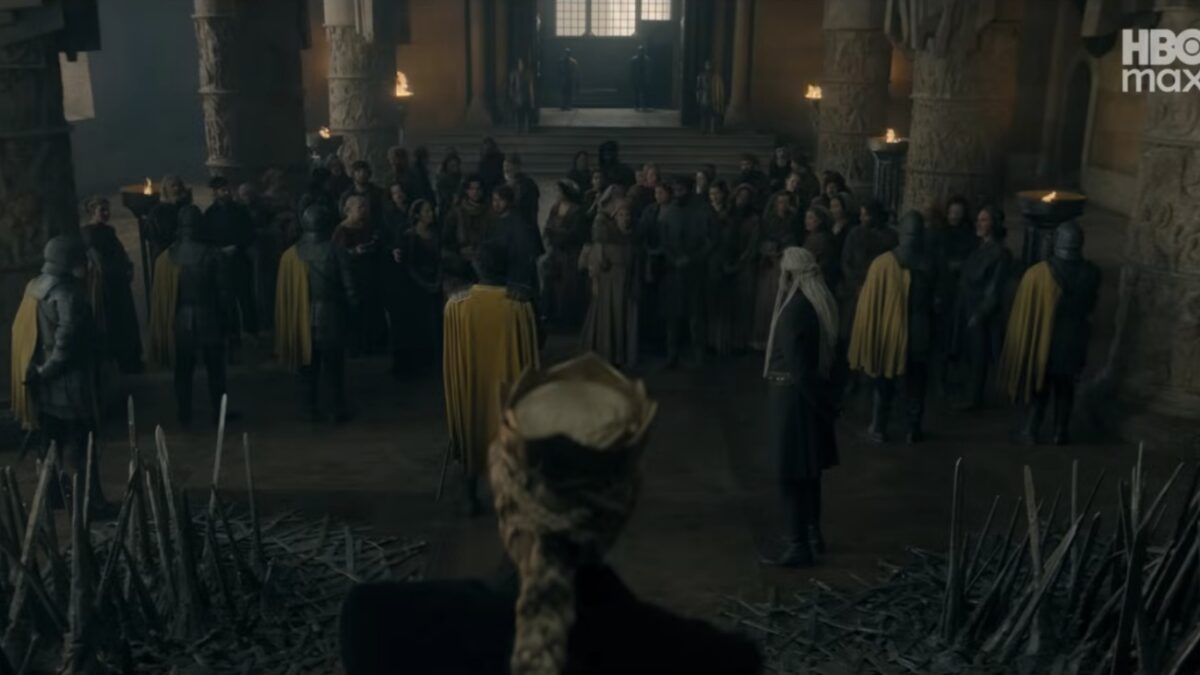

House of the Dragon is a feminist show. Don’t take my word for it: showrunner Ryan Condal described the Game of Thrones prequel as “a true feminist story that explores the strengths and shortcomings — warts and all — of the two women at the center of it” in an interview with Variety. The other lead showrunner, Sara Hess, echoed that statement, saying in a behind-the-scenes video, “there are armies, there are dragons, there’s castle strongholds and political maneuvering, but at the end of the day, it comes down to these two women trying to figure it out.”
Why, then, are all of the best characters men?
It’s a contradiction that’s worth examining closer because it sits at the heart of the series. The first episode of season three, which released on June 21, featured a massive battle and was generally well received. But more quietly, the beginning of that season made it clear the character rot that began in season two will continue to fester.
It’s not wrong to say that two women, Rhaenyra Targaryen and Alicent Hightower, are at the center of the “Dance of the Dragons.” But what Condal and Hess have done is change a story where two women are the paramount political actors to one where they are impotent moral compasses. Olivia Cooke, who plays Alicent, told The Hollywood Reporter that she and Rhaenyra are “both surrounded by [male characters] being idiotic. And we know if all these men just f—-d off, and it was just us two, the realm would be fine. It’s the meddling and the peacocking and egos that completely muddy everything.”
Creator George R.R. Martin’s versions still face prejudice because they’re women, but they’re also driven by recognizably human flaws — anger, pride, spite, vindictiveness. If there’s a feminist reading of the story, it’s that they help drive history rather than merely endure it.
Powerless Women
The problem with House of the Dragon is that it needs Rhaenyra and Alicent to be benevolent and capable, but it also needs to deliver on the fundamental premise of the show: a bitter civil war in which dragons fight dragons and the Targaryens nearly wipe themselves out. The only way to make those two things work is by making Rhaenyra and Alicent effectively powerless compared to the bloodthirsty men surrounding them, and at the mercy of a series of unlucky and unfortunate coincidences.
That’s what the creators settled upon. According to The Hollywood Reporter, “When shaping the first season, the showrunners realized a theme was coming into focus — one they hadn’t expected: The patriarchy would rather destroy itself than see a woman on the throne.”
Thus, what was a Game of Thrones-esque story — family versus family, the human heart in conflict with itself — had “women vs. patriarchy” drawn on its forehead whilst in a drunken stupor on the couch. There’s a significant problem, though: the show’s telling is inconsistent with its own past.
To begin with Rhaenyra, to say that opposition to her becoming queen was driven purely by sexism simply doesn’t square with what we see. For starters, she fathered three obvious bastard children and purported to pass one of them off as the next heir to the throne. In order to avoid ridicule, she fled the court and left it in the hands of Alicent’s faction. In other words, she displayed extremely poor judgment that made a challenge to her rule inevitable.
This poor decision-making compounds in season two. With battle lines drawn and Alicent’s son Aegon proclaimed as king, Rhaenyra dithers and refuses to commit to the unavoidable war that’s now facing her faction. Her council is uncooperative and patronizing — but who could blame them? They’re risking their lives for her while she … smuggles herself into King’s Landing to ask Alicent for a peace she would have no ability to authorize.
And the most frustrating thing: the show recognizes none of this. To the writers, Rhaenyra is a good leader being unfairly held back by sexism. If anything, the writers’ insecurity about Rhaenyra’s fitness to rule bleeds into the character. This comes to a head in the first episode of season three, where she rashly proclaims that she will fly to battle. When her son Jacaerys tells her this will be a bad idea, she flippantly says that he’ll be king if she dies. She doesn’t seem to understand that if she dies, many of the lords who support her won’t support Jacaerys because he’s a bastard — which is, again, her fault. Further, it’s a complete shift from Aegon’s arc from season two. To assuage his own insecurity he wants to ride into battle with his dragon, everyone tells him not to, he does it anyway, and is horribly maimed as a consequence. But when it’s Rhaenyra, it’s suddenly a great idea?
Alicent’s Failures
Alicent is no better. The series creators told Cooke to portray Alicent as a “women for Trump” style character. Essentially: she’s the Bill Kristol of Team Green. The show’s perspective on Alicent is that she’s “the good one,” and that she’s made a lot of mistakes but is well intentioned and fundamentally a good person. Rather than put her son on the throne because he’s the first-born son and that’s how things work, Alicent buys into an obvious misinterpretation of her husband’s last words that’s so feeble that nobody else in the story buys it. And like Kristol, the defining moment of her character is when he stabs her team in the back. In the finale of season two, she offers to surrender to Rhaenyra and let her kill her sons Aegon and Aemond. In return, she can be free and do as she pleases.
Let’s not mince words: Alicent’s son Aegon II is a bad guy, and it was incredibly irresponsible for her to push him onto the throne. And yet, he only did it because she made him. She blames herself for not raising him right and not preparing him to rule, and she’s obviously extremely guilty about how he turned out … and we’re supposed to believe that she’s going to offer up his head on a platter? And that this is some sort of redemption for her, and not another despicable betrayal of everything she stands for? Ditto with Aemond, whom Alicent has a scene with in the premiere of season three, in which she tries to manipulate him into flying to his certain death at Harrenhal. Even Tywin Lannister, perhaps the worst parent ever, wouldn’t have done that.
Other Poorly Written Women
Other women in House of the Dragon don’t fare any better. Unfortunately, there is not a single female character that’s actually well-written. By contrast, several of the men are: while they’re all varying degrees of bad people, Aegon, Aemond, Daemon, and even Criston Cole are all fascinating to watch and have a lot of depth. I’m mostly still watching for their sakes. But for a so-called feminist series … ouch.
Making the series into women versus patriarchy is also a bizarre choice because, spoiler alert, the women lose. If you’ve seen Game of Thrones, you’re aware no queen has sat the Iron Throne before. Knowing that, how do you think this show is going to end? Barring a completely off the wall change, Rhaenyra and Alicent do not get happy endings. Is the message that women are helpless victims and get crushed by the patriarchy no matter how competent they are? What sort of demotivational claptrap is that? Say what you will about the girlboss archetype, at least it aspires to something.
It’s also a diversion from what actually worked in Game of Thrones. Cersei Lannister and Daenerys Targaryen were deeply morally flawed and yet were loved, iconic characters all the same. Even Catelyn Stark was shown to not be immune to personal vices. More importantly, Game of Thrones recognized that these were flaws, and they made her feel more human, and thus more relatable.
A Better Story
There was a better story you could have told if you really wanted to make House of the Dragon about women’s empowerment. Alicent, for example, gains a large amount of power by being the mother of a future king. Consider that she’s the third child of a lord’s younger brother: even if women inherited on the same basis as men, she’d almost certainly never be lord of anything. But by influencing her family, she wields vastly more authority than would have ever been possible elsewise. But the message of Martin’s series A Song of Ice and Fire has never been “power is good, and the more power you have, the better you are.” Alicent has that power in theory, but because she’s more focused on power than caring for the human needs of her actual, existing family, she loses control of them. It’s that sort of tragedy that a better version of House of the Dragon would have focused on telling. It’s just not something that lends itself well to political philosophies that are obsessed with power.
I liked the first episode of season three. But I liked it explicitly because Rhaenyra and Alicent were mostly sidelined and powerless. The world and the characters — the real characters, the ones that actually feel like people — were able to take over. But as House of the Dragon progresses, the toxic Rhaenyra-Alicent relationship looks set to poison everything else.