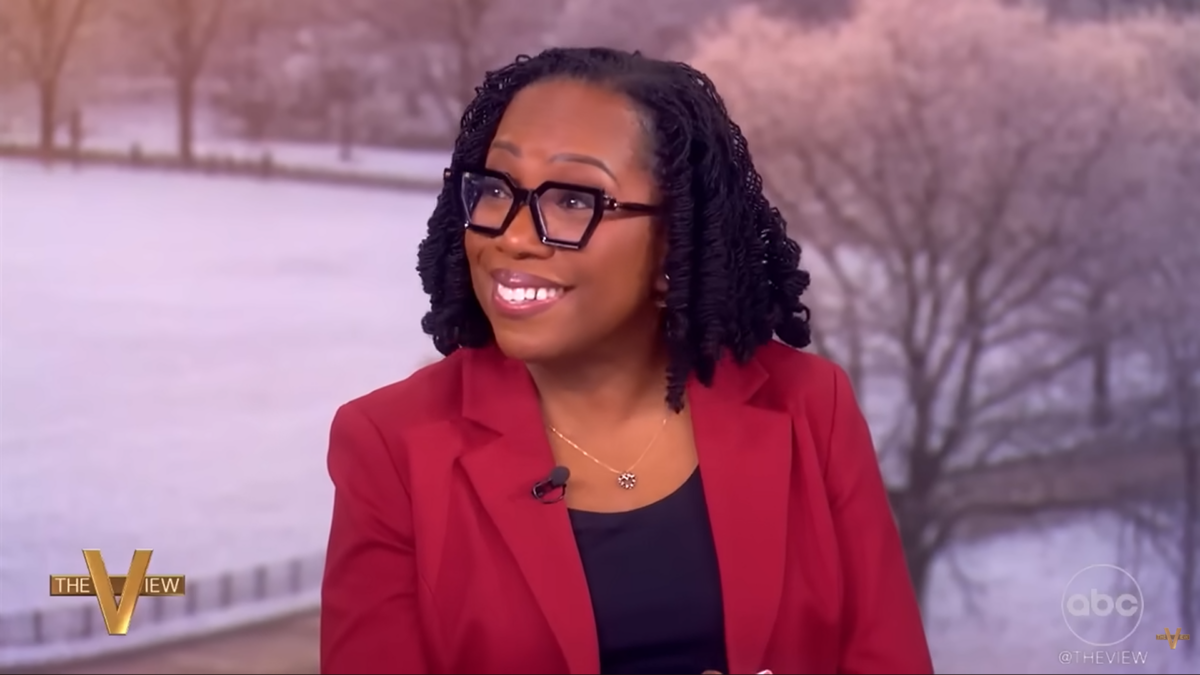

One really has to admire the hutzpah of Supreme Court Justice Ketanji Brown Jackson. Not only is she comfortable signing off on some of the most asinine opinions imaginable, but she’s also shameless in gaslighting her conservative colleagues on “partiality” — an issue she and her fellow liberal justices know quite a bit about.
The latest incident occurred Monday evening when the Supreme Court released an order pertaining to its recently released Louisiana v. Callais decision kneecapping race-based redistricting. As The Federalist reported, the order fast-tracked transmission of the ruling to the lower courts so they and Louisiana could correct the latter’s unconstitutional congressional map ahead of the 2026 midterms.
Clearly disturbed about the Pelican State fixing its racially gerrymandered map before the general election, Jackson penned a solo dissent lambasting her colleagues’ decision to authorize the ruling’s transmission in accordance with existing Supreme Court rules. She more specifically attacked the court for declining “to stay on the sidelines and take no position by applying our default procedures” as to “avoid the appearance of partiality.”
“But, today, the Court chooses the opposite. Not content to have decided the law, it now takes steps to influence its implementation,” Jackson wrote. “The Court unshackles itself from both constraints today and dives into the fray. And just like that, those principles give way to power. Because this abandon is unwarranted and unwise, respectfully, I dissent.”
It’s hard not to see the irony in all of this. While Jackson feigns worry about the order’s effect on “the appearance of partiality,” it is her and her liberal colleagues who have made “partiality” and politics central to how they operate on the high court.
In Monday’s order, Justice Samuel Alito (joined by Justices Clarence Thomas and Neil Gorsuch) authored a concurring opinion addressing Jackson’s “trivial” and “insulting” dissent. The Bush appointee notably included a footnote in the opinion recognizing that the “constitutional question” of whether Louisiana’s congressional map is unlawful “was argued and conferenced nearly seven months ago.” Put another way, that the court seemingly answered the question not long after it held oral arguments in the case on Oct. 15, 2025.
The reason that detail is significant is because former White House Press Secretary Sean Spicer reported more than a week before Callais‘ release that the liberal justices were slow-walking their dissent in the case as a way of impacting the 2026 midterms. The April 29 Callais decision was notably the final case from the court’s October sitting to be released.
“I have been told by reliable sources that that [Louisiana v. Callais] decision is done, and that the minority is slow-walking the dissent so that states … do not have time to redistrict ahead of” the election, Spicer said during a podcast interview.
Spicer’s reporting on the alleged tactics of the liberal justices falls in lockstep with bombshell revelations first disclosed by Federalist Editor-in-Chief Mollie Hemingway in her new bestselling book, Alito: The Justice Who Reshaped the Supreme Court and Restored the Constitution.
Following the infamous leak of the majority’s Dobbs draft opinion overturning Roe v. Wade, Hemingway revealed how the conservative justices — who were facing a wave of death threats —pleaded with their liberal colleagues to quickly finish their dissent so the court could release the full Dobbs decision. The apparent hope was that doing so might cause the threats against them and their families to subside.
Rather than accommodate this request, however, Hemingway reported how the liberals continued to slow-walk their dissent for nearly two months. Not only did sources tell Hemingway that Justice Elena Kagan screamed at Justice Stephen Breyer for his apparent willingness to oblige the conservatives’ request, but The Federalist editor-in-chief also described how the liberal justices included a gratuitous footnote in their dissent to an unreleased case that delayed the Dobbs decision by several more weeks.
A Supreme Court decision is not considered final until it is handed down from the bench. That means that had one of the justices in the Dobbs majority changed their mind due to the threats against them — or worse, if one of them were to be killed — the case’s outcome would have changed.
Jackson’s latest temper tantrum has nothing to do with concerns about the “appearance” of Supreme Court “partiality.” As Alito noted in his concurrence, she doesn’t “explain why [her] insistence on unthinking compliance with [Supreme Court] Rule 45.3’s default rule does not create the appearance of partiality (by running out the clock) on behalf of those who may find it politically advantageous to have the election occur under [Louisiana’s] unconstitutional map.”
What Jackson really finds problematic is that the court’s order and the Callais decision don’t comport with her left-wing politics. She and her liberal colleagues are not concerned about the rule of law, but about how states’ move toward a race-neutral approach to redistricting will impact Democrat prospects in an upcoming election.
If Jackson and Co. had any interest in the Supreme Court avoiding “the appearance of partiality,” they’d cut their left-wing political theater and actually behave like judges are supposed to. But that would require them to abandon their devotion to political activism, a habit they just refuse to break.