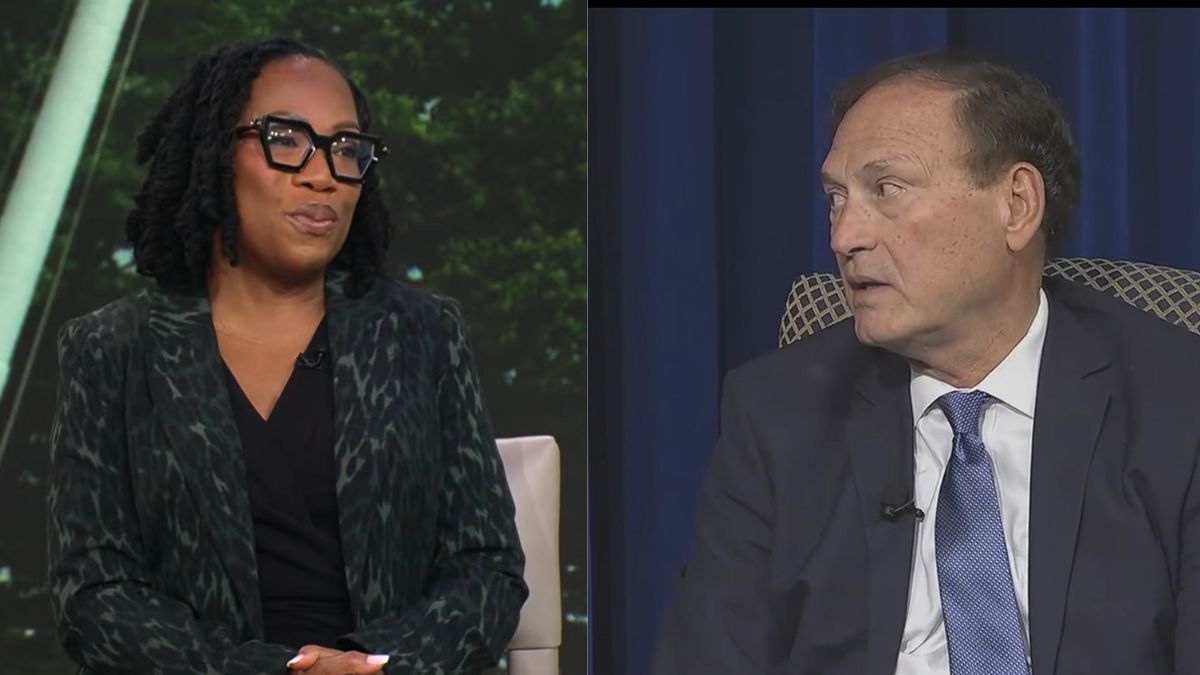

Justice Ketanji Brown Jackson’s Supreme Court opinions are often poorly argued and lack coherent legal reasoning. And in the high court’s latest release, Justice Samuel Alito made sure she knew it.
The Alito-driven smackdown happened late Monday when the Supreme Court released an order related to its landmark Louisiana v. Callais decision, in which the majority (led by Alito) determined that Louisiana’s most recent congressional map is an unconstitutional racial gerrymander. Equally significant, however, is that the ruling effectively nuked states’ ability to partake in race-based redistricting.
In its newest order, the high court agreed to fast-track the transmission of its decision to the lower courts rather than wait 32 days, as per normal custom. The move came in response to a request by the Louisiana residents who challenged the unlawful map to waive the 32-day period. They argued that doing so would allow the lower courts and state legislature to quickly rectify the unconstitutional map ahead of the 2026 midterm elections.
The Supreme Court’s decision to grant the Callais appellees’ request in accordance with existing SCOTUS rules did not sit well with Jackson. The Biden appointee penned an unhinged solo screed claiming the court’s order “has spawned chaos in the State of Louisiana.”
Jackson started off by recognizing Louisiana Gov. Jeff Landry’s recent suspension of the state’s U.S. House primaries in light of Callais‘ release to fix the illegal map, as well as the subsequent legal challenges to his decision. In doing so, she charged that “[t]hese post-Callais developments have a strong political undercurrent,” and attacked her colleagues for declining “to stay on the sidelines and take no position by applying our default procedures” as to “avoid the appearance of partiality.”
“But, today, the Court chooses the opposite. Not content to have decided the law, it now takes steps to influence its implementation,” Jackson wrote. “The Court unshackles itself from both constraints today and dives into the fray. And just like that, those principles give way to power. Because this abandon is unwarranted and unwise, respectfully, I dissent.”
Clearly fed up with Jackson’s political activism from the bench, Alito, joined by Justices Clarence Thomas and Neil Gorsuch, wrote a concurring opinion addressing the junior justice’s charges he said “cannot go unanswered.”
The Bush appointee noted how Jackson’s position “would require that the 2026 congressional elections in Louisiana be held under a map that has been held to be unconstitutional.” He further highlighted how the Biden appointee “does not claim that it is now too late for the state legislature or the District Court to adopt a new map that complies with the Constitution” or “assert that it is not feasible for the elections to be held under such a map.”
“Instead,” Alito wrote, “the dissent offers two reasons for its proposed course of action. One is trivial at best, and the other is baseless and insulting.”
Alito went on to rip the incoherence behind Jackson’s opposition to the court’s suspension of its 32-day default rule. He additionally admonished her claim that the court’s order creates the appearance of “partiality,” noting how she “does not explain why [her] insistence on unthinking compliance with [Supreme Court] Rule 45.3’s default rule does not create the appearance of partiality (by running out the clock) on behalf of those who may find it politically advantageous to have the election occur under the unconstitutional map.”
“The dissent goes on to claim that our decision represents an unprincipled use of power. … That is a groundless and utterly irresponsible charge,” Alito wrote. “What principle has the Court violated? The principle that Rule 45.3’s 32-day default period should never be shortened even when there is good reason to do so? The principle that we should never take any action that might unjustifiably be criticized as partisan?”
But Alito wasn’t done humiliating Jackson and her inability to act as a competent judge.
In concluding his concurrence, the Bush appointee slammed the junior justice’s accusations that the court “unshackles itself from constraints” by underscoring that it is her “rhetoric that lacks restraint.”
The concurrence was yet another example of Alito’s legal acumen. As Federalist Editor-in-Chief Mollie Hemingway details in her bestselling book, Alito: The Justice Who Reshaped the Supreme Court and Restored the Constitution, the senior justice has long served as one of the high court’s most impressive and impactful jurists.