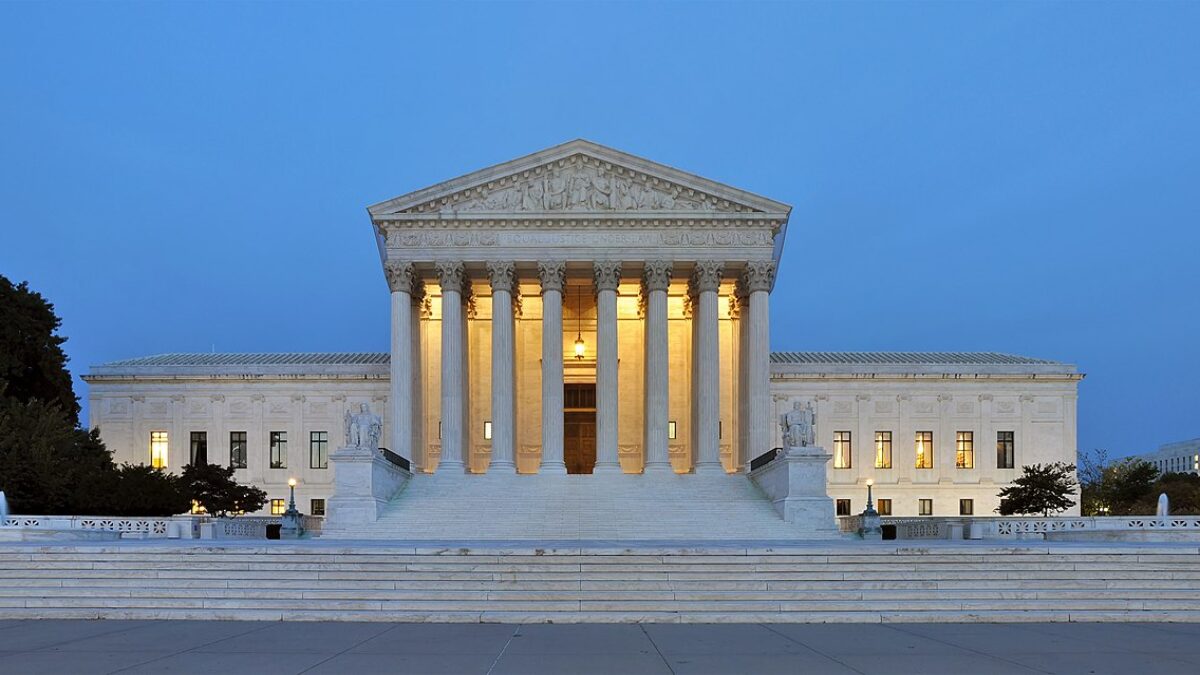

The U.S. Supreme Court released a bombshell ruling on Wednesday significantly curtailing states’ use of race in the redistricting process.
“Section 2 of the Voting Rights Act of 1965 … was designed to enforce the Constitution — not collide with it. Unfortunately, lower courts have sometimes applied this Court’s §2 precedents in a way that forces States to engage in the very race-based discrimination that the Constitution forbids,” Associate Justice Samuel Alito wrote for the majority (6-3).
Known as Louisiana v. Callais, the case centers around Louisiana’s creation of a second majority-black district in its most recent congressional map. The Pelican State added the second majority-minority district following a lower court order that said its original map — which only included one majority-black district — likely violated Section 2 of the Voting Rights Act (VRA).
The new map prompted a new lawsuit from a different set of plaintiffs, who alleged the creation of a second majority-minority district constituted an unconstitutional racial gerrymander. A different lower court agreed with these plaintiffs.
Writing for the majority, Alito said that the debacle presents a good vehicle for the justices to tackle “the long-unresolved question [of] whether compliance with the Voting Rights Act provides a compelling reason that may justify the intentional use of race in drawing legislative districts.” After examining the facts of the case and what the Constitution requires, he noted that the majority determined that, “Correctly understood, §2 does not impose liability at odds with the Constitution, and it should not have imposed liability on Louisiana for its 2022 map.”
“Compliance with §2 thus could not justify the State’s use of race-based redistricting here. The State’s attempt to satisfy the Middle District’s ruling, although understandable, was an unconstitutional racial gerrymander, and we therefore affirm the decision below,” Alito wrote.
Associate Justice Clarence Thomas authored a separate concurring opinion, which Associate Justice Neil Gorsuch joined. In noting his full agreement with the majority opinion, the Bush 41 appointee wrote that he “would go further and hold that §2 of the Voting Rights Act does not regulate districting at all.”
“The relevant text prohibits States from imposing or applying a ‘voting qualification,’ ‘prerequisite to voting,’ or ‘standard, practice, or procedure,’ in a manner that results in a denial or abridgement of the right to vote based on race … How States draw district lines does not fall within any of those three categories,” Thomas wrote. “The words in §2 instead ‘reach only “enactments that regulate citizens’ access to the ballot or the processes for counting a ballot;” they “do not include a State’s . . . choice of one districting scheme over another.”‘ … Therefore, no §2 challenge to districting should ever succeed.”
Associate Justice Elena Kagan authored the court’s dissenting opinion, which Associate Justices Sonia Sotomayor and Ketanji Brown Jackson joined. The three Democrat appointees contended that, “Under the Court’s new view of Section 2, a State can, without legal consequence, systematically dilute minority citizens’ voting power.”
“I dissent because the Court betrays its duty to faithfully implement the great statute Congress wrote. I dissent because the Court’s decision will set back the foundational right Congress granted of racial equality in electoral opportunity. I dissent,” Kagan wrote.