
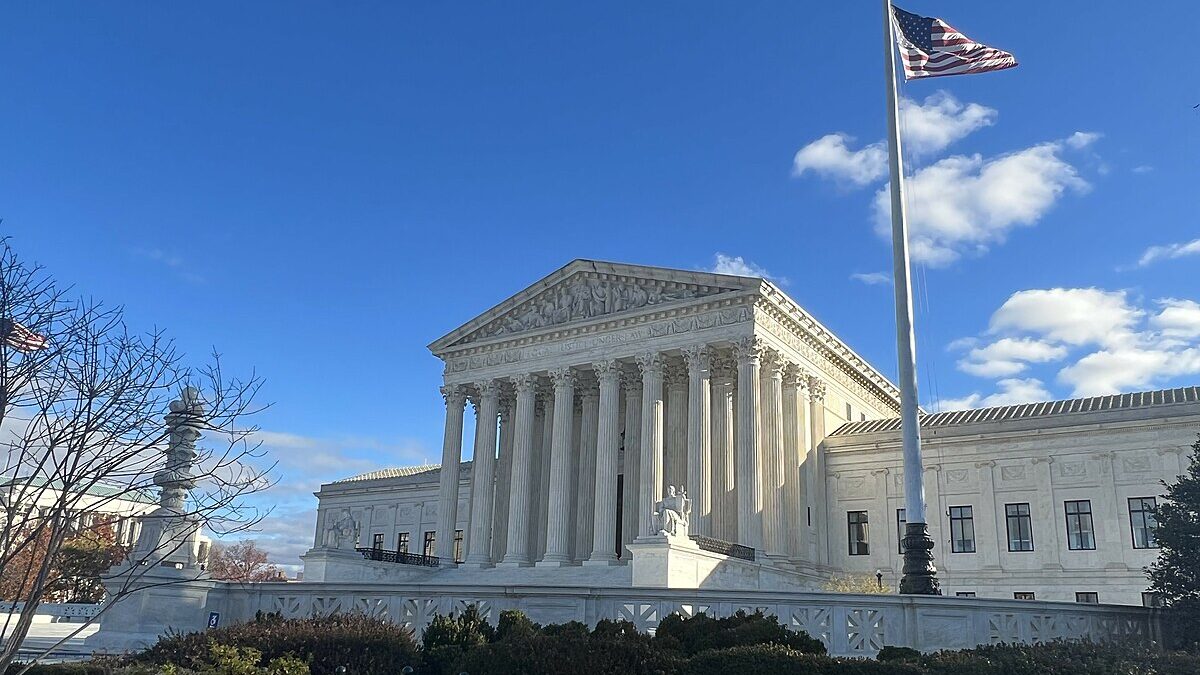
The U.S. Supreme Court unanimously sided with the Trump administration on Tuesday in a dispute involving its policy regulating immigration judges’ “work-related speech.”
In its per curiam opinion, the high court vacated and remanded a decision by the 4th Circuit Court of Appeals that centered around the government’s rules governing the executive’s immigration courts. The specific policy in question — which was enacted in October 2021 under the Biden administration — required immigration judges “to obtain supervisory approval for public speeches relating to their official duties” and was designed “to ensure that employee speech which may be seen as bearing the ‘imprimatur’ of the Office is consistent with its official positions,” according to SCOTUS.
The National Association of Immigration Judges (NAIJ) challenged the rule in federal court, arguing that it violated its members’ First and Fifth Amendment rights. As noted by the Supreme Court, however, under the 1978 Civil Service Reform Act (CSRA), Congress “intended” for federal employees to bring “most work-related grievances” to the executive’s Merit Systems Protection Board (MSPB) and the Special Counsel — “not to federal district court.”
According to SCOTUS, the district court overseeing the case dismissed the NAIJ’s argument that its members’ constitutional claims “were not the kind of work-related claims that Congress intended to steer out of district court.” It held that it lacked jurisdiction over the matter, and that the CSRA “covered” respondent’s claims.
While agreeing with the district court’s conclusions that the NAIJ’s claims were covered by the CSRA and that Congress precluded district courts from overseeing such matters, the 4th Circuit panel nevertheless vacated the lower court’s ruling based on “factual circumstances” that it said “called into question” whether the CSRA was “functioning as Congress intended.” The appellate court further remanded the case back to the district court “for factfinding into the current operation of the MSPB,” as summarized by SCOTUS.
In vacating and remanding that decision, the Supreme Court ruled that the 4th Circuit’s actions were “based on an issue the parties had not raised” throughout litigation. By all accounts, the high court reasoned, the 4th Circuit’s decision “violated the party presentation principle when it decided ‘a case different from the one [respondent] advanced.'”
“Federal courts are not ‘roving commissions’ … licensed to ‘”sally forth each day looking for wrongs to right.”‘ … The Court of Appeals lost sight of those principles here,” the justices ruled.
While concurring with the court’s judgement, Associate Justice Clarence Thomas authored a separate opinion in the matter. Joined by Associate Justice Amy Coney Barrett, the Bush 41 appointee explained why he believed the 4th Circuit’s ruling “was also wrong on the merits.”
“The Fourth Circuit’s analysis bears little resemblance to legal interpretation. Neither the President’s view that he can remove federal executive officials … nor his having done so, change the meaning of the statute or the binding nature of this Court’s interpretation of it,” Thomas wrote.
The senior justice went on to note that the judiciary lacks the authority to “‘rewrite the statutory scheme in order to approximate what we think Congress might have wanted had it known that’ the President or courts may conclude that its removal restrictions were ‘beyond its authority.'” He further underscored that laws “change only when Congress changes them, not when judges decide that they no longer vindicate Congress’s purposes.”
“As Judge Quattlebaum wrote in dissent, the Fourth Circuit’s decision below ‘undermines important principles of our system of justice,’ including that law remains law despite the ‘political controversies of the day,'” Thomas concluded.





.jpg)