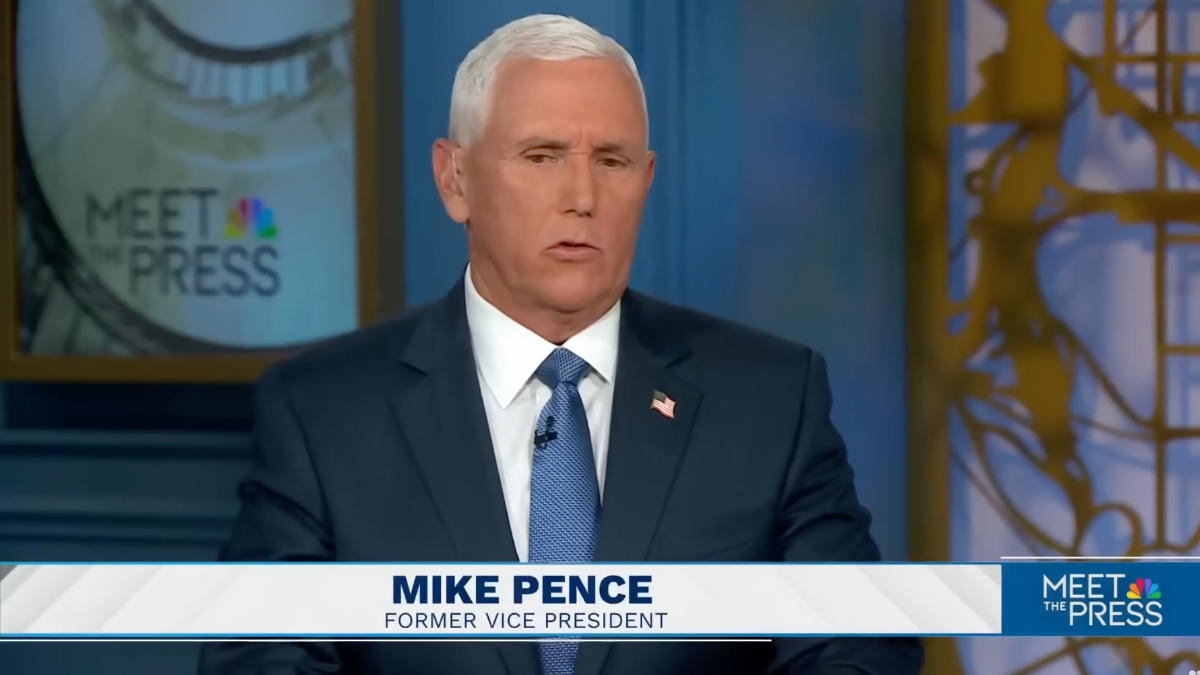

Former Vice President Mike Pence has emerged as one of the most vocal opponents of the Justice Department’s now abandoned Anti-Weaponization Fund, an initiative intended to compensate individuals harmed by politically motivated government misconduct. Pence and other critics characterized the fund as an improper use of taxpayer money, claiming it was a “bad idea from the start.” Yet Pence’s opposition is profoundly ironic, given that few public figures played a larger role in setting the chain of events into motion that made such a fund necessary in the first place. Pence now condemns as “deeply offensive” a remedy designed to address the very culture of institutional weaponization that he helped create during his time in the White House.
Contrary to much of the media coverage surrounding this controversy, the Anti-Weaponization Fund was not an extraordinary new mechanism conjured out of thin air. The payments were to be made through the Judgment Fund, a permanent, indefinite appropriation established by Congress to satisfy judgments and settlements against the federal government. In this instance, the settlement stems from litigation brought by President Trump after his confidential tax information was unlawfully disclosed. Whatever one’s view on the politics of the settlement, the underlying mechanism is a standard feature of federal law.
The larger question is not whether the government possesses the authority to compensate victims of official misconduct; it clearly does. The important question is why so many Americans now find themselves in need of such compensation in the first place.
The answer leads directly back to the firing of General Michael Flynn and, specifically, to Mike Pence’s role in that decision.
For years, the public understanding of Flynn’s removal rested on the assumption that the Trump administration had simply accepted the FBI’s claim that Flynn lied about his conversations with Russian Ambassador Sergey Kislyak. The transcripts of those conversations, finally released in 2020, showed otherwise. Flynn had not lied.
What remained unknown until last year was Pence’s role in the episode. By early 2017, President Trump was already deeply skeptical of the FBI. Rather than relying solely on the bureau’s representations, he directed an evaluation of the Flynn situation, which included Vice President Pence reviewing the underlying transcripts to determine for himself whether Flynn had actually lied.
That detail fundamentally changed the story. For years, even many Trump supporters assumed that Flynn’s firing was the result of the FBI misleading Trump. In reality, Pence was given the opportunity to review the transcript and assess the facts firsthand. Yet despite having access to the underlying record, Pence emerged as one of the key figures advancing the claim that Flynn had been dishonest.
What remains unexplained is how that conclusion was reached.
The allegation against Flynn was based on a specific claim: Critics insisted Flynn had discussed sanctions with the Russian ambassador and subsequently lied about it. This accusation became the cornerstone of the effort to remove him and served as a foundational narrative for the broader Russiagate saga.
The problem is that Flynn did not discuss sanctions. He discussed expulsions.
Although these terms are often treated interchangeably in media accounts, they possess distinct legal and diplomatic meanings. In late December 2016, the Obama administration announced a package of measures directed at Russia. Some were sanctions imposed on specific individuals and entities, others were the expulsion of Russian diplomats. The Obama administration’s own announcement treated these as separate actions, because they were.
When Flynn spoke with Kislyak, the conversation concerned the Russian diplomats ordered to leave the country. Flynn urged restraint, suggesting that Russia avoid escalating tensions during the transition period. Years later, when the transcripts were finally released, they confirmed exactly what Flynn had maintained all along, that the discussion concerned expulsions, not sanctions.
This distinction was not a minor technicality but the entirety of the case against him.
Flynn noted this publicly before his departure, explaining that the conversation was about “the 35 guys who were thrown out.” As a former director of the Defense Intelligence Agency and incoming National Security Advisor, Flynn understood the nuance between sanctions and expulsions. The significance of this nuance becomes even clearer when reviewing notes taken by former FBI Deputy Director Andrew McCabe during a Feb. 10, 2017, meeting with Pence. The notes show McCabe characterizing the controversy as one involving “US sanctions.” McCabe knew the contents of the transcripts. He knew they concerned expulsions. Yet he presented the matter to the vice president as though Flynn had lied about sanctions.
How Pence responded to that information remains one of the most important unanswered questions of the entire Russiagate affair.
Perhaps he failed to review the transcript. Perhaps he reviewed it but failed to grasp the difference between sanctions and expulsions. Or perhaps he understood exactly what the transcript showed and accepted a narrative he knew to be false. We do not know, because Pence has never been pressed to explain his role.
What we do know is that Flynn was removed from office based upon a premise that collapsed the moment the transcripts became public.
The consequences were enormous. Flynn’s departure removed one of the administration’s most experienced national security officials and a key skeptic of the Russia Collusion narrative. The pressure campaign against the administration intensified, the Mueller investigation followed, and a decade of legal and political warfare became a defining feature of American life.
History is rarely simple, but it is difficult to imagine the Russiagate saga unfolding the same way had Flynn remained in place. Had Pence acknowledged what the transcript plainly showed, or challenged McCabe’s characterization of the conversation, Flynn may never have been forced out and the trajectory of the Trump presidency could have been dramatically altered.
Perhaps Flynn would have remained National Security Advisor, perhaps the momentum behind Russiagate would have been broken before it reached critical mass, perhaps many of the investigations and prosecutions that followed would never have occurred.
Nor is Flynn the only episode that raises questions about Pence’s conduct. A separate debate exists over his statements in the days leading up to Jan. 6, when he assured Trump supporters that “come this Wednesday, we’ll have our day in Congress. We’ll hear the objections. We’ll hear the evidence.” Pence actively fueled expectations and then abruptly retreated to a purely ceremonial interpretation of his role. It is another example of a breach of trust for which Pence has never provided a satisfactory public explanation.
The course that events might have taken had Pence exercised better judgment at pivotal moments can never be known. It is nevertheless difficult to escape the conclusion that many Americans would have been spared the hardship inflicted by the weaponization of law and government had he done so.
That reality is precisely why the Anti-Weaponization Fund was proposed in the first place.
Pence is entitled to oppose compensating victims of lawfare. What he is not entitled to do is pretend he had no role in creating them. The Anti-Weaponization Fund may now be dead, but the underlying problem it sought to address remains very much alive. Before condemning efforts to provide relief to individuals whose lives were upended by such weaponization, he should first answer for the unanswered questions surrounding his own conduct, from his role in Flynn’s removal to the assurances he gave supporters before Jan. 6 and later abandoned.