
Democrats’ uniform opposition to the SAVE America Act demonstrates their unremitting antagonism toward any reform that increases the integrity of the election process. The same can be said of a meritless lawsuit in Kansas (League of Women Voters v. Schwab) that seeks to eliminate the most basic safeguard in mail voting: verifying that the signature on a returned ballot matches that of the voter.
In the suit, the plaintiffs, represented in part by the law firm of Marc Elias — the Democrat election lawyer who has made a career out of seeking to tear down every election integrity safeguard he can find — claim that signature verification violates the Kansas Constitution’s equal protection and due process provisions. In essence, they contend, human beings are incapable of conducting a signature analysis.
This legal challenge is frivolous. Kansas has elaborate procedures to ensure signature verification is applied in a uniform and consistent manner. It also provides a robust “cure” process, giving voters ample opportunity to resolve any perceived mismatch.
Kansas is not the only state that the left and Elias are targeting with this nonsense. Similar cases have been brought in California, Colorado, Texas, Washington, Florida, Arizona, and Michigan.
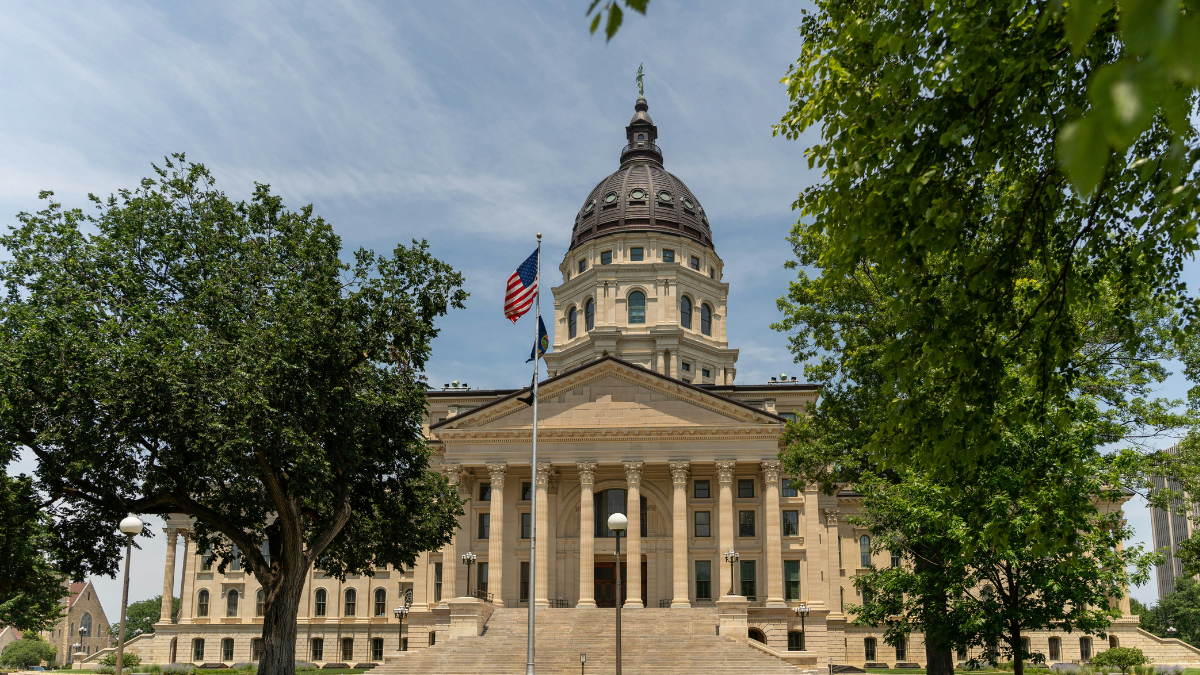
Earlier this year, the Kansas legislature responded to this baseless suit by overwhelmingly passing a bill (House Bill 2569) that imposes a contingency plan if courts strip away this critical protection. Under this bill, if a court enjoins the state’s signature verification, Kansas’ no-excuse mail voting system would be discontinued so the state would not be left with an all-risk, no-safeguard version of voting by mail.
H.B. 2569 would not eliminate mail voting. It would simply require that voters have an excuse to vote by mail (in other words, implementing the same rules that were used before the misguided era of no-excuse mail voting arose). If a voter is absent from the state on Election Day, is disabled, has religious objections, or is an election official, voting by mail would still be permissible.
One would hope the likelihood of any court striking down a signature verification requirement would be too remote to contemplate. Indeed, to date, the plaintiffs’ legal theory has been rejected everywhere it has been floated. But with five of the seven justices on the state Supreme Court having been appointed by Democrat governors, including three by the current governor, Laura Kelly, the Kansas Supreme Court has moved so far to the left over the last 10-15 years that there is no guarantee the court will eventually come down in line with the law when this case reaches its courtroom.
Unsurprisingly, Gov. Kelly vetoed the bill. And Republican leaders quietly abandoned any attempt to override that veto after concluding, according to reports I received from insiders, that they were two votes short in the House. Two votes.
The fact that a small handful of Republican legislators refused to vote in favor of an override —just enough for the vote to fail — is incredibly disappointing. They are all that stood between Kansas enacting a solid contingency plan that would preserve a basic level of election security.
What is most galling, however, is the opposition of Rep. Ken Rahjes, a Republican from tiny Agra, Kansas, a rural district just south of the Nebraska border. Incredibly, Rahjes is now running for secretary of state, the very office responsible for overseeing elections in Kansas.
Voters should ask themselves a simple question: If Rahjes is unwilling to support a bill that provides an eminently sensible back-up plan in case the signature verification requirement is struck down, why should anyone trust him to protect election integrity as secretary of state? The idea that a Republican candidate for that office is comfortable weakening safeguards against potential voter fraud is not just disappointing; it should be disqualifying.
This is how confidence in government erodes. Not because of some abstract theory, but because voters watch elected officials refuse to defend even the most basic safeguards.
For nearly 30 years, Kansas has permitted no-excuse mail voting. That system only works when it is paired with common-sense protections, chief among them signature verification. The numbers make clear just how reasonable that safeguard is: In 2024, according to the Kansas secretary of state, out of nearly 150,000 mail ballots cast, only 94 were rejected due to an uncured signature mismatch. Just 6/100 of 1 percent! The system is careful, targeted, and fair.
But if a voter’s identity cannot be verified, mail voting becomes an exercise in blind trust — trust that ballots are being completed and returned by the correct individuals, with no meaningful way to confirm it. That is not a serious system, and does not inspire public confidence.
H.B. 2569 recognized a simple reality: If courts eliminate the signature-verification requirement, Kansas must adjust to address that new reality, not by eliminating mail voting entirely, but by returning to a more limited, accountable system that can function without that safeguard. It was a rational, measured response. Yet, when the time came to defend that principle and override the governor’s veto, a few (but just enough) legislators chose convenience over conviction and declined to stand up.
Trust in elections is fragile. It depends not just on the rules themselves, but on whether elected officials are willing to stand behind them. When legislators refuse to do so, voters notice and confidence in the system begins to erode. Voters in Kansas deserve better.