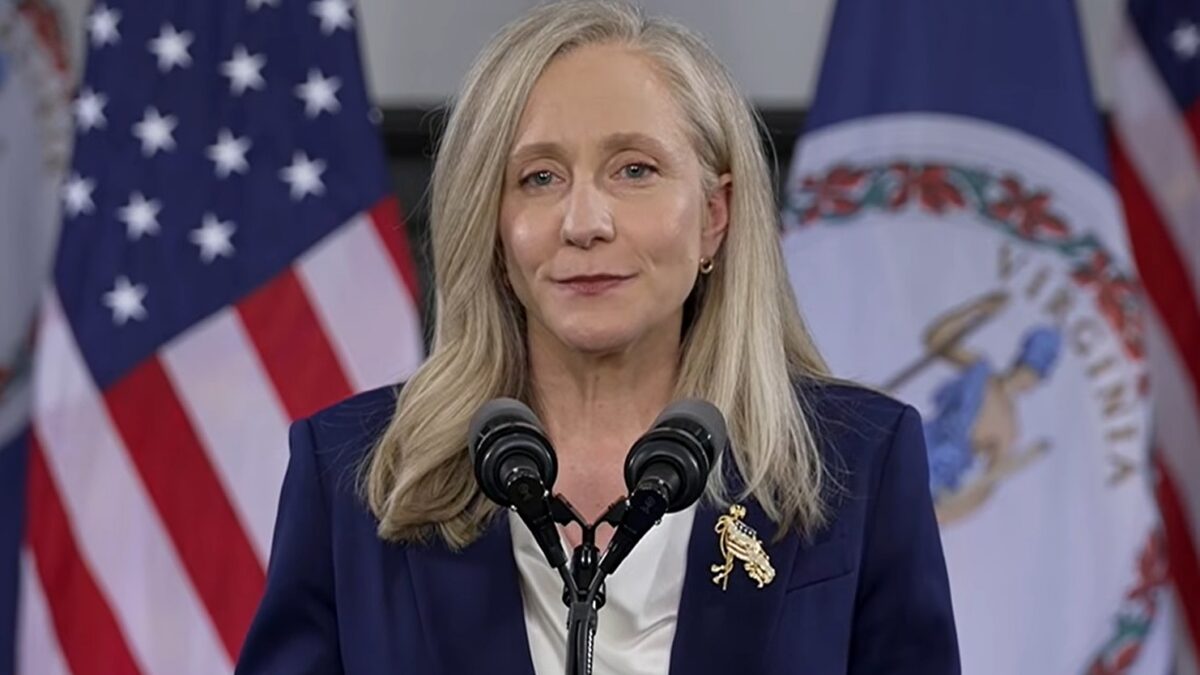

Half of Virginians found out Tuesday that they are not allowed to have political representation in the U.S. House because Democrats in the state’s capital decided resistance to President Donald Trump was more important than the political concerns of their neighbors.
But the post-mortem assessment that Republicans and aligned organizations should have spent more, gotten involved more quickly, or been building a get-out-the-vote campaign well before the eve of the election season, which started March 6, was completely foreseeable.
Democrats pumped millions of dollars into the pro-gerrymandering race — mostly dark money from outside the commonwealth — engaged their base, ran incessant ads, and were ostensibly able to pull together the same coalition of Democrats who looked the other way and voted for now-Attorney General Jay Jones, who fantasized about murdering his Republican colleague and his children.
But it is not as if Democrats had a particularly strong showing, all things considered.
The pro-gerrymander “yes” campaign won with an unofficial count of 1,574,809 votes, while now-Gov. Abigail Spanberger, D-Va., got 1,976,857 votes — about 400,000 more. The “no” campaign lost with 1,486,594.
In terms of being a special election in April — a month in which Virginia has “never had elections before” — the turnout was enormous. The “no” campaign surpassed the number of votes Republican gubernatorial candidate Winsome Sears, who was the sitting lieutenant governor at the time, in the 2025 November general election against Spanberger.
Former Gov. Glenn Youngkin, R-Va., by comparison, got 1,663,596 in the 2021 election.
Why were Republicans not able to recreate the Youngkin majority for an election that has a greater effect on the midterms than essentially any other race this year?
“I don’t know that it can’t be recreated,” Jeff Ryer, chairman of the Republican Party of Virginia, told The Federalist, looking toward the midterms. “The Youngkin majority didn’t have the level of disadvantages that we were faced with — whether it’s outspending or having an election in April, a month when Virginia has never had elections before. … I just think that we need the right circumstances.”
For many observers, fundraisers and the Republican National Committee (RNC) seemed to let the election slip away, and now the extremely slim Republican majority in the U.S. House is likely to be four seats closer to Democrat control — and endless investigations, subpoenas, and impeachments for President Donald Trump.
“A lot of people invested in the legal effort early on, but not in the in the referendum effort, which was seen, I think, as a longer shot,” Ryer said. “There are a lot of people today who aren’t surprised, necessarily, by the result. They’re surprised by the closeness of the vote.”
As of about one week out from the last day to vote, committees opposing the measure raised roughly $21 million, compared to over $64 million raised in favor of gerrymandering, according to data from the Virginia Public Access Project. The Washington Post reported another roughly $7 million for the “no” campaign from a group called Justice for Democracy, but that still falls far short of 64 million. By comparison, incumbent Sen. John Cornyn and groups backing him spent nearly 60 million on campaign advertising ahead of his primary race against fellow Republican Ken Paxton, CBS News reported in February.
Ryer has maintained that the RNC — which led some of the legal efforts — has been very helpful during the process, and gradually came on board for grassroots campaigning after early voting was underway. He also told The Federalist before early voting got underway that money was pretty thin coming from national Republicans. And, the vote certainly was close, as 51.44 percent voted “yes” and 48.56 percent voted “no,” according to the unofficial numbers.
“I don’t think necessarily that they let it slip away. I think that we had to demonstrate ourselves as being worthy of an investment first, and I think that’s what our grassroots effort did,” Ryer continued. “It wasn’t until we got about midway through the race that we were able to demonstrate the level of grassroots support that we had and really getting our activists engaged and involved in the fight.”
Midway through early voting — after major cash injections from Democrats that allowed them to shape the narrative of the gerrymandering issue — is when Republican donors started being more “invested in the prospect that we could win,” Ryer said. “That was not obvious in January, when the Democrats rammed this through the General Assembly.”
The money received by the “no” campaign still paled in comparison to the “yes” campaign, by a three-to-one or four-to-one margin, Ryer said. Eventually, people supporting the “no” campaign did end up running ads.
From the beginning, Ryer had put in place a traditional grassroots effort consisting of phone calls, text messages, mailers, door knocking, and other similar efforts to reach voters.
When asked if the “no” team put together a ballot harvesting initiative to make sure “no” votes were actually getting to the ballot box, Ryer said, “we had a very concerted effort in identifying Republican voters who either were on the permanent absentee list and/or requested an absentee ballot. We tracked them throughout the race, and those particular voters received more attention from us than any voter on a number of contacts bases — so we did everything we could to make sure that our voters who were voting absentee had their votes counted.”
He said the party will monitor those ballots once the data comes in to find out their rate of success.
There were other potential third-party grassroots organizations that offered help, but were apparently rejected, like Turning Point Action. Turning Point said “people refused to fund” a “full proposal to train Virginia and D.C. conservatives for aggressive ballot chase and GOTV work.” The organization’s Andrew Kolvet described why conservatives keep losing battles.
“Until our side invests the same amount of money and enthusiasm in [get-out-the-vote], in canvassing, in voter relationships, voter [registration] as it does with consultants and media buyers, we’re gonna continue to come up just short, and the country’s gonna really be damaged as a result. That’s just the bottom line,” Kolvet said. “If you’re gonna continually get outspent when you’re sitting on mountains of cash — which, if you kind of tally it together, all these PACs and all these groups on the right, we have a lot of cash right now. And you could say, ‘oh, we’re keeping out powder dry for the midterms’ — you just lost four House seats.”
Nonetheless, Ryer said he believes the primary driver of the “no” vote’s loss was the “misleading language on the ballot.” Democrats did inject highly partisan language on the ballot, claiming it would “restore fairness” to voting.
“I think that was really the key to their success,” Ryer said. “It’s not exactly what we would call an accurate depiction of what was on the ballot, and that was intentional. They put forward a misleading ballot question, because one that told the truth would have been defeated.”
The fight over the gerrymander is not technically over. Lawsuits that were paused by the Virginia Supreme Court before the election are picking up steam again, and late Wednesday afternoon, a county circuit court in Tazewell ruled that all votes from the referendum are ineffective and that the election results cannot be certified.
This same court previously ruled in favor of two challenges to the gerrymandering referendum, but has each time been blocked by the Supreme Court. However, the Supreme Court has yet to rule on the merits.
The entire referendum process was clearly illegal from day one, and there is theoretically still room for legal challenges.
Ryer said his team is going to challenge the ballot language as being against the “Plain English Rule” under Va. Code 24.2-684.
“We are pursuing it, and that is one of our bones of contention,” Ryer said. “I think plain English doesn’t mean necessarily that the language is used — it has to have some relation to what’s actually happening and what is actually being done.”
Former Republican Virginia Attorney General Ken Cuccinelli, who also opposes the referendum, disagrees, stating that “the only requirement of the rule is that the wording be in ‘plain English’, there’s no fairness requirement, so don’t expect this to be central to the Va. Supreme Court’s resolution of the case. The special session or non-conforming passage are more likely to be the basis of decision.”
Cuccinelli described in a post on X what he believes are the legal avenues most likely to be successful:
1. First passage was invalid. The amendment was taken up during a special session convened in 2024 for budget purposes. The General Assembly’s own call to the Governor (under Art. IV, §6 and Art. V, §5) and its governing resolution (HJR 6001) limited the session’s scope. Expanding it to include a constitutional amendment on redistricting required a two-thirds vote that never occurred. A Tazewell County judge found this action “void, ab initio.”
2. Art. XII, §1 requires that after first passage, a proposed amendment be “referred to the General Assembly at its first regular session held after the next general election of members of the House of Delegates.” An election must intervene between first and second passage. Here, first passage occurred during an election cycle — not before an intervening one.
3. Art. XII, §1 requires the amendment be submitted to voters “not sooner than ninety days after final passage by the General Assembly.” The timeline from second passage to the April 21 vote did not satisfy this requirement.
Plus ONE challenge to the proposed maps:
4. Art. II, §6 requires that “every electoral district shall be composed of contiguous and compact territory.” The proposed congressional maps violate this contiguity requirement (rather badly).
Aside from the legal challenges themselves, or squishy decisions from judges and justices, a political contingency also hangs in the air: Two Virginia Supreme Court justices’ terms end soon.
Justice D. Arthur Kelsey’s term ends on Jan. 31, 2027, and Justice Stephen R. McCullough’s term ends on March 2, 2028. Both were appointed by Republican-majority legislatures, and both will likely be vying to be reappointed to the court under Democrat control.