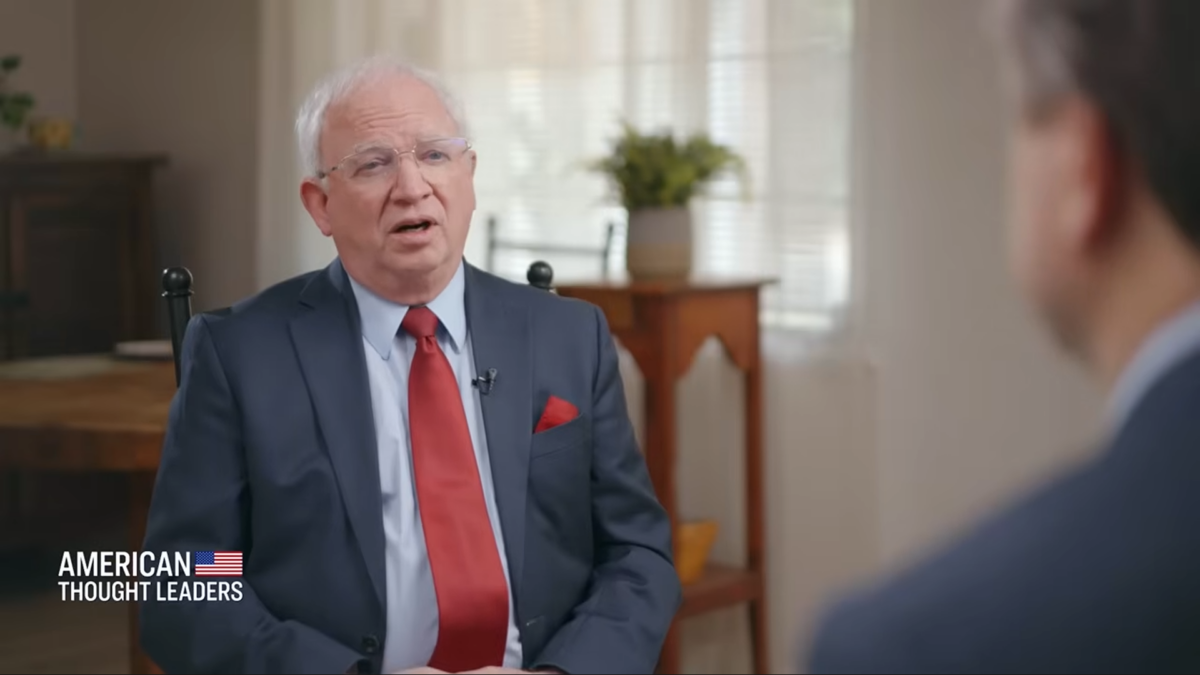
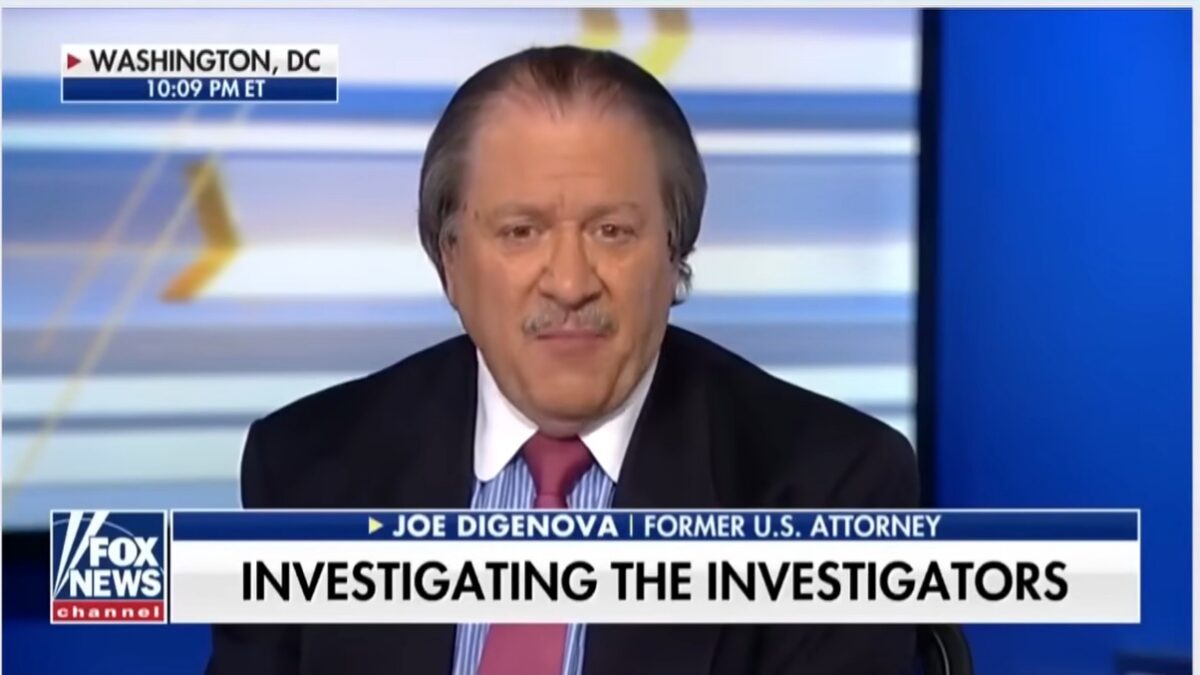

Joe diGenova has been appointed counselor to the attorney general, effectively as a Russiagate czar. The reaction has been entirely predictable and follows a familiar pattern. The legacy media is already raining down a steady stream of hostile stories, dismissing diGenova as an aging partisan chasing President Donald Trump’s so-called conspiracy theories.
And it is true that diGenova, an 81-year-old veteran of the Reagan era, where he served as U.S. attorney for the District of Columbia, is not the most conventional pick for the role. But that misses the more important point. For the first time in nearly a decade, there is actually a Russiagate czar. That alone changes the dynamic entirely. Acting Attorney General Todd Blanche deserves credit for finally doing what his predecessors would not or could not do.
Since the start of Russiagate ten years ago, every supposed effort at accountability has been either half-hearted, stop-start, or a last-minute scramble. In some cases, it has amounted to outright cover-up, with former Attorney General Bill Barr, himself a CIA alumnus, insisting that the CIA “stayed in its lane.” The current investigation diGenova is set to oversee, a conspiracy investigation in the Southern District of Florida focused on former CIA Director John Brennan, suggests the opposite: that the CIA did not, in fact, stay in its lane.
A Pattern of Broken Investigations
The removal earlier this month of the attorney who had been running that investigation, Maria Medetis Long, followed by diGenova’s appointment, underscores a broader pattern of stop-start handling. Once again, an effort has been disrupted midstream, leaving diGenova to pick up the pieces.
But while this pattern has been frustrating, the positive development is that there is now finally someone in charge of the effort who does not require on-the-job training, and whose wife, Victoria Toensing, was herself targeted by an FBI raid in connection with the couple’s friendship with Rudy Giuliani. Previous efforts — whether under John Huber, who was tasked with investigating the illegal surveillance of the Trump campaign, John Durham, who was appointed to investigate the origins of the Russia collusion hoax, or Medetis Long, who later ran the Southern District effort — have either obstructed the process or, at best, done the minimum required to produce a narrow, alibi-style report before moving on. By contrast, this time there is someone in charge who has been in the trenches from the beginning.
DiGenova knows the story and has followed the details, the players, and the evolution of the scandal from day one. As far back as 2018, he was dismissed as a conspiracy theorist for saying, “Make no mistake about it: A group of FBI and DOJ people were trying to frame Donald Trump of a falsely created crime.” That claim was widely ridiculed at the time, but it has since been fully vindicated by subsequent developments.
Whatever may be said of him, it is far better to have someone who understands the terrain and is fully committed than someone who does the minimum and exits, or worse, is there to sabotage, delay, and run out the clock.
There is, of course, deep frustration about the wasted time, much of which was not coincidental. Key information and evidence have repeatedly surfaced only after the five-year statute of limitations expired, reflecting how the system protects itself, with time itself becoming a central constraint on accountability.
This does not make diGenova’s task any easier. In fact, the challenges are enormous. Even without the five-year limitation, Russiagate is not a single event but a sprawling, interwoven matrix of facts, timelines, and actors. It involves overlapping stories, multiple institutional players, and layers ranging from relatively minor figures to senior officials at the highest levels of government. Even forming a coherent overview is difficult, let alone establishing accountability across that landscape.
From Political Smear to Institutional Operation
At the highest level, the origins of the scandal trace back to early 2016, when internal emails show Hillary Clinton’s campaign discussing what it referred to as the “Trump swift boat project,” meaning a political smear campaign. Russiagate did not begin as an intelligence matter, as the media narrative has maintained, but as a fabricated political operation designed to function both as a shield and a sword.
The shield was to deflect attention from Clinton’s email problems by attributing any damaging disclosures to Russian hacking and, by extension, to Trump. When emails were released, the narrative was ready: Russia had acted to help Trump. The sword was to portray Trump himself as compromised or aligned with Russia.
Had that plan succeeded and Clinton won, the story would have disappeared almost immediately. The individuals who were later targeted would have gone on with their lives, and most people would never even have heard of Russia collusion.
But Trump’s victory changed everything.
What began as a campaign tactic was taken up and expanded by elements within the federal government. There had already been crossover before the election, most notably when the FBI opened an investigation in July 2016. But the post-election period is where the real escalation occurred.
The narrative shifted from a made-up allegation to an official government position. The claim was no longer simply that Trump might have connections to Russia, but that his victory itself was the product of Russian intervention.
Post-Election Escalation, Leaks, and Intelligence Laundering
The Obama-ordered Intelligence Community Assessment, which the CIA has still not withdrawn despite the recent recall of other discredited assessments, was central to that narrative shift. Despite underlying intelligence that did not support the conclusion, it asserted that Russian President Vladimir Putin preferred Trump and acted to help him win. According to declassified material released in July 2025 by Director of National Intelligence Tulsi Gabbard, internal intelligence assessments instead suggested either no preference or, at most, a preference for Clinton based on predictability. But those assessments were inverted by senior officials in order to construct a narrative against Trump.
One of the most consequential steps was the inclusion of the Steele dossier in that process. The document was, at best, completely unverified and has since been widely exposed as fabricated. Yet at that stage, in January 2017, it had still not entered the public domain.
A central function of the Intelligence Community Assessment, therefore, was to launder the dossier into public circulation. Once that occurred, the story took off. The next three years were dominated by nonstop claims built on its contents, including allegations of “pee tapes,” secret communications, and coordinated collusion between Trump and Putin. All of it was made from whole cloth by the Clinton campaign and Steele, yet it went on to shape the entire political environment.
There is also evidence that Brennan later misrepresented his role in this process. That is something diGenova will be looking at very closely.
After the Steele dossier was inserted into public circulation to amplify the narrative, many more leaks occurred to the same end, including fabricated allegations against then-National Security Adviser Michael Flynn, and a completely false claim that the Trump campaign had been in touch with Russian intelligence. The effect was to place a cloud over the presidency from day one.
As with the original campaign smear, all of this served both as a shield, explaining away Clinton’s loss, and as a sword, constraining Trump’s ability to govern. It also had broader consequences. By effectively criminalizing diplomacy with Russia, it limited Trump‘s policy options and contributed to longer-term geopolitical instability, including the Ukraine war and the emerging China-Russia alliance.
The appointment of Robert Mueller as special counsel was the culmination of this process, and it introduced its own layer of complexity, specifically the fact that a visibly impaired figure was placed in a nominal leadership role while the operational driving force was carried out by anti-Trump operatives such as Andrew Weissmann. Later, in a continuation of the broader effort to undermine Trump, some of the same actors reappeared in the Ukraine impeachment effort and later again in the false claim that the Hunter Biden laptop was a Russian plot. These episodes were not isolated. They were part of a wider pattern that included rogue FBI agents leaving a trail of anti-Trump sabotage across multiple high-profile investigations.
The Task Ahead
DiGenova will be dealing with a vast record, multiple threads, and years of accumulated material. The challenge is to stay focused, identify actionable paths within existing constraints, and proceed methodically.
If that happens, there is at least a credible prospect of some measure of accountability.
The key is not to get lost in the sheer volume of detail, but to keep the focus on the central issue: a coordinated effort at the highest levels of government to promote and sustain a false narrative that the president of the United States had colluded with a foreign power. In legal terms, the task is to connect these elements into a coherent case establishing a conspiracy by government officials, acting under color of law, to deprive President Trump of his civil rights.
After a wasted decade, this is both the best opportunity and, realistically, the last real chance to get something done.